What Is Radiation Pressure?
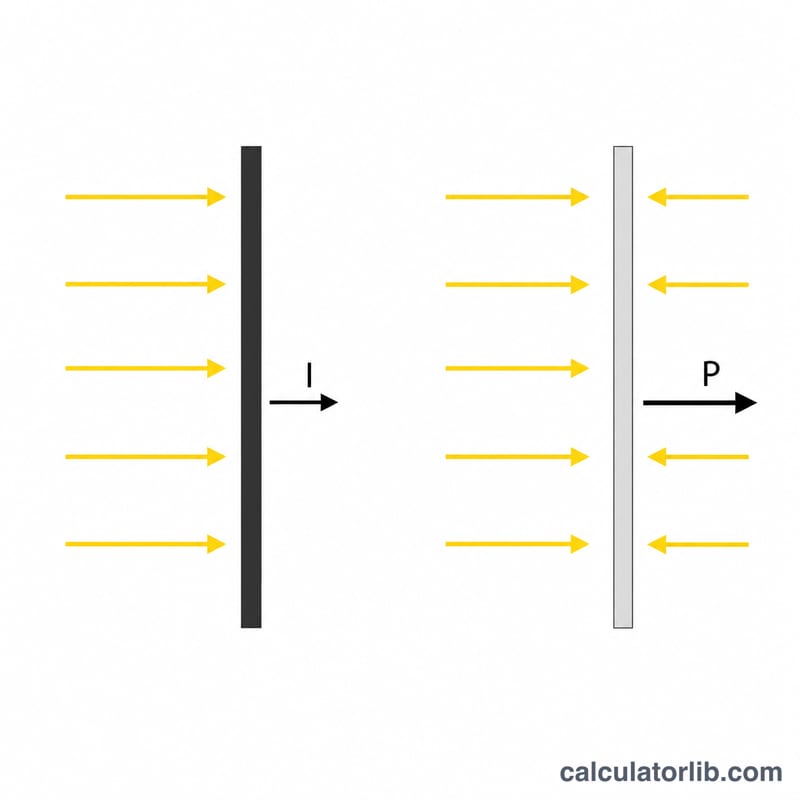
Radiation pressure is the mechanical pressure exerted on a surface by electromagnetic radiation (light). Because photons carry momentum, they push on any object they strike. Although the effect is tiny in everyday life, it is significant for solar sails, dust grains in space, comet tails, and high-power lasers. This calculator is universal — it relies only on physical constants and works in any context.
How to Use the Calculator
Enter the light intensity I in watts per square meter (W/m²) — for example, the solar constant near Earth is about 1361 W/m². Then choose whether the surface is perfectly absorbing or perfectly reflecting. The tool returns the radiation pressure in pascals (N/m²) and the total force this pressure would produce over one square kilometer.
The Formula Explained
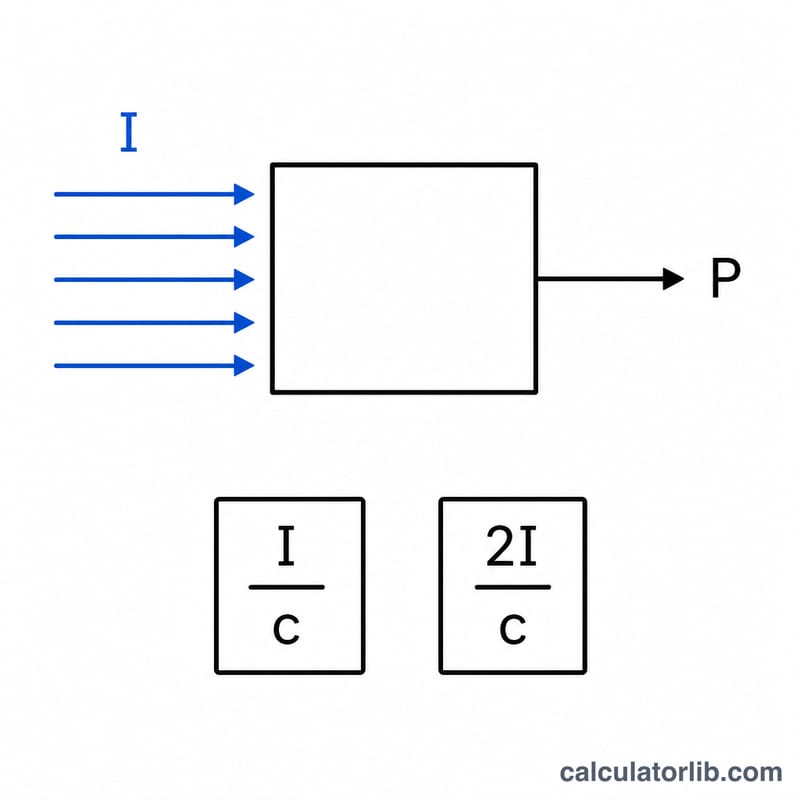
For a perfectly absorbing surface, all incoming photon momentum is transferred: $$P = \frac{\text{Intensity }I}{c}$$ where \(c = 299{,}792{,}458 \ \text{m/s}\) is the speed of light. For a perfectly reflecting surface, photons reverse direction, so twice the momentum is delivered: $$P = \frac{2\,\text{Intensity }I}{c}$$ Real surfaces fall between these two extremes depending on reflectivity.
Worked Example
Suppose sunlight with intensity \(I = 1361 \ \text{W/m}^2\) strikes a perfectly reflecting solar sail. Then $$P = \frac{2 \times 1361}{299{,}792{,}458} \approx 9.08 \times 10^{-6} \ \text{Pa}.$$ Over one square kilometer (\(10^6 \ \text{m}^2\)), that produces a force of about 9.08 N — small, but it acts continuously and accelerates a lightweight sail over time.
Absorbing vs Reflecting: Scenario Comparison
The table shows approximate sunlight intensity at several planetary orbits, with pressure and total force on a 1 km² (106 m²) surface facing the Sun at normal incidence. It uses \(c = 299{,}792{,}458\) m/s.
| Scenario | Intensity (W/m²) | Absorbing P (µPa) | Reflecting P (µPa) | Force on 1 km², absorbing | Force on 1 km², reflecting |
|---|---|---|---|---|---|
| Earth orbit | 1361 | 4.540 | 9.080 | 4.54 N | 9.08 N |
| Mars orbit | ≈ 590 | 1.968 | 3.936 | 1.97 N | 3.94 N |
| Venus orbit | ≈ 2600 | 8.673 | 17.345 | 8.67 N | 17.35 N |
| Jupiter orbit | ≈ 50 | 0.1668 | 0.3336 | 0.167 N | 0.334 N |
Example: for Mars, \(F = \dfrac{590}{299{,}792{,}458}\times 10^{6}\ \text{m}^2 \approx 1.97\) N (absorbing).
Inverse-square drop: Sunlight intensity falls as \(1/r^2\), and so does radiation pressure. Mars is about 1.52 AU from the Sun, so its intensity is about \(1361/1.52^2 \approx 590\) W/m². Jupiter is about 5.2 AU away, giving roughly \(1361/5.2^2 \approx 50\) W/m². The reflecting-to-absorbing ratio stays 2 at every distance. Values for other planets are approximate because orbits are elliptical.
FAQ
Why is reflecting pressure double? A reflected photon changes its momentum by twice its incoming value (it stops and goes back), so it transfers twice the impulse compared to being absorbed.
What units does intensity use? Intensity must be in W/m². Pressure comes out in pascals (N/m²).
Is this the same as solar wind pressure? No. Solar wind is a stream of charged particles; radiation pressure here is from light (photons) alone.