
What is the Schwarzschild Radius?
The Schwarzschild radius is the radius of the event horizon of a non-rotating, uncharged black hole. If you were to compress any object to a size smaller than this radius, its escape velocity would exceed the speed of light, and it would become a black hole. It is named after physicist Karl Schwarzschild, who derived the solution in 1916 from Einstein's field equations of general relativity.
How to Use This Calculator
Simply enter the mass of the object in kilograms — or pick a preset such as Earth or the Sun — and the calculator returns the Schwarzschild radius in both meters and kilometers. Masses are often very large, so scientific notation like 1.989e30 is accepted.
The Formula Explained
The radius is given by:
$$r_s = \frac{2\,G\,M}{c^{2}}$$
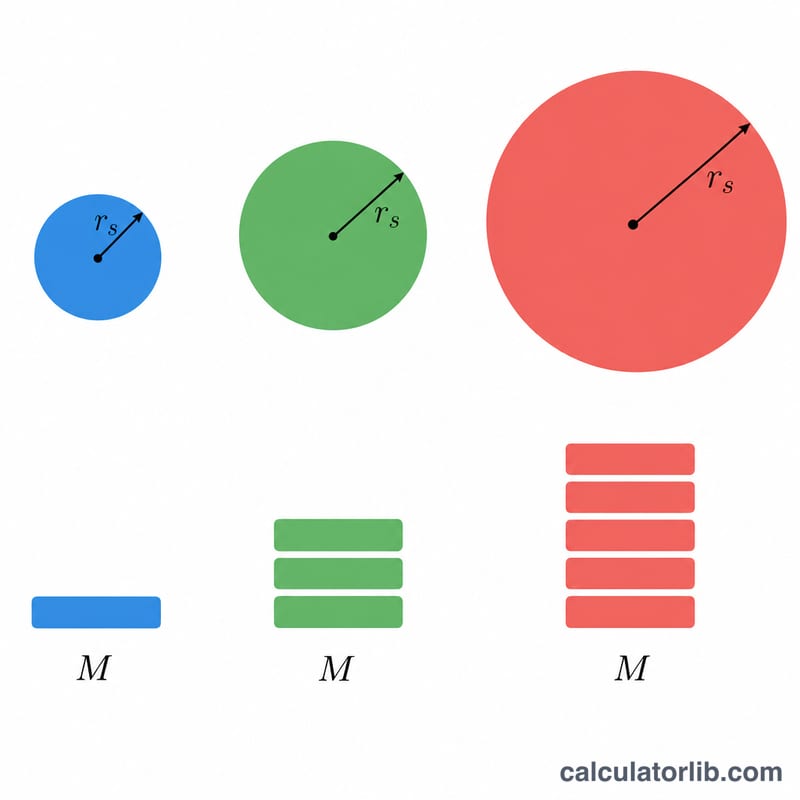
where G is the gravitational constant (\(6.674 \times 10^{-11}\ \text{m}^3\cdot\text{kg}^{-1}\cdot\text{s}^{-2}\)), M is the mass in kilograms, and c is the speed of light (\(299{,}792{,}458\ \text{m/s}\)). Because c² is enormous, the resulting radius is tiny unless the mass is astronomical.
Worked Example
For the Sun, \(M = 1.989 \times 10^{30}\ \text{kg}\). Then $$r_s = \frac{2 \times 6.674\mathrm{e}{-11} \times 1.989\mathrm{e}{30}}{(299{,}792{,}458)^2} \approx 2.954 \times 10^{3}\ \text{m},$$ or about 2.95 km. So if the Sun collapsed into a black hole, its event horizon would be roughly 3 kilometers across in radius.
FAQ
Does every object have a Schwarzschild radius? Mathematically yes — even your body has one (about \(10^{-25}\ \text{m}\)), but it is far smaller than the object itself, so no black hole forms.
What is Earth's Schwarzschild radius? About 8.87 millimeters — Earth would have to be crushed to marble size to become a black hole.
Does this account for rotation? No. This is the simple Schwarzschild (non-rotating) case. Spinning black holes use the more complex Kerr metric.