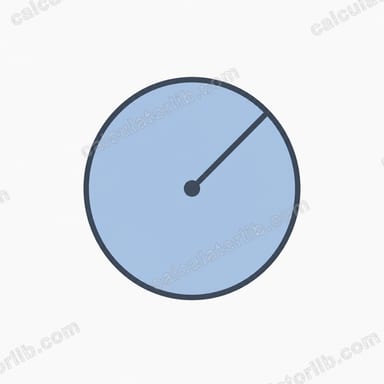

What this calculator does
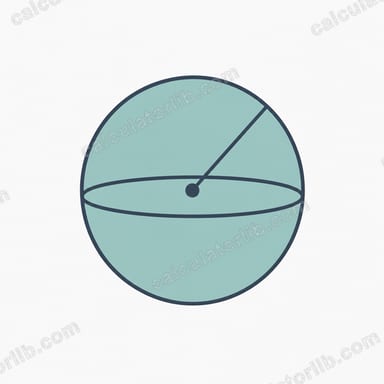
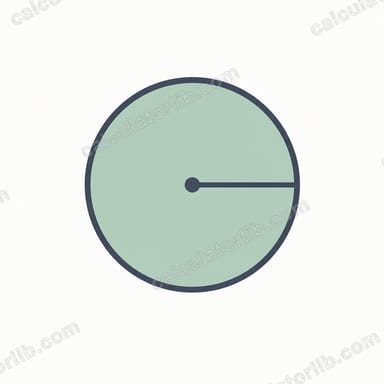
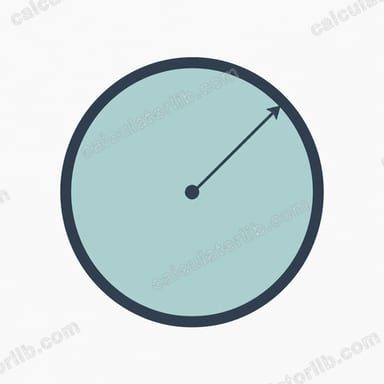
The Radius of a Sphere Calculator finds the radius r of a perfect sphere from any one of four common measurements: its volume, surface area, diameter, or circumference. Once the radius is known, it also reports the other three properties so you have a complete picture of the sphere in a single step.
How to use it
Choose which quantity you already know — volume, surface area, diameter, or circumference — then type that value into the input box. Use consistent units (for example, if you enter volume in cm³, the radius comes back in cm). Press calculate and the tool returns the radius plus the matching diameter, volume, surface area, and circumference.
The formulas explained
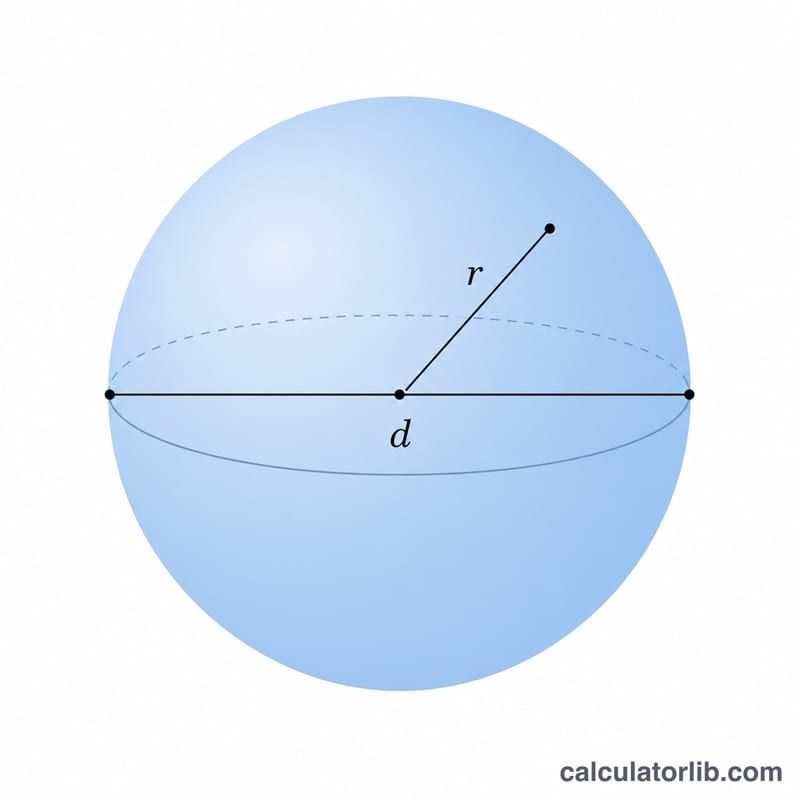
The radius is derived by rearranging the standard sphere equations. From volume, since \(V = \frac{4}{3}\pi r^3\), solving for \(r\) gives $$r = \sqrt[3]{\frac{3V}{4\pi}}.$$ From surface area, since \(A = 4\pi r^2\), solving gives $$r = \sqrt{\frac{A}{4\pi}}.$$ For a diameter \(d\), the radius is simply \(r = \frac{d}{2}\), and for a circumference \(C\) around a great circle, \(r = \frac{C}{2\pi}\).
Worked example
Suppose a sphere has a volume of 904.7787 cubic units. Then $$r = \sqrt[3]{\frac{3 \times 904.7787}{4\pi}} = \sqrt[3]{\frac{2714.336}{12.566}} = \sqrt[3]{216} = 6 \text{ units}.$$ From this radius the diameter is 12, the surface area is \(4\pi(6^2) \approx 452.39\), and the circumference is \(2\pi(6) \approx 37.70\).
FAQ
What units does it use? Any units you like — the result simply follows your input. Volume should be cubic units and area square units; the radius comes out in linear units.
Can I go from radius to volume? Yes — enter the diameter (twice the radius) and the calculator displays the volume, area, and circumference automatically.
Does it work for a hemisphere? No. These formulas describe a full sphere. A hemisphere has half the volume and a different surface-area formula.