
What Is the Radius of a Circle?
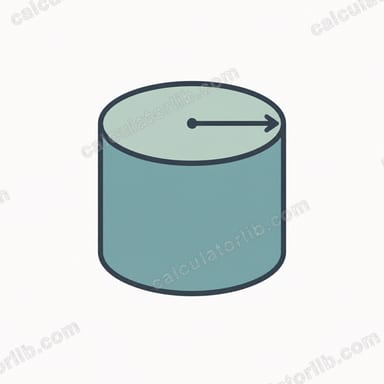
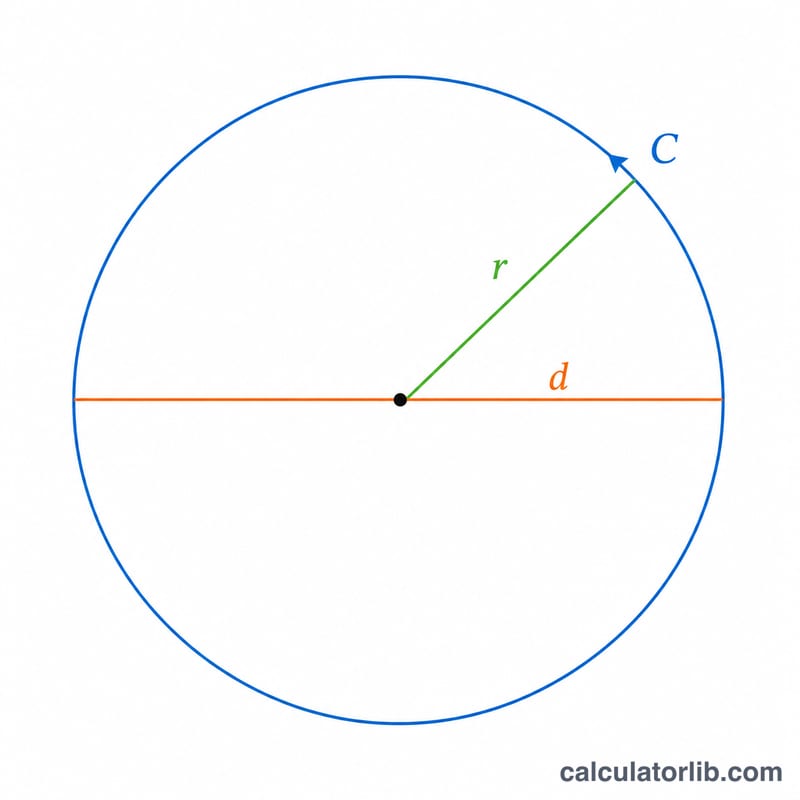
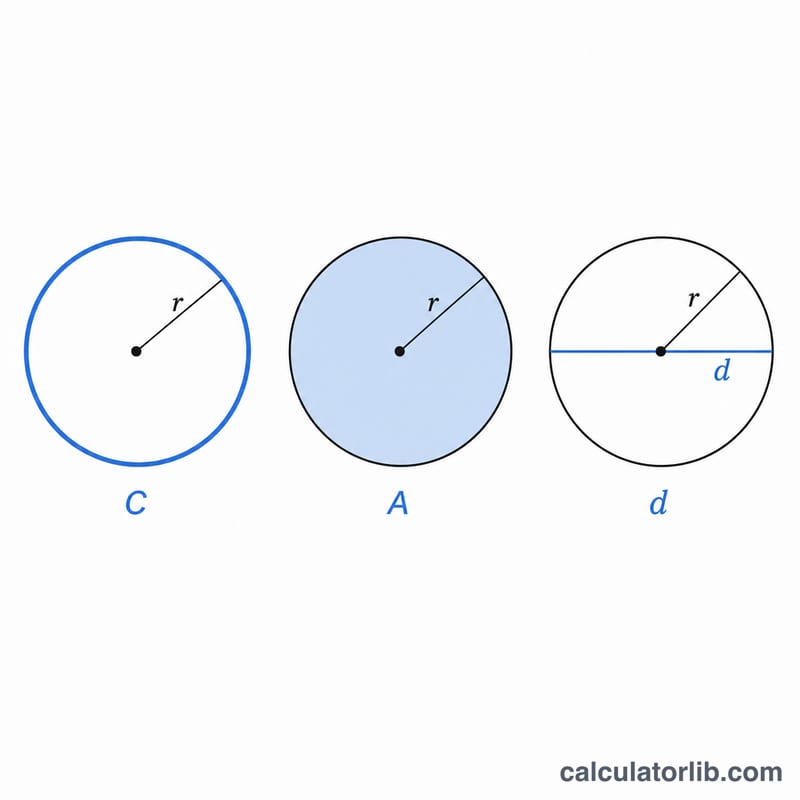
The radius of a circle is the distance from its center to any point on its edge. It is the most fundamental measurement of a circle — once you know the radius, you can derive the diameter, circumference, and area. This calculator works the other way around too: give it any one of those three measurements and it returns the radius along with all the others.
How to Use This Calculator
Pick which value you already know — the diameter, the circumference, or the area — then type the number and read off the radius. The tool also reports the remaining circle properties so you get a complete picture in one step. All measurements share the same units (e.g. if you enter centimeters, the radius is in centimeters and the area is in square centimeters).
The Formula Explained
The radius relates to each circle property through \(\pi\) (≈ 3.14159):
From diameter: $$r = \frac{\text{Diameter}}{2}$$ since the diameter is simply twice the radius.
From circumference: $$r = \frac{\text{Circumference}}{2\pi}$$ because \(C = 2\pi r\).
From area: $$r = \sqrt{\frac{\text{Area}}{\pi}}$$ because \(A = \pi r^2\).
Worked Example
Suppose a circle has a circumference of 31.4159 units. Divide by \(2\pi\): $$\frac{31.4159}{2 \times 3.14159} \approx \frac{31.4159}{6.28318} \approx 5$$ So the radius is 5 units, the diameter is 10 units, and the area is \(\pi \times 5^2 \approx 78.54\) square units.
FAQ
What if I only know the diameter? Just select "Diameter" — the radius is exactly half of it.
Can the radius be negative? No. A radius is a distance, so it is always zero or positive. Enter only non-negative values.
Which value of \(\pi\) is used? The calculator uses the full-precision value of \(\pi\) built into the math library for accurate results.