What is the Ratio of 3 Numbers Calculator?
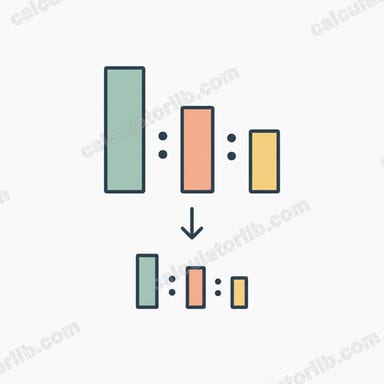
This tool reduces a three-part ratio, written as A:B:C, to its simplest equivalent form. Just like simplifying a fraction, a ratio is in lowest terms when no whole number greater than 1 divides all three parts. For example, 12:18:30 simplifies to 2:3:5, which describes the same proportional relationship using the smallest possible whole numbers.
How to use it
Enter the three quantities in the A, B and C fields and submit. The calculator computes the greatest common divisor (GCD) of all three values and divides each term by it. Decimal inputs such as 1.5:3:4.5 are supported — the values are first scaled up to whole numbers, then reduced.
The formula explained
The greatest common divisor of three numbers is found by chaining the two-number GCD: \(g = \gcd(\gcd(a, b), c)\). The simplified ratio is then $$\frac{a}{g} : \frac{b}{g} : \frac{c}{g}.$$ Because \(g\) divides every term exactly, the new ratio represents exactly the same proportion.

Worked example
Take 12:18:30. The GCD of 12 and 18 is 6; the GCD of 6 and 30 is 6, so \(g = 6\). Dividing each term: \(12/6 = 2\), \(18/6 = 3\), \(30/6 = 5\). The simplest form is 2:3:5.

More Worked Examples: Decimals and Already-Simplified Ratios
The method is always the same. If any value has decimals, multiply all three values by the same power of 10 to make them whole numbers. Then find the GCD of the three numbers in a chain, \(g = \gcd(\gcd(a,b),c)\), and divide each value by it.
Example 1: 0.4 : 1.2 : 2
- Scale by 10: \(0.4 : 1.2 : 2 \rightarrow 4 : 12 : 20\).
- \(\gcd(4, 12) = 4\).
- \(\gcd(4, 20) = 4\), so \(g = \) 4.
- Divide: \(\frac{4}{4} : \frac{12}{4} : \frac{20}{4} = 1 : 3 : 5\).
Result: 1 : 3 : 5.
Example 2: 1.5 : 2.25 : 3
- The longest decimal part has two places, so scale by 100: \(1.5 : 2.25 : 3 \rightarrow 150 : 225 : 300\).
- \(\gcd(150, 225) = 75\).
- \(\gcd(75, 300) = 75\), so \(g = 75\).
- Divide: \(\frac{150}{75} : \frac{225}{75} : \frac{300}{75} = 2 : 3 : 4\).
Result: 2 : 3 : 4.
Example 3: 7 : 11 : 13 (already in lowest terms)
- \(\gcd(7, 11) = 1\), because both numbers are prime and different.
- \(\gcd(1, 13) = 1\), so \(g = 1\).
- Divide: \(\frac{7}{1} : \frac{11}{1} : \frac{13}{1} = 7 : 11 : 13\).
Result: 7 : 11 : 13, unchanged. A GCD of 1 means no further simplification is possible.
Interpreting the Simplified Ratio
A ratio such as 2 : 3 : 5 describes parts of a whole. Adding the parts gives \(2 + 3 + 5 = 10\) parts in total. Each value is therefore a fraction of that total:
- First share: \(\frac{2}{10} = 20\%\)
- Second share: \(\frac{3}{10} = 30\%\)
- Third share: \(\frac{5}{10} = 50\%\)
The shares add up to 100%.
Splitting a total of 200
First find the size of one part: \(\frac{200}{10} = 20\). Then multiply by each ratio term:
- \(2 \times 20 = 40\)
- \(3 \times 20 = 60\)
- \(5 \times 20 = 100\)
Check: \(40 + 60 + 100 = 200\).
Equivalent ratios and lowest terms
The simplified ratio is equivalent to the original. For example, 20 : 30 : 50 and 2 : 3 : 5 give the same percentages and the same split of any total, because every term was divided by the same number. Only the size of each part changes, not the proportions. If the GCD is 1, the ratio is already in lowest terms, and the numbers you entered are the simplest whole-number form.
FAQ
Can I enter decimals? Yes. Values like 1.5:3:4.5 are scaled to whole numbers (15:30:45) and reduced to 1:2:3.
What if the ratio is already simplest? If the GCD is 1, the ratio is returned unchanged — for example 4:9:25 stays 4:9:25.
Does order matter? The order of the parts is preserved; only the scale changes, so A:B:C maps directly to the reduced A:B:C.