What This Calculator Does
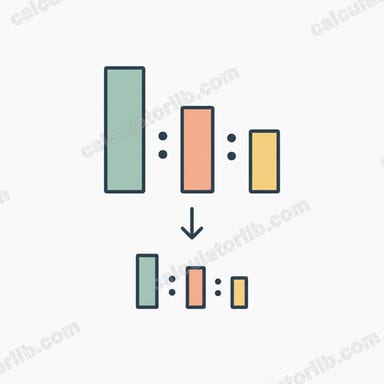
The Three Numbers in a Ratio Calculator splits a single total amount into three shares according to a ratio a:b:c. Whether you are dividing profits between three business partners, splitting a bill, sharing an inheritance, or mixing ingredients, this tool gives you each part instantly and proportionally.

How to Use It
Enter the total amount you want to divide, then type the three ratio numbers (A, B and C). The calculator adds the ratio numbers together to get the total number of "shares", then allocates the amount in proportion. The three results always add back up to your original total.
The Formula Explained
Given a total T and ratio a:b:c, first compute the sum \(S = a + b + c\). Each part is then:
$$\text{Part A} = T \times \frac{a}{S}, \quad \text{Part B} = T \times \frac{b}{S}, \quad \text{Part C} = T \times \frac{c}{S}.$$Because the three fractions \(a/S\), \(b/S\) and \(c/S\) add up to 1, the three parts always recombine to \(T\).

Worked Example
Suppose you want to split $1,000 in the ratio 2:3:5. The sum is \(2 + 3 + 5 = 10\). So
$$\text{Part A} = 1000 \times \frac{2}{10} = 200, \quad \text{Part B} = 1000 \times \frac{3}{10} = 300, \quad \text{Part C} = 1000 \times \frac{5}{10} = 500.$$The three shares \((200 + 300 + 500)\) total 1,000, confirming the split.
More Worked Examples
Example 1: A decimal ratio
Split 750 in the ratio 1.5 : 2 : 0.5. Ratio parts do not have to be whole numbers.
- Add the parts: \(S = 1.5 + 2 + 0.5 = 4\).
- Part A: \(750 \times \frac{1.5}{4} = \) 281.25
- Part B: \(750 \times \frac{2}{4} = 375\).
- Part C: \(750 \times \frac{0.5}{4} = 93.75\).
- Check: \(281.25 + 375 + 93.75 = 750\). ✓
Example 2: A ratio that does not divide evenly
Split 100 in the ratio 1 : 1 : 1.
- Add the parts: \(S = 1 + 1 + 1 = 3\).
- Each share: \(100 \times \frac{1}{3} = 33.333\ldots\)
- Rounded to cents, each share is 33.33.
- Check: \(33.33 + 33.33 + 33.33 = 99.99\). This is 0.01 short of 100 because of rounding.
The unrounded shares always sum exactly to the total. Rounded money amounts can be off by a cent or two. In practice, give the extra cent to one party, for example 33.34 + 33.33 + 33.33 = 100.00, or follow whatever rounding rule your agreement specifies. Always re-add the rounded parts to confirm they match the total.
Comparing Different Ratio Splits
The table splits the same total of 1,000 using five different ratios. Each share is \(1000 \times \frac{\text{part}}{S}\), rounded to two decimals where needed.
| Ratio | Sum of parts (S) | Part A | Part B | Part C | Total check |
|---|---|---|---|---|---|
| 1 : 1 : 1 | 3 | 333.33 | 333.33 | 333.33 | 999.99 (exact thirds sum to 1,000; give the spare cent to one part) |
| 1 : 2 : 3 | 6 | 166.67 | 333.33 | 500.00 | 1,000.00 |
| 2 : 3 : 5 | 10 | 200 | 300 | 500 | 1,000 |
| 5 : 3 : 2 | 10 | 500 | 300 | 200 | 1,000 |
| 1 : 1 : 0 | 2 | 500 | 500 | 0 | 1,000 |
Notes: reversing the ratio (2:3:5 vs 5:3:2) swaps the largest and smallest shares. Setting one part to 0 turns the calculation into a two-way split, because that part receives nothing and the other parts share the whole total. Only the relative sizes matter: 2:3:5 gives the same split as 4:6:10.
FAQ
Can I use decimals in the ratio? Yes. Ratios like 1.5:2:0.5 work fine; the calculator divides by their sum.
What if I only need two parts? Set the third ratio number to 0 and that part will be zero, leaving the total split between the other two.
Do the parts always add up to the total? Yes, the proportional method guarantees the three parts sum exactly to the amount you entered (aside from tiny rounding in display).