
What This Calculator Does
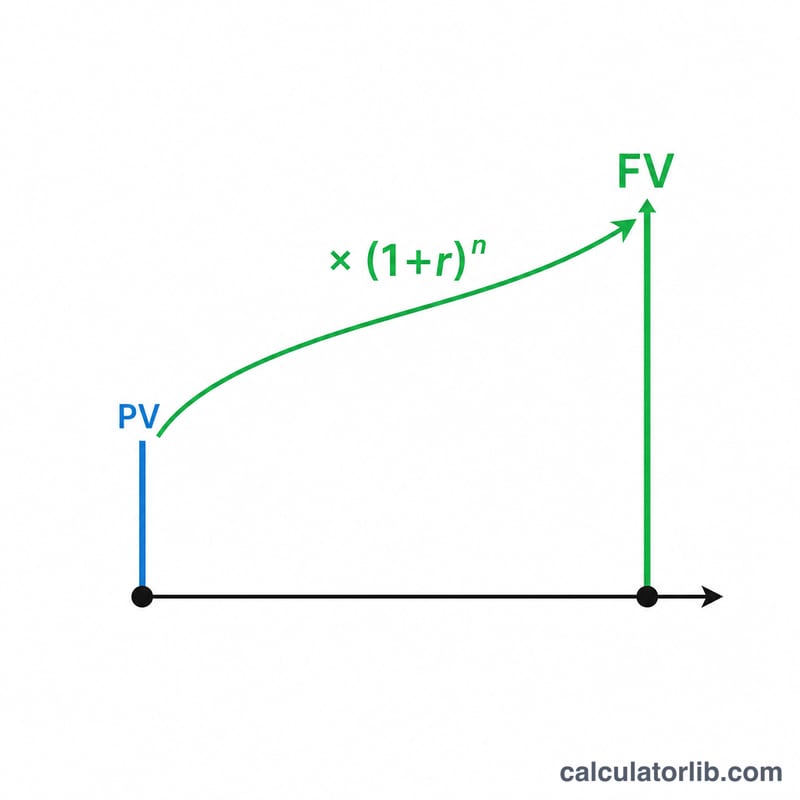
The Present & Future Value Algebra Calculator applies the core time-value-of-money relationship between a sum today and the same money grown or discounted across time. It solves either direction of the compound-interest equation: turning a present value (PV) into a future value (FV), or discounting a future value back to its present value. This tool is universal arithmetic — it works for any currency and any compounding period (years, months, quarters) as long as the rate matches the period.
The Formula Explained
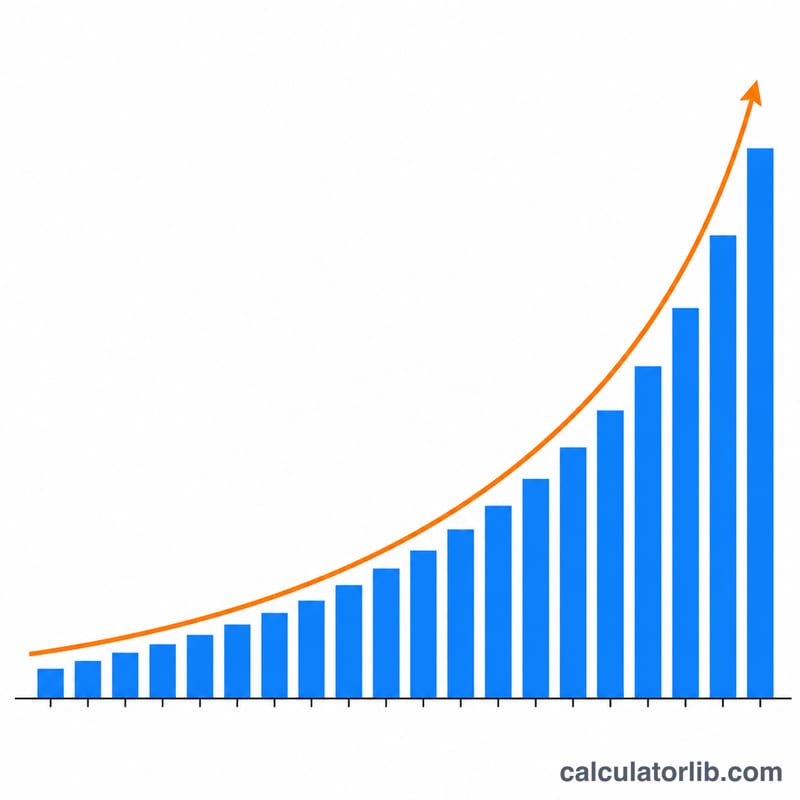
Future value is found with $$\text{FV} = \text{PV}(1 + r)^n$$ where r is the interest rate per period (as a decimal) and n is the number of periods. Rearranging algebraically to solve for the present value gives $$\text{PV} = \frac{\text{FV}}{(1 + r)^n}$$ The expression \((1 + r)^n\) is the compounding (or discounting) growth factor — each period multiplies the balance by \((1 + r)\), and raising it to the power \(n\) compounds that effect.
How to Use It
First choose whether you are solving for Future Value or Present Value. Enter the known amount: if you want FV, this is your starting PV; if you want PV, this is the target FV. Enter the interest rate per period as a percentage (the tool converts it to a decimal), and the number of periods \(n\). The result shows the computed value, the growth factor \((1 + r)^n\), and the total interest or discount difference.
Worked Example
Invest $1,000 at 5% per year for 10 years. The growth factor is \((1.05)^{10} \approx 1.628895\). So $$\text{FV} = 1000 \times 1.628895 \approx \$1{,}628.89$$ meaning about $628.89 of compound interest is earned.
FAQ
Does the rate have to be annual? No. Use whatever period you like — just make sure \(r\) and \(n\) use the same period (e.g., a monthly rate with a number of months).
How do I convert an annual rate to monthly? Divide the annual percentage by 12 and use months for \(n\), assuming monthly compounding.
What if the rate is 0%? The growth factor becomes 1, so PV and FV are equal — money neither grows nor shrinks.