
What Is Future Value?
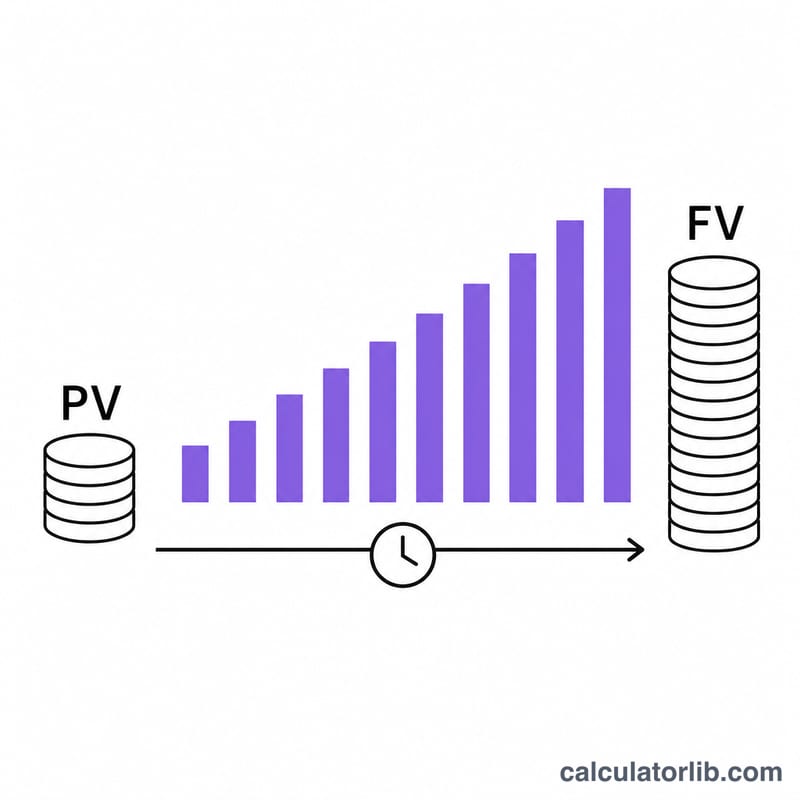
Future value (FV) tells you how much a lump-sum investment made today will be worth at a future date once compound interest is applied. It is one of the most important concepts in personal finance because it shows the power of letting your money grow over time. This calculator works for any currency and any jurisdiction — it is pure time-value-of-money math.
How to Use This Calculator
Enter your present value (the amount you invest today), the annual interest rate as a percentage, the number of years you plan to stay invested, and how often interest compounds (annually, monthly, daily, etc.). The calculator returns your future value, the original principal, and the total interest earned.
The Formula Explained
The compound interest version of the future value formula is:
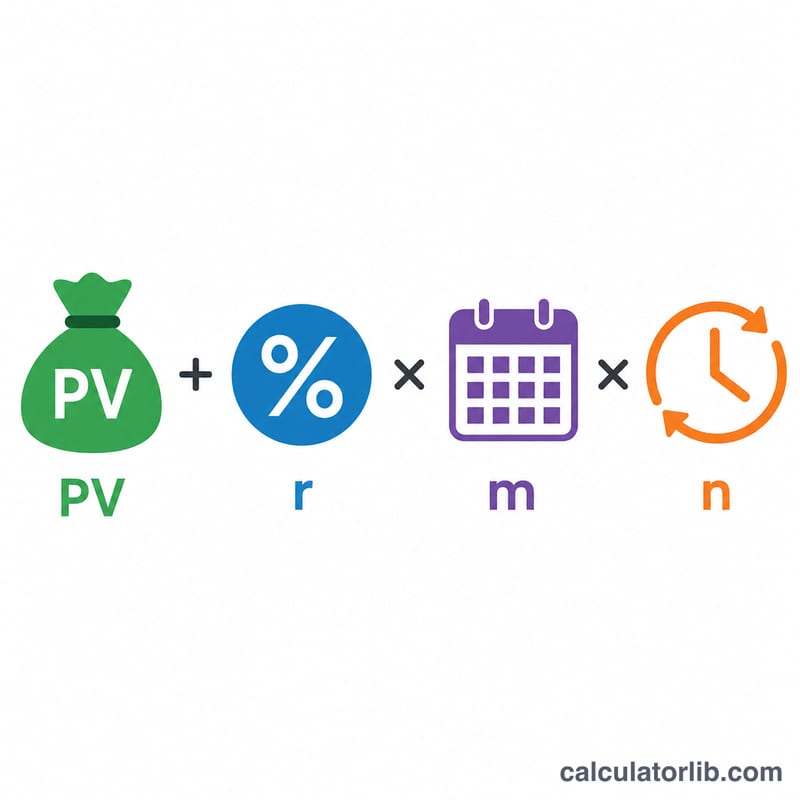
$$\text{FV} = \text{PV} \times \left(1 + \frac{r}{m}\right)^{m \cdot n}$$
Here PV is the present value, r is the annual rate written as a decimal, m is the number of compounding periods per year, and n is the number of years. More frequent compounding (larger m) produces slightly more growth for the same nominal rate.
Worked Example
Suppose you invest $10,000 at a 5% annual rate compounded monthly for 10 years. Then \(r/m = 0.05/12 \approx 0.0041667\) and \(m \cdot n = 120\). So $$\text{FV} = 10{,}000 \times (1.0041667)^{120} \approx \$16{,}470.09$$ You earned about $6,470 in interest without adding another cent.
FAQ
Does this account for monthly deposits? No — this calculator is for a single lump-sum investment. For recurring contributions, use an annuity or savings-plan calculator.
What rate should I use? Use the nominal annual percentage rate (APR). The calculator converts it into the periodic rate based on your compounding frequency.
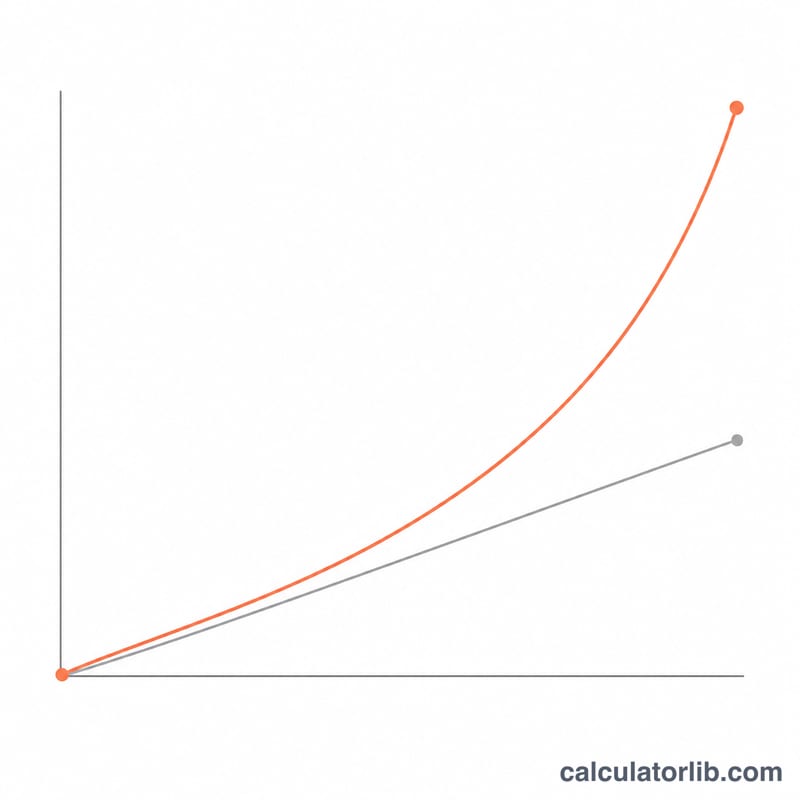
Why does daily compounding give more than annual? Each compounding period adds interest to the balance, and that interest then earns interest itself. More frequent compounding means more chances to earn interest on interest.