
What Is Present Value?
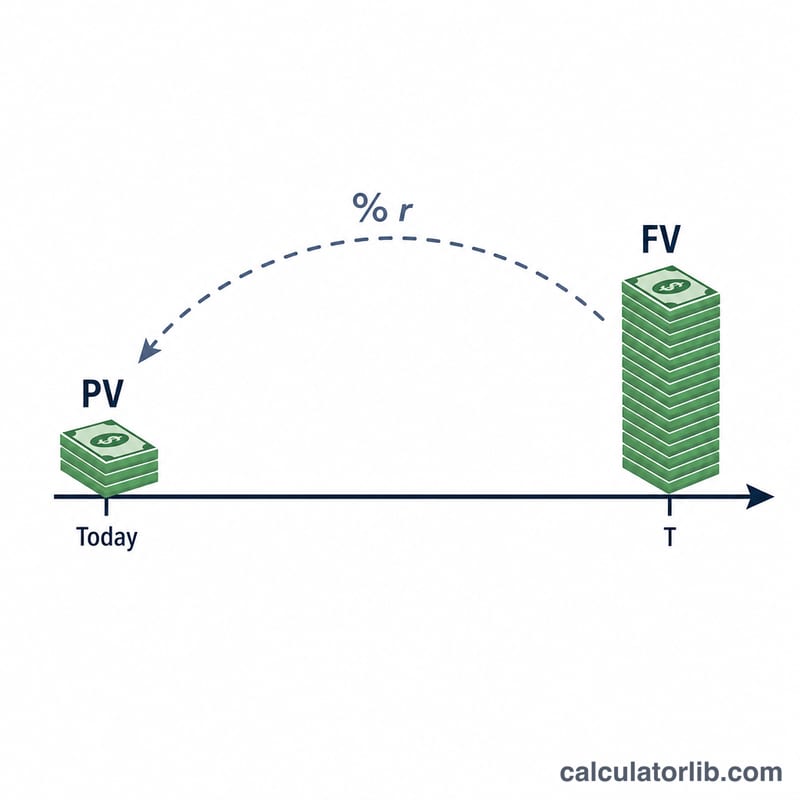
Present value (PV) is the current worth of a sum of money you expect to receive at some point in the future. Because money can earn a return over time, a dollar today is worth more than a dollar tomorrow. This calculator answers the question: "How much would I need to invest today to grow into a specific future amount?" — or equivalently, "What is a future payment really worth right now?"
How to Use This Calculator
Enter three values: the Future Value (FV) — the amount you'll receive later; the Annual Discount Rate as a percentage (your required return or interest rate); and the Number of Periods in years. The tool instantly returns the present value along with the total discount and the discount factor applied.
The Formula Explained
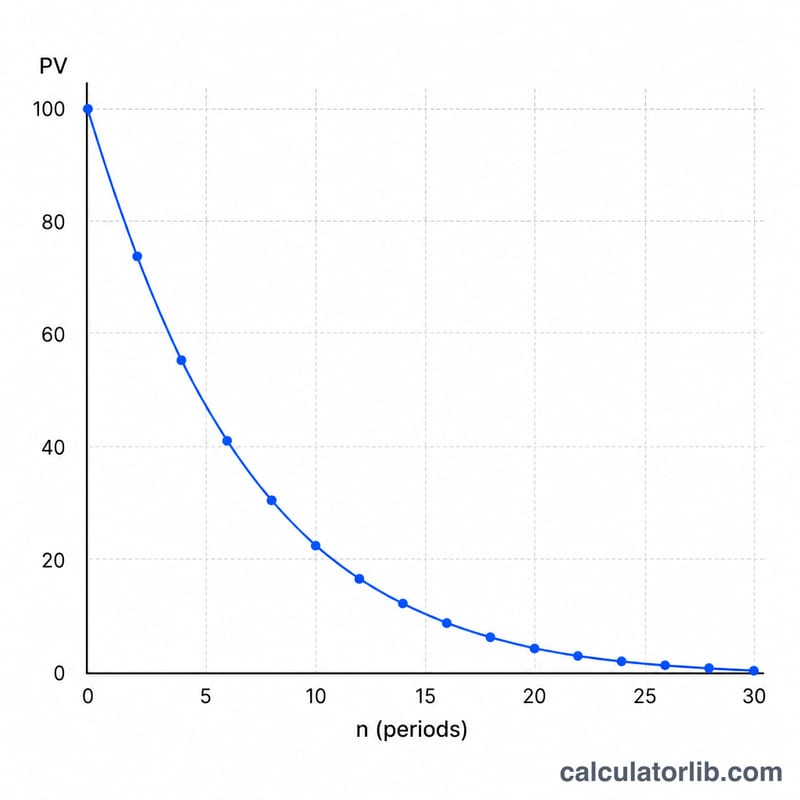
The core equation is $$PV = \dfrac{FV}{(1 + r)^n}$$ where FV is the future sum, r is the periodic discount rate (as a decimal), and n is the number of periods. The denominator \((1 + r)^n\) is the discount factor — it represents how much $1 today would grow to. Dividing the future value by it strips out the compounding to reveal today's equivalent value.
Worked Example
Suppose you're promised $10,000 in 10 years and your discount rate is 5% per year. The discount factor is \((1.05)^{10} \approx 1.628895\). Then $$PV = \dfrac{10{,}000}{1.628895} \approx \$6{,}139.13$$ So receiving $10,000 in a decade is worth about $6,139 today at a 5% rate — a discount of roughly $3,861.
FAQ
What discount rate should I use? Use the return you could realistically earn elsewhere, your cost of capital, or an interest rate that reflects the risk and inflation of the cash flow.
Does a higher rate increase or decrease present value? A higher discount rate lowers present value, because future money is discounted more heavily.
Can n be a fraction? Yes — you can enter partial periods (e.g., 2.5 years) and the formula still works using fractional exponents.