
What is the Rounding Numbers Calculator?
This calculator rounds any number to a chosen number of decimal places. It supports three rounding modes: round half up (the standard method taught in schools), always round up (ceiling), and always round down (floor). You can even round to the left of the decimal point by entering a negative number of places — for example, rounding to the nearest ten or hundred.
How to use it
Enter the number you want to round, choose how many decimal places to keep, and pick a rounding mode. A value of 2 keeps two decimals (hundredths), 0 rounds to a whole number, and -1 rounds to the nearest ten. The result shows the rounded figure plus the difference from the original so you can see exactly how much it changed.
The formula explained
Standard half-up rounding uses the formula:
$$\text{round}(x, n) = \dfrac{\lfloor x \cdot 10^{n} + 0.5 \rfloor}{10^{n}}$$
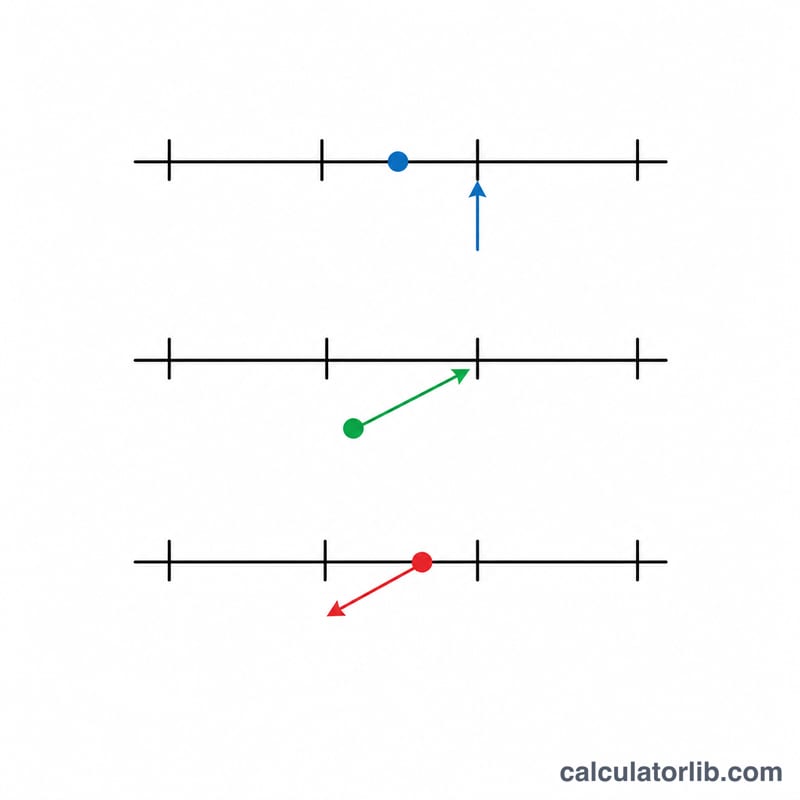
The number is first scaled up by \(10^{n}\) to move the target digit just left of the decimal point. Adding 0.5 and taking the floor pushes any value of 0.5 or more up to the next integer, while smaller fractions fall back down. Dividing by \(10^{n}\) restores the original scale. Ceiling and floor modes skip the +0.5 step and simply round every value up or down respectively.
$$\text{up} = \dfrac{\lceil x \cdot 10^{n} \rceil}{10^{n}}, \quad \text{down} = \dfrac{\lfloor x \cdot 10^{n} \rfloor}{10^{n}}$$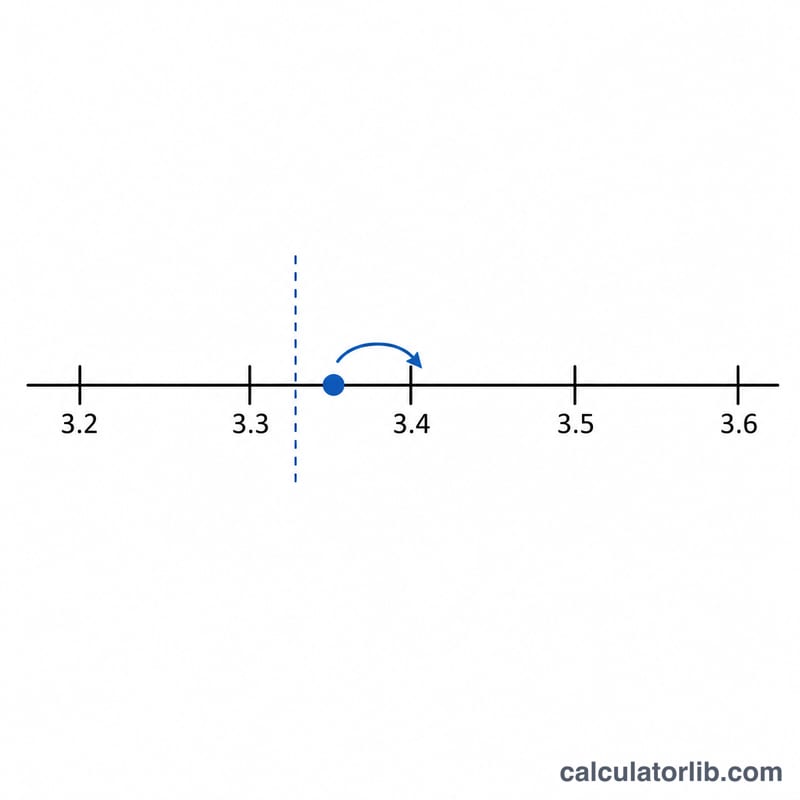
Worked example
Round 3.14159 to 2 decimal places using half-up. Scale: \(3.14159 \times 100 = 314.159\). Add 0.5: \(314.659\). Floor: \(314\). Divide by 100: 3.14. The difference from the original is \(3.14 - 3.14159 = -0.00159\).
FAQ
What does "round half up" mean? When the digit being dropped is exactly 5 (or the remainder is \(\geq 0.5\)), the kept digit increases by one. So 2.5 becomes 3 and 2.45 becomes 2.5.
Can I round to tens or hundreds? Yes. Enter a negative number of places: -1 rounds to the nearest ten, -2 to the nearest hundred.
Why does the difference sometimes show a long decimal? Floating-point arithmetic can produce tiny trailing values; the displayed rounded number itself is correct.