
What This Calculator Does
The Life Insurance Premium Calculator gives you a quick, ballpark estimate of what a term life insurance policy might cost. It combines your chosen coverage amount, policy term, age, gender, and smoker status with a base rate per $1,000 of cover to produce annual, monthly, and total-over-term premium figures. It is a planning tool — actual insurer quotes depend on full underwriting, medical history, occupation, and country-specific pricing.
How to Use It
Enter the coverage (sum assured) you want, the number of years you want to be covered, your current age, and the base rate your insurer quotes per $1,000 of coverage each year (commonly $0.50–$3.00 for healthy adults). Select your gender and whether you smoke, then read off your estimated annual and monthly premiums.
The Formula Explained
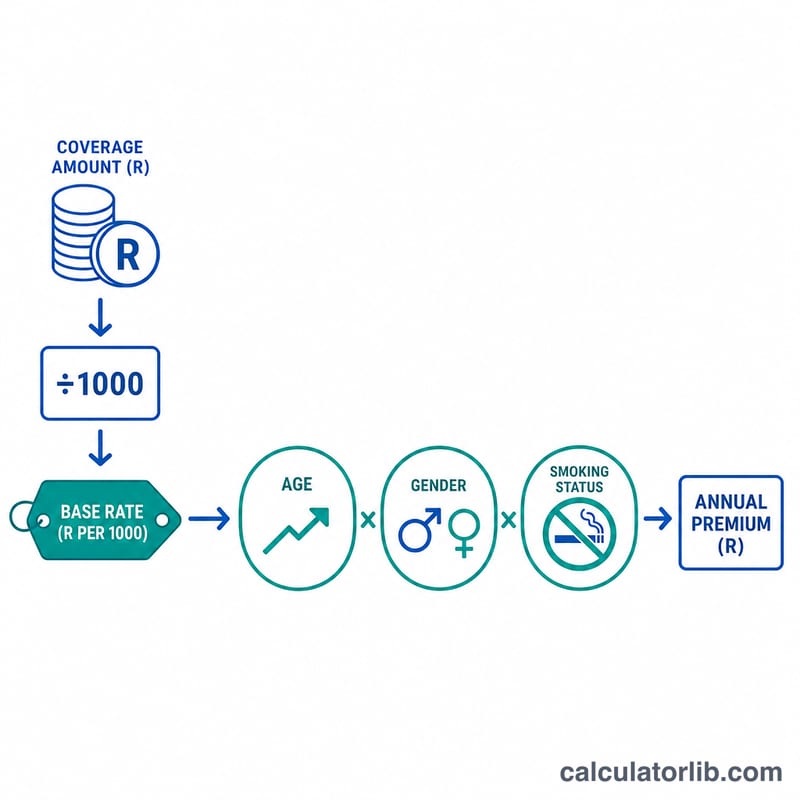
The core premium is \(\frac{\text{Coverage}}{1000} \times \text{Rate}\). This is then multiplied by a risk multiplier built from three loadings: an age factor that adds 3% per year above age 30, a gender factor (0.90 for females reflecting lower average mortality), and a smoker factor of 1.75 for smokers. The monthly premium is the annual figure divided by 12, and the total paid is the annual premium times the policy term.
$$\text{Annual Premium} = \frac{\text{Coverage}}{1000} \times \text{Rate} \times R$$
$$\text{where}\quad \left\{ \begin{aligned} R &= A \times G \times S \\ A &= 1 + \max\!\left(0,\ \text{Age} - 30\right)\times 0.03 \\ G &= \begin{cases} 0.90 & \text{Female} \\ 1.00 & \text{otherwise} \end{cases} \\ S &= \begin{cases} 1.75 & \text{Smoker} \\ 1.00 & \text{otherwise} \end{cases} \end{aligned} \right.$$
Worked Example
Suppose you want $500,000 of cover for 20 years, you are a 35-year-old non-smoking male, and the base rate is $1.50 per $1,000. The age factor is \(1 + 0.03 \times (35 - 30) = 1.15\), gender 1.0, smoker 1.0, so the multiplier is 1.15. Annual premium:
$$\frac{500000}{1000} \times 1.50 \times 1.15 = 500 \times 1.50 \times 1.15 = \mathbf{\$862.50}$$
Monthly = $71.88, and total over 20 years = $17,250.
Premium Comparison Across Scenarios
The table applies this calculator's own simplified formula with a fixed base rate of $1.50 per $1,000, $500,000 of coverage and a 20-year term. The base annual premium is \(\frac{500000}{1000} \times 1.50 = 750\). Each row multiplies that by the risk multiplier \(R = A \times G \times S\). Monthly is annual ÷ 12, and the total over the term is annual × 20. Figures are rounded to the cent.
| Scenario | Multiplier R | Annual premium | Monthly premium | Total over 20 years |
|---|---|---|---|---|
| 30-year-old non-smoking male | 1.00 | $750.00 | $62.50 | $15,000.00 |
| 35-year-old non-smoking male | 1.15 | $862.50 | $71.88 | $17,250.00 |
| 35-year-old non-smoking female | 1.035 | $776.25 | $64.69 | $15,525.00 |
| 35-year-old male smoker | 2.0125 | $1,509.38 | $125.78 | $30,187.50 |
| 45-year-old non-smoking male | 1.45 | $1,087.50 | $90.63 | $21,750.00 |
| 45-year-old male smoker | 2.5375 | $1,903.13 | $158.59 | $38,062.50 |
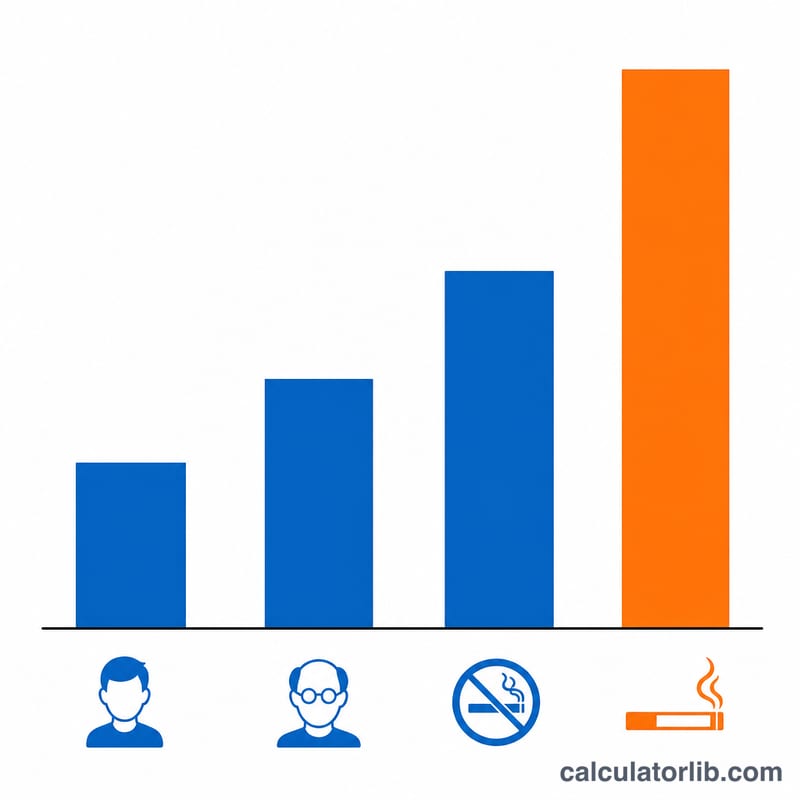
Example: for the 35-year-old male smoker, \(R = 1.15 \times 1.00 \times 1.75 = 2.0125\), so the annual premium is \(500 \times 1.50 \times 2.0125 = 1509.375\), or about $1,509.38. The smoker loading nearly doubles the cost at the same age. Ten extra years of age adds 30 percentage points to the age factor in this model. These are illustrative results of a simplified formula, not insurer quotes.
Risk Multiplier Lookup Table
Important: these are the calculator's own simplified loadings, not insurer actuarial tables. Real insurers price using mortality tables, health history, occupation, policy type and underwriting class, so actual premiums differ and do not rise in a straight line with age.
Age factor
\(A = 1 + 0.03 \times \max(0,\ \text{age} - 30)\), so ages 30 and under all have \(A = 1.00\).
| Age | Age factor A |
|---|---|
| 30 or under | 1.00 |
| 35 | 1.15 |
| 40 | 1.30 |
| 45 | 1.45 |
| 50 | 1.60 |
| 55 | 1.75 |
| 60 | 1.90 |
Gender and smoker factors
| Input | Factor |
|---|---|
| Female (G) | 0.90 |
| Otherwise (G) | 1.00 |
| Smoker (S) | 1.75 |
| Non-smoker (S) | 1.00 |
Combined multiplier examples
| Profile | Calculation | R |
|---|---|---|
| 30, female, non-smoker | 1.00 × 0.90 × 1.00 | 0.90 |
| 40, female, non-smoker | 1.30 × 0.90 × 1.00 | 1.17 |
| 40, male, smoker | 1.30 × 1.00 × 1.75 | 2.275 |
| 50, female, smoker | 1.60 × 0.90 × 1.75 | 2.52 |
| 60, female, non-smoker | 1.90 × 0.90 × 1.00 | 1.71 |
| 60, male, smoker | 1.90 × 1.00 × 1.75 | 3.325 |
Life Insurance Terms Glossary
- Coverage (sum assured / death benefit)
- The amount the insurer pays to beneficiaries if the insured person dies during the policy. It is the main driver of premium size.
- Policy term
- The number of years the policy stays in force, such as 10, 20 or 30. In this calculator the term only sets how many years of premiums are added up; it does not change the yearly premium.
- Base rate per $1,000
- The starting price for each $1,000 of coverage before any risk adjustments. Coverage ÷ 1,000 × base rate gives the base annual premium.
- Premium (annual / monthly)
- The amount paid to keep the policy active. The annual premium is the yearly cost, and the monthly figure here is the annual premium divided by 12. Insurers often add a small surcharge for monthly billing.
- Risk multiplier (loading)
- A factor applied to the base premium to reflect higher or lower expected risk. Here it combines age, gender and smoker factors: \(R = A \times G \times S\).
- Term life insurance
- Insurance that pays a benefit only if death occurs within a set period. It usually has no cash value and is generally cheaper than permanent insurance for the same coverage.
- Underwriting
- The insurer's process of assessing an applicant's risk using age, health, medical history, lifestyle, occupation and sometimes medical exams. It determines whether the applicant is accepted and at what price.
- Smoker status
- Insurers typically classify someone as a smoker if they have used tobacco or nicotine products within a recent period, often the past 12 months, though definitions vary by insurer and country. Smokers usually pay substantially higher premiums.
This is general information, not financial or insurance advice. Ask a licensed insurer or adviser for real quotes.
FAQ
Is this an actual quote? No — it is an educational estimate. Insurers use detailed actuarial tables and medical underwriting.
Why does smoking raise the price so much? Smokers have materially higher mortality risk, so this tool applies a 1.75× loading, in line with typical industry practice.
What base rate should I use? If you do not have a quote, try $1–$2 per $1,000 for a healthy adult; older or higher-risk applicants pay more.