
What Is the Mixed Numbers Calculator?
A mixed number combines a whole number with a proper fraction, such as 2 1/2. This calculator lets you add, subtract, multiply, or divide two mixed numbers and returns the answer as a simplified fraction, an equivalent mixed number, and a decimal. It handles negative whole numbers and automatically reduces the result to lowest terms.
How to Use It
Enter the whole number, numerator, and denominator for each mixed number. Choose an operation (+, −, ×, ÷). Press calculate to see the simplified result. If a denominator is left at zero it is treated as 1 to avoid division errors, and dividing by a zero second fraction is guarded.
The Formula Explained
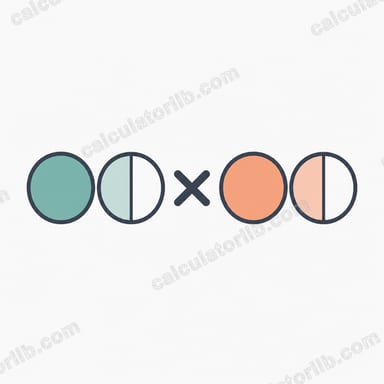
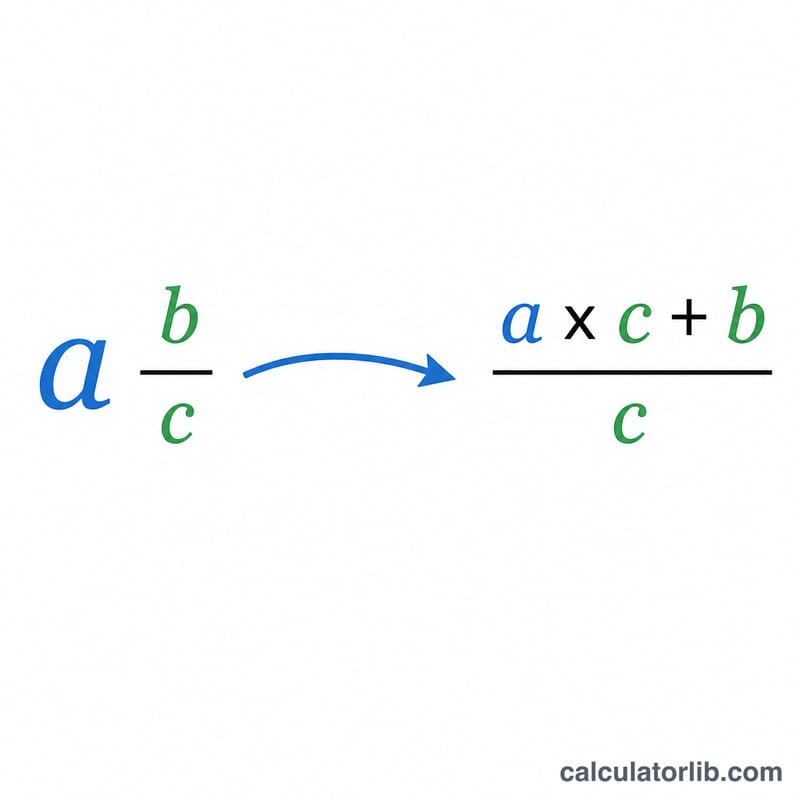
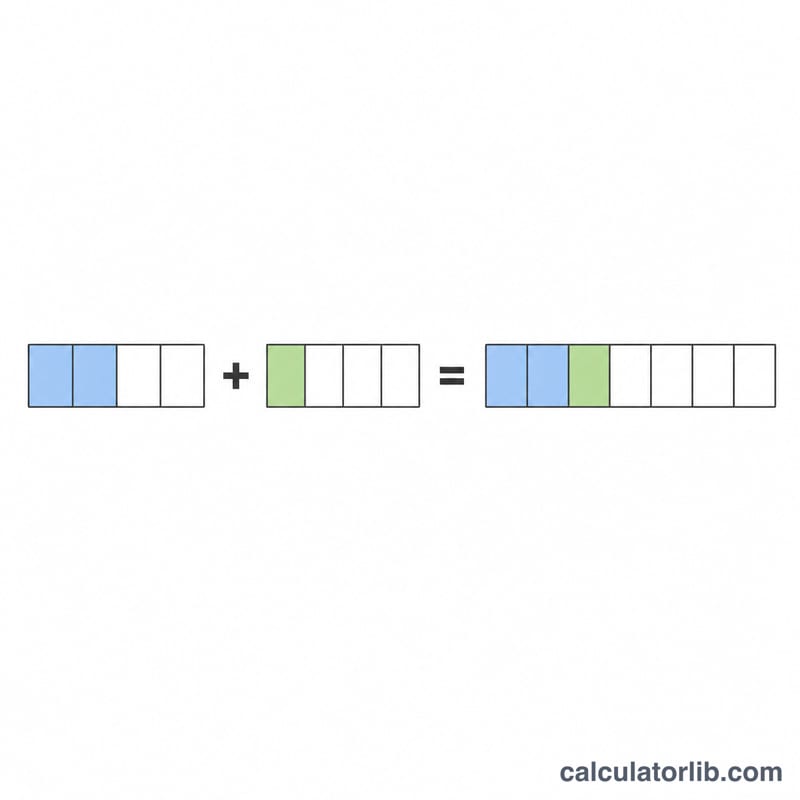
First each mixed number is converted to an improper fraction using \(\frac{a \times c + b}{c}\). For example 2 1/2 becomes \(\frac{2 \times 2 + 1}{2} = \frac{5}{2}\). The two improper fractions are then combined: addition and subtraction use a common denominator $$\frac{ps \pm rq}{qs},$$ multiplication is $$\frac{pr}{qs},$$ and division flips the second fraction to give $$\frac{ps}{qr}.$$ Finally the result is reduced by dividing numerator and denominator by their greatest common divisor (GCD).
Worked Example
Compute 2 1/2 + 1 3/4. Convert: 2 1/2 = 5/2 and 1 3/4 = 7/4. Common denominator: $$\frac{5 \times 4 + 7 \times 2}{2 \times 4} = \frac{20 + 14}{8} = \frac{34}{8}.$$ Reduce by GCD 2: \(\frac{17}{4}\). As a mixed number that is 4 1/4, or 4.25 in decimal.
FAQ
What if the numerator is bigger than the denominator? That is fine — the calculator still converts and simplifies correctly, returning a proper mixed number.
How are negatives handled? A negative whole number makes the entire mixed number negative; the sign is carried through every operation.
Why show both a fraction and a decimal? The simplified fraction is exact, while the decimal gives a quick sense of size for measurements and estimates.