
What is a Resistor Calculator?
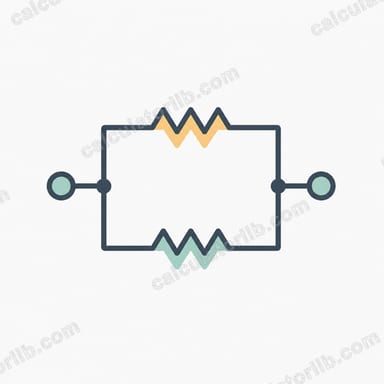
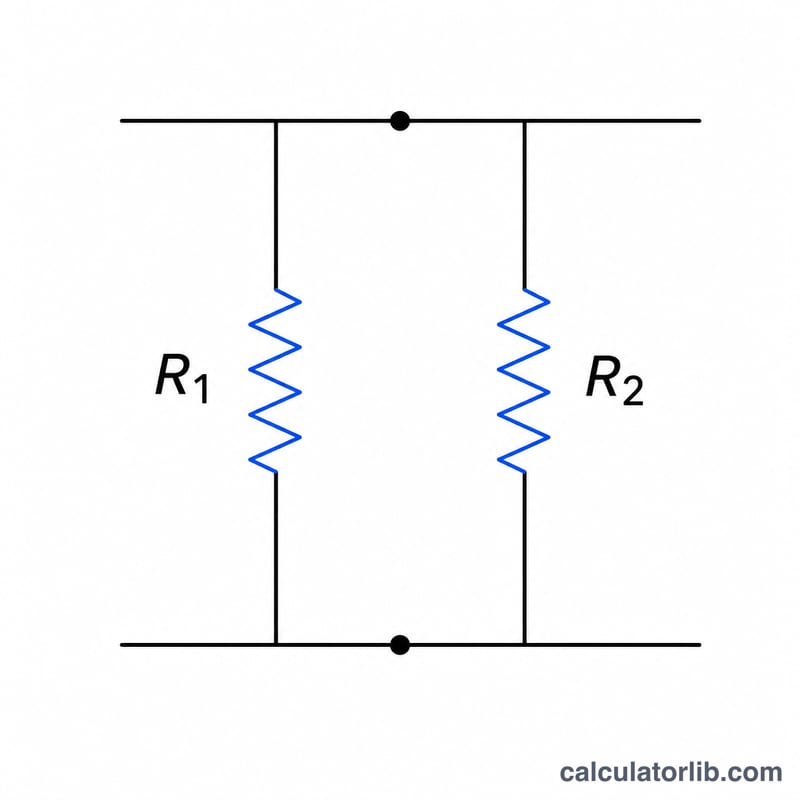
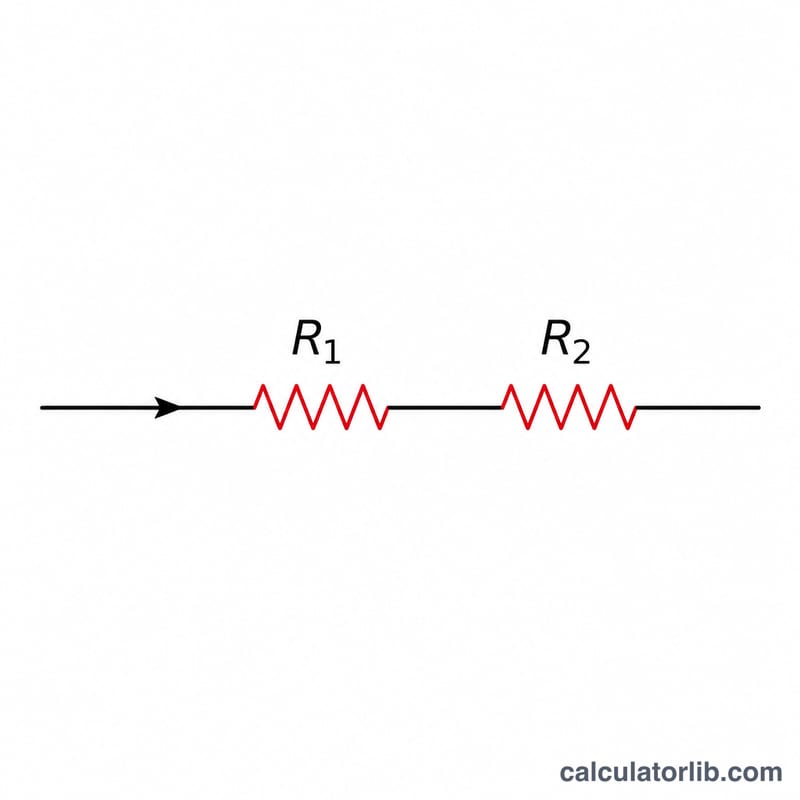
A resistor calculator finds the equivalent (total) resistance of two or more resistors connected together. Resistors can be wired in two basic ways — series, where they sit end to end in a single path, or parallel, where they share the same two nodes. Each arrangement combines resistance differently, and this tool handles both for up to four resistors.
How to use it
Choose the connection type (series or parallel), then enter the resistance of each resistor in ohms (Ω). R1 and R2 are required; R3 and R4 are optional, so you can combine two, three, or four resistors. The calculator returns the equivalent resistance you would measure across the whole network.
The formula explained
For resistors in series, the total is simply the sum: $$R = R_1 + R_2 + \cdots + R_n$$ Because the same current flows through each resistor, their voltage drops add, so the resistances add too.
For resistors in parallel, the reciprocals add: $$\frac{1}{R} = \frac{1}{R_1} + \frac{1}{R_2} + \cdots + \frac{1}{R_n}$$ Each resistor offers an additional path for current, so the equivalent resistance is always smaller than the smallest individual resistor.
Worked example
Suppose you have a 100 Ω and a 220 Ω resistor. In series the total is $$100 + 220 = 320 \ \Omega$$ If instead they are in parallel: $$\frac{1}{R} = \frac{1}{100} + \frac{1}{220} = 0.01 + 0.004545 = 0.014545$$ so \(R = 1 / 0.014545 \approx 68.75 \ \Omega\) — less than either resistor, as expected.
FAQ
Why is parallel resistance lower? Adding a parallel path gives current more routes to flow, reducing overall opposition.
Can I leave R3 and R4 blank? Yes. Only the values you fill in are combined; empty fields are ignored.
What units are used? All values are in ohms (Ω). Convert kΩ or MΩ to ohms first (1 kΩ = 1,000 Ω, 1 MΩ = 1,000,000 Ω).