
What Is Hooke's Law?
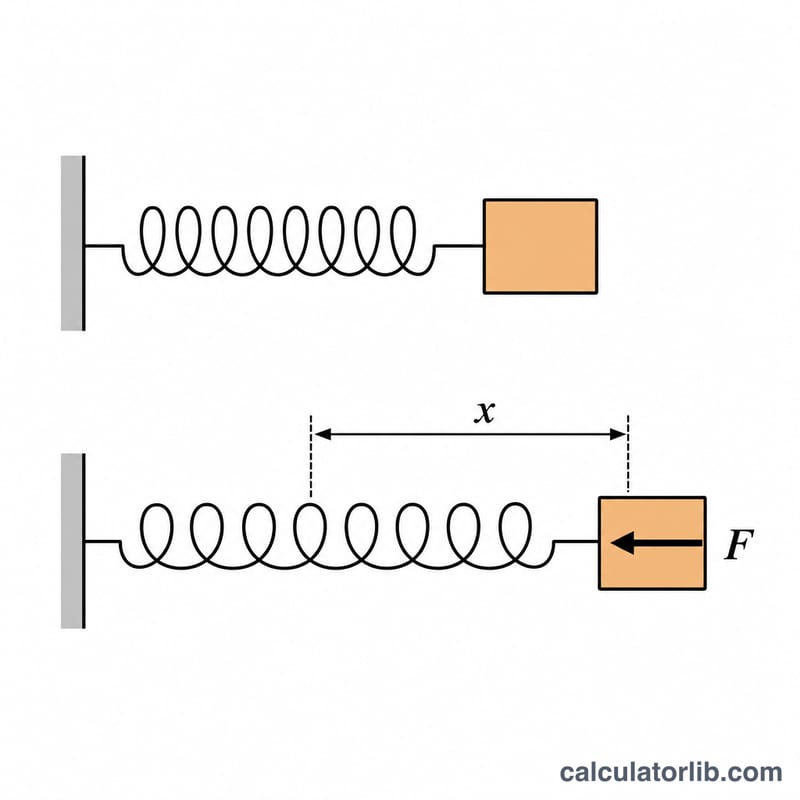
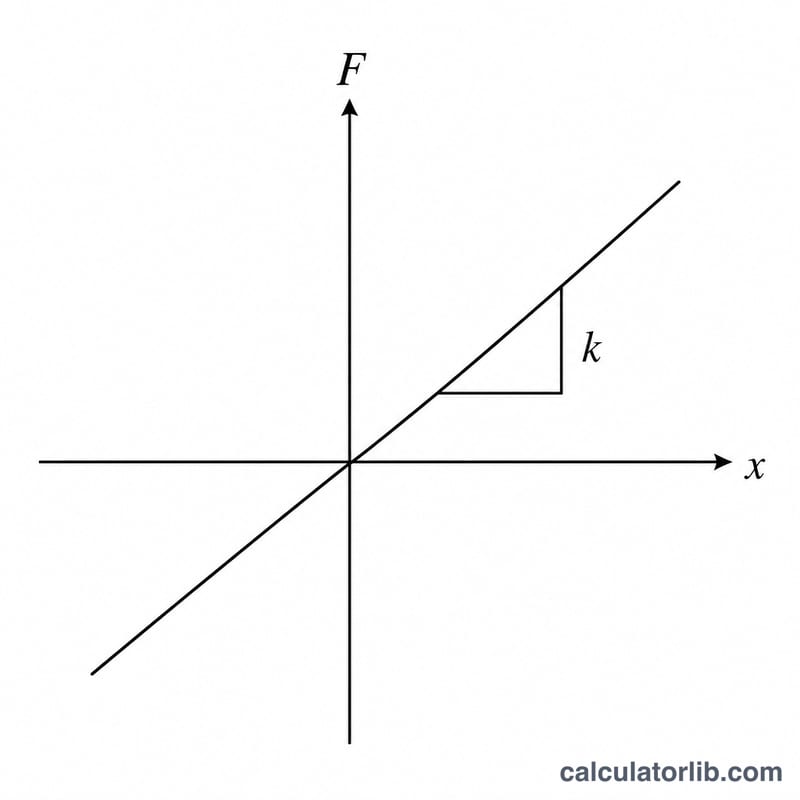
Hooke's Law describes the behavior of an ideal elastic spring. It states that the force a spring exerts is directly proportional to how far it is stretched or compressed from its natural (equilibrium) position. The relationship is written as \(F = -k \cdot x\), where F is the restoring force in newtons (N), k is the spring constant in newtons per meter (N/m), and x is the displacement in meters (m). The negative sign indicates that the force always acts opposite to the displacement, pulling or pushing the spring back toward equilibrium.
How to Use This Calculator
Enter the spring constant k — a measure of stiffness, with larger values meaning a stiffer spring — and the displacement x, the distance the spring is stretched (positive) or compressed (negative). The calculator returns the restoring force F. A negative result simply means the force points back toward the rest position; the force magnitude row shows the absolute strength of that force.
The Formula Explained
In $$F = -k \cdot x$$ doubling the displacement doubles the force, and doubling the stiffness also doubles the force. Hooke's Law holds only within the spring's elastic limit; stretch it too far and the material deforms permanently, breaking the linear relationship.
Worked Example
Suppose a spring has a stiffness of \(k = 100 \text{ N/m}\) and is stretched by \(x = 0.2 \text{ m}\). Then $$F = -100 \times 0.2 = -20 \text{ N}$$ The magnitude of the restoring force is 20 N, directed back toward equilibrium.
FAQ
Why is the force negative? The minus sign shows the force is a restoring force — it always opposes the displacement direction.
What units should I use? Use newtons per meter for k and meters for x to get the force in newtons (SI units).
Does Hooke's Law always apply? No. It is accurate only for small deformations within the elastic limit. Beyond that, springs behave non-linearly.