
What is Snell's Law?
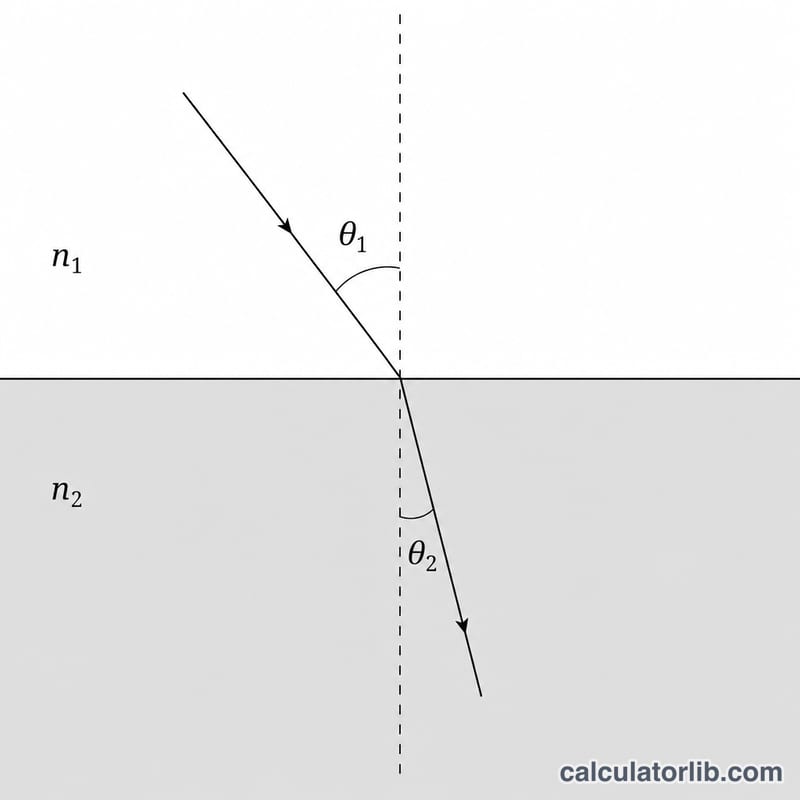
Snell's Law describes how light bends (refracts) when it passes from one transparent medium into another with a different optical density. It connects the angle of incidence \(\theta_1\) and the angle of refraction \(\theta_2\) to the refractive indices \(n_1\) and \(n_2\) of the two media: \(n_1\cdot\sin(\theta_1) = n_2\cdot\sin(\theta_2)\). This calculator solves for the refraction angle \(\theta_2\) and also reports the critical angle when light travels from a denser to a rarer medium.
How to use this calculator
Enter the refractive index of the medium the light starts in (\(n_1\)), the angle of incidence \(\theta_1\) measured from the surface normal (0–90°), and the refractive index of the medium the light enters (\(n_2\)). The calculator returns \(\theta_2\). If the geometry produces \(\sin(\theta_2)\) greater than 1, no refracted ray can exist and the result is flagged as total internal reflection.
The formula explained
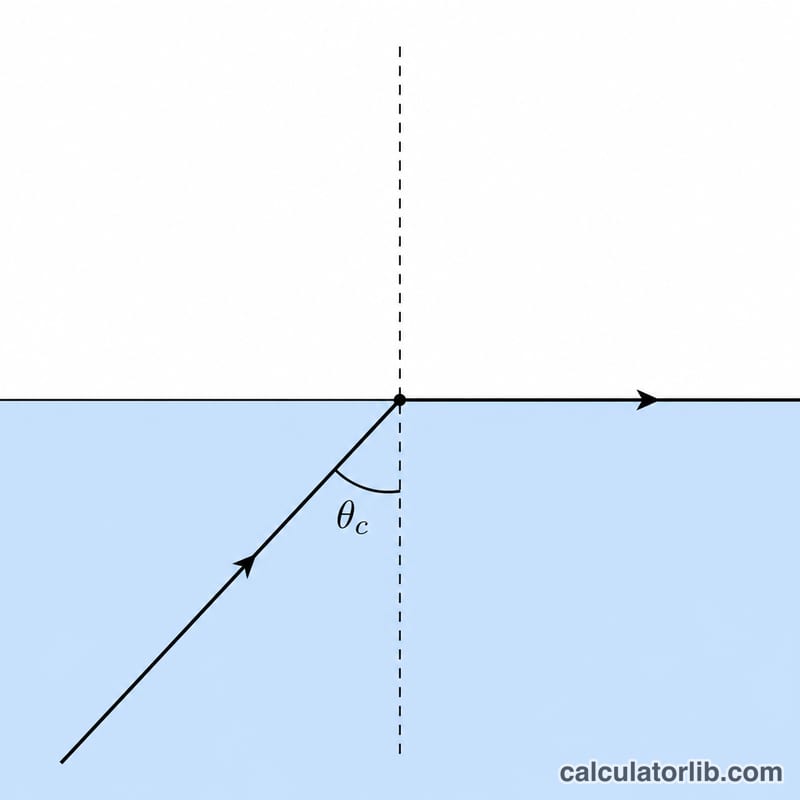
Rearranging Snell's Law gives $$\theta_2 = \arcsin\left(\frac{n_1\cdot\sin(\theta_1)}{n_2}\right).$$ When \(n_1 < n_2\) the ray bends toward the normal; when \(n_1 > n_2\) it bends away. If \(n_1 > n_2\), there is a critical angle $$\theta_c = \arcsin\left(\frac{n_2}{n_1}\right):$$ beyond it light is totally internally reflected — the principle behind fiber optics.
Worked example
Light passes from air (\(n_1 = 1.00\)) into water (\(n_2 = 1.33\)) at an incidence angle of 30°. Then $$\sin(\theta_2) = \frac{1.00 \times \sin 30^\circ}{1.33} = \frac{0.5}{1.33} \approx 0.3759,$$ so \(\theta_2 = \arcsin(0.3759) \approx 22.08^\circ\). The ray bends toward the normal, as expected when entering a denser medium.
FAQ
What is the refractive index of common materials? Vacuum ≈ 1.0000, air ≈ 1.0003, water ≈ 1.33, glass ≈ 1.5, diamond ≈ 2.42.
Why do I get "Total Internal Reflection"? When light goes from a denser to a rarer medium past the critical angle, \(\sin(\theta_2)\) exceeds 1, which has no real solution, so the light reflects entirely back.
Is the angle measured from the surface? No — both \(\theta_1\) and \(\theta_2\) are measured from the surface normal (the perpendicular to the boundary).