
What Is the Speed of Light Calculator?
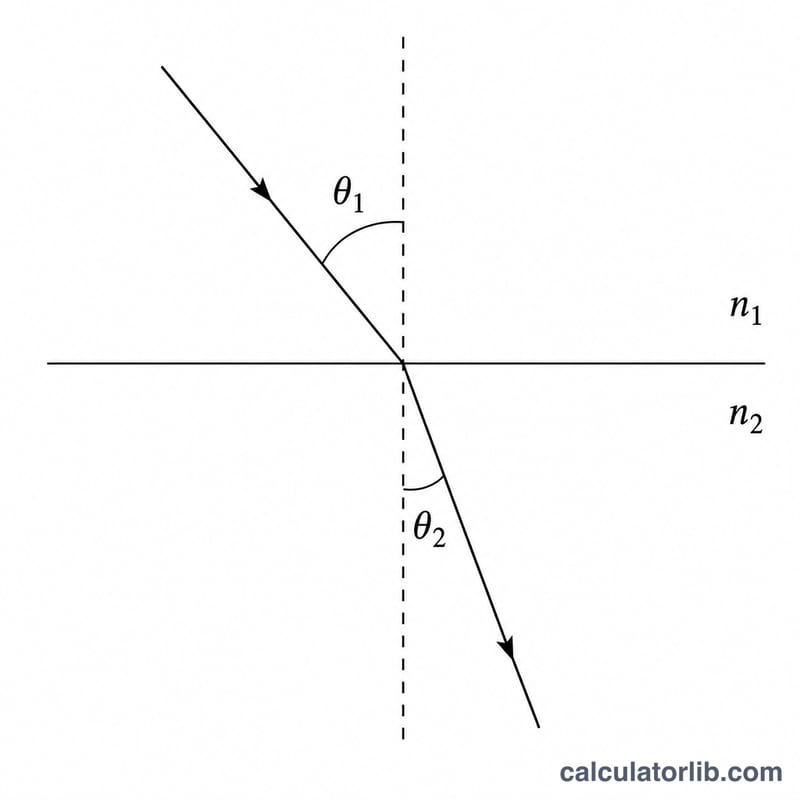
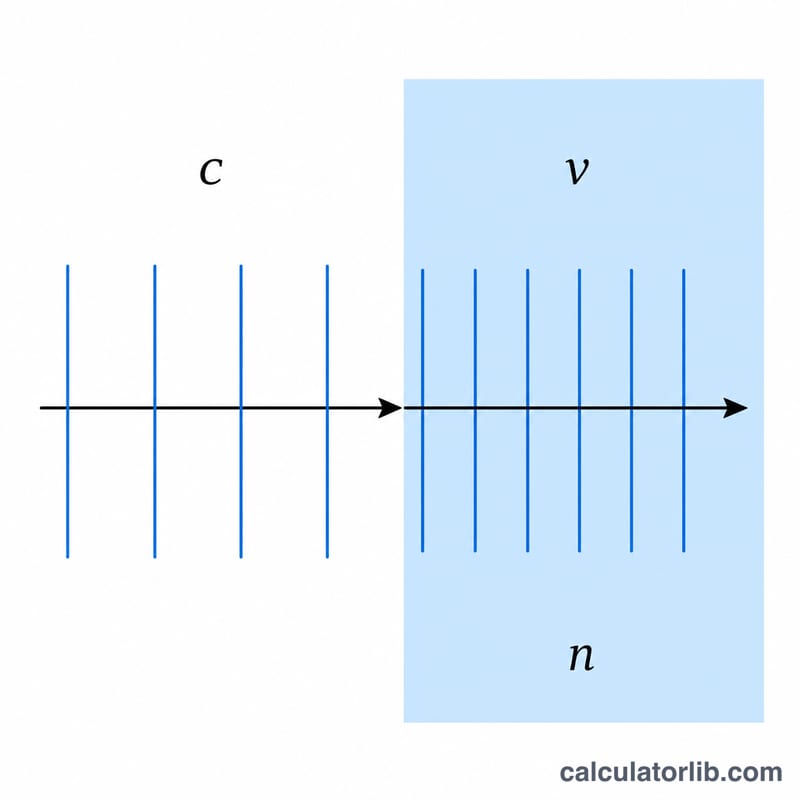
This calculator finds how fast light travels through a given medium. While light moves at its maximum speed in a vacuum — the famous constant \(c = 299{,}792{,}458\ \text{m/s}\) — it slows down when passing through materials like air, water, or glass. The amount it slows is described by the medium's refractive index (n). The tool applies the relationship \(v = c/n\) to give you the velocity in both meters per second and kilometers per second.
How to Use It
Enter the refractive index of the medium you are interested in. Common values are n = 1 for vacuum, 1.000293 for air, 1.333 for water, and about 1.5 for typical glass. The higher the index, the more light is slowed. Press calculate to see the resulting speed.
The Formula Explained
The governing equation is:
$$v = \frac{c}{\text{Refractive index } (n)} = \frac{299792458\ \text{m/s}}{\text{Refractive index } (n)}$$
Here v is the phase speed of light in the medium, c is the speed of light in vacuum (an exactly defined value), and n is the dimensionless refractive index, which is always 1 or greater for normal materials. Because n appears in the denominator, a larger refractive index produces a smaller speed.
Worked Example
Suppose light travels through water, which has a refractive index of n = 1.333. Then:
$$v = 299{,}792{,}458 \div 1.333 \approx 224{,}900{,}569\ \text{m/s}$$ or about 224,901 km/s. This is roughly 75% of the vacuum speed of light.
FAQ
Can light go faster than c? No material's bulk light speed exceeds c. Refractive indices below 1 affect phase velocity in special cases but never transmit information faster than c.
What index should I use for vacuum? Use exactly n = 1, which returns the full speed c.
Why is c an exact number? Since 1983 the meter is defined in terms of the speed of light, making \(c = 299{,}792{,}458\ \text{m/s}\) an exact, unchanging constant by definition.