
What this calculator does
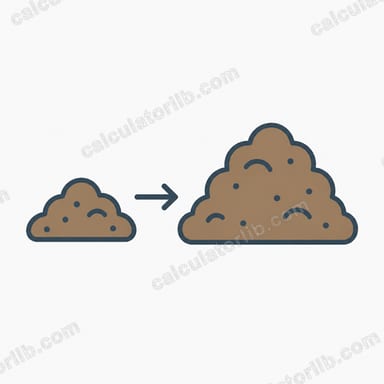
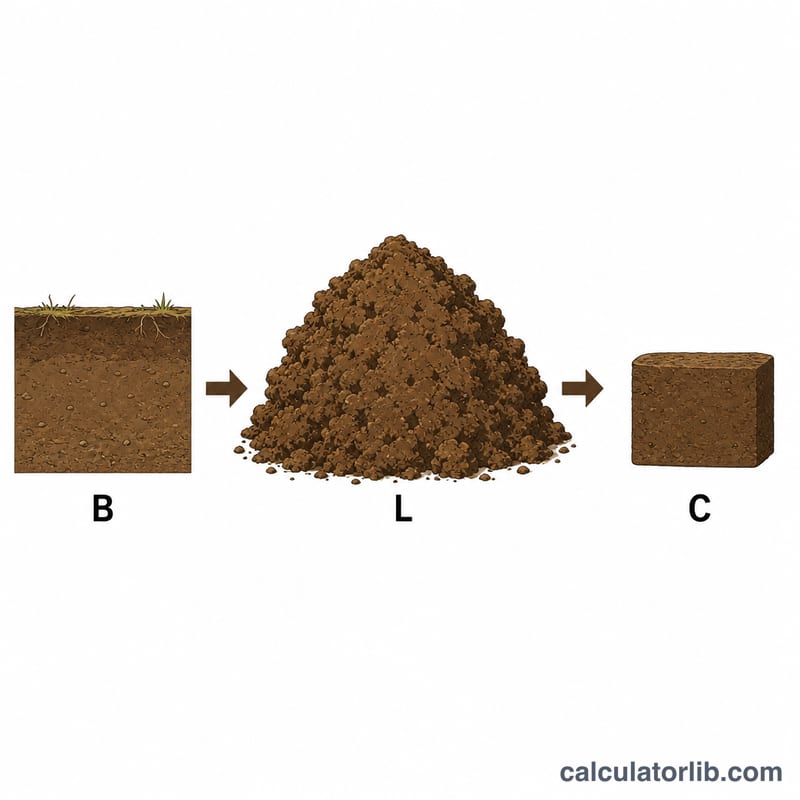
Earthwork estimation tracks the same body of soil in three different physical states. Bank volume (also called in-situ or undisturbed) is the soil as it sits in the ground. Loose volume is that soil after it has been dug out and loosened, which makes it swell and occupy more space. Compacted volume is the soil after it has been placed and compacted in a fill, which usually shrinks it below its original in-situ size. This tool converts a volume you enter in any one of these states into the equivalent volume in all three, using the standard swell factor L and compaction factor C.
How to use it
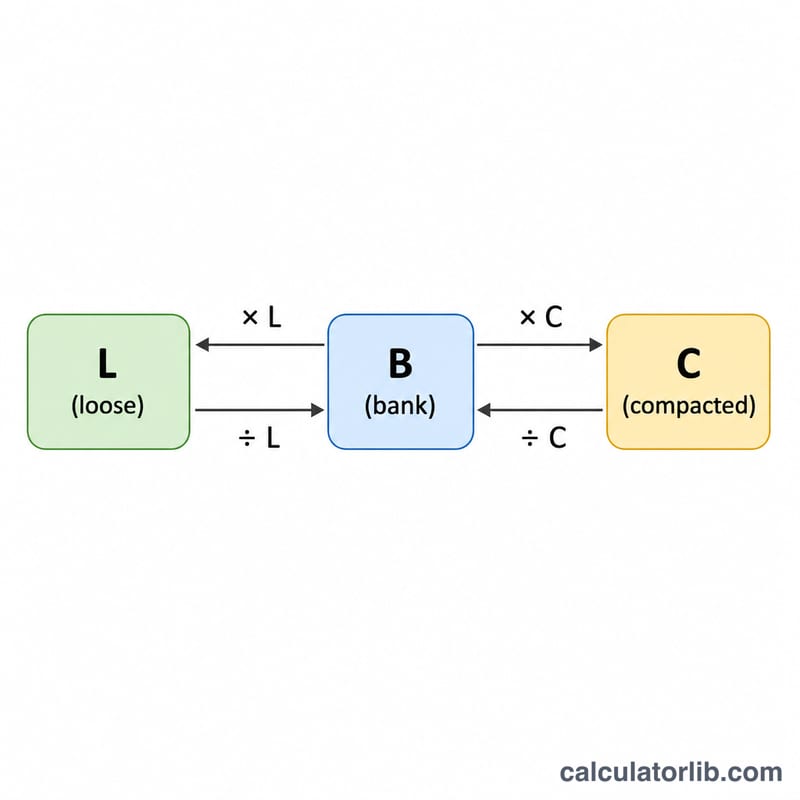
Pick which state your entered volume represents, type the volume in cubic meters, then choose the swell factor (\(L\)) and compaction factor (\(C\)) for your material. The calculator first back-converts your input to bank volume, then derives the loose and compacted figures. Whichever state you selected will read back exactly as you entered it.
The formula explained
By definition \(L = \text{loose} / \text{bank}\) and \(C = \text{compacted} / \text{bank}\). So bank volume \(B\) is found from your input \(V\): if you entered bank, \(B = V\); if loose, \(B = V / L\); if compacted, \(B = V / C\). Then $$V_{loose} = B \cdot L, \quad V_{comp} = B \cdot C$$ The arithmetic is exact; only the displayed result is rounded.
Worked example
Enter 100 m³ as bank volume with \(L = 1.25\) and \(C = 0.85\). Bank volume stays 100 m³. Loose volume $$100 \times 1.25 = 125 \text{ m}^3$$ Compacted volume $$100 \times 0.85 = 85 \text{ m}^3$$ If instead you enter 125 m³ as loose volume with the same factors, bank = \(125 / 1.25 = 100\) m³, loose = 125 m³ and compacted = 85 m³ — the same body of soil.
FAQ
Why is the loose volume larger than the bank volume? Digging breaks up the soil structure and introduces voids, so the loosened material swells. That swell is captured by \(L\), which is at least 1 for typical soils.
Why is the compacted volume smaller? Compaction squeezes out air and water voids so the soil packs tighter than it was in the ground, giving \(C\) below 1 for most materials.
Which units does it use? All volumes are in cubic meters (m³). If your data is in another unit, convert it first (1 yd³ = 0.764554858 m³, 1 ft³ = 0.0283168466 m³, 1 L = 0.001 m³).