
What is the Telescope Field of View Calculator?
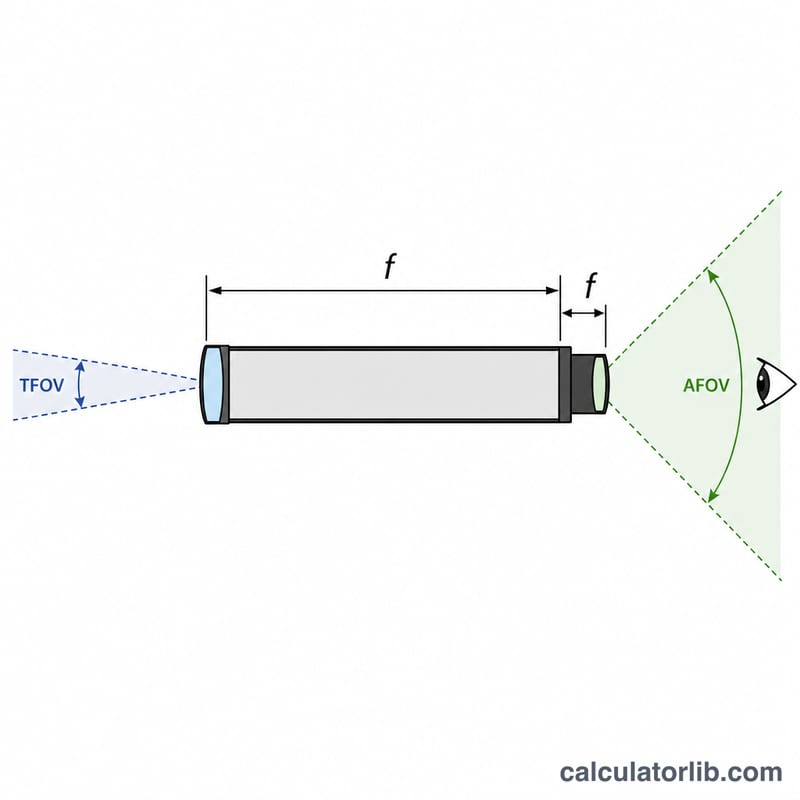
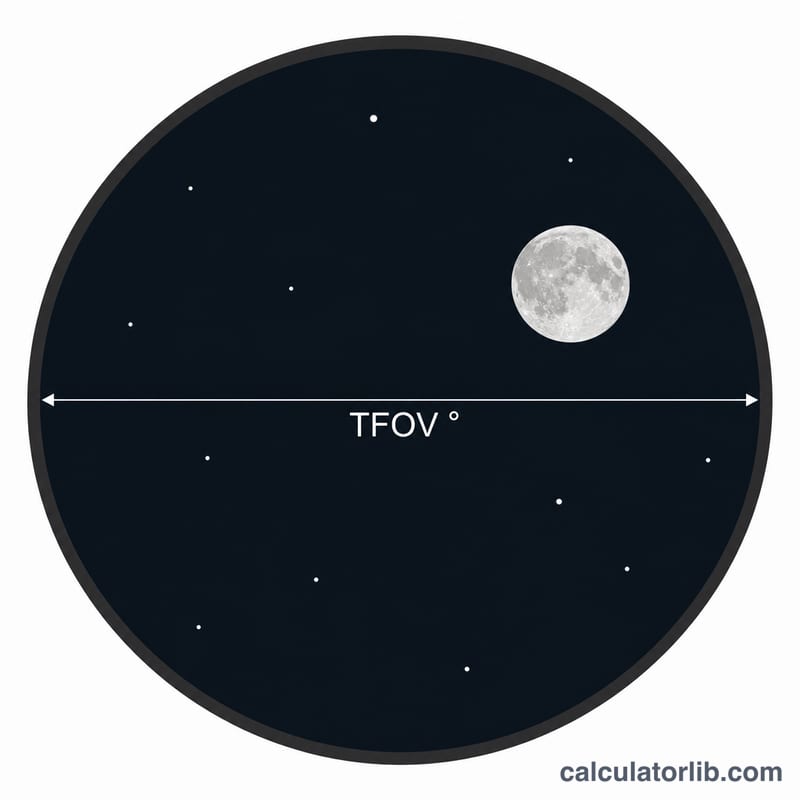
This tool tells you how much of the sky you can see through your telescope with a given eyepiece. The true field of view (TFOV) is the actual angular diameter of the patch of sky visible in the eyepiece, measured in degrees. It depends on your telescope's focal length, your eyepiece's focal length, and the eyepiece's apparent field of view (AFOV). The calculator also reports the resulting magnification.
How to use it
Enter three numbers: the telescope's focal length in millimetres (often printed on the tube, e.g. 1000 mm), the eyepiece's focal length in millimetres (e.g. 25 mm), and the eyepiece's apparent field of view in degrees (Plössl eyepieces are typically 50–52°, while ultra-wide designs can reach 82–100°). Press calculate to get magnification and the true field of view in both degrees and arcminutes.
The formula explained
Magnification is simply the telescope focal length divided by the eyepiece focal length: a 1000 mm scope with a 25 mm eyepiece yields \(1000 \div 25 = 40\times\) magnification. The true field of view is the eyepiece's apparent field of view divided by that magnification:
$$\text{TFOV} = \frac{\text{AFOV}}{M}$$This is the standard simple-approximation method used by most amateur astronomers.
Worked example
Suppose \(f_{\text{scope}} = 1200\ \text{mm}\), \(f_{\text{eyepiece}} = 10\ \text{mm}\), and \(\text{AFOV} = 68\degree\). Magnification \(= 1200 \div 10 = 120\times\).
$$\text{TFOV} = 68 \div 120 = 0.567\degree$$which is about 34 arcminutes — just over the apparent diameter of the full Moon (≈30 arcminutes).
FAQ
Why is the moon about half a degree? The full Moon spans roughly \(0.5\degree\), so a TFOV near \(0.5\degree\) barely fits it in the field.
What AFOV should I enter? Use the value from your eyepiece's specifications; if unknown, \(50\degree\) is a reasonable default for standard eyepieces.
Does this account for distortion? No — this is the simple approximation. Apparent field edge distortion in some eyepieces can make the precise TFOV vary slightly, but the formula is accurate enough for planning observations.