
What It Calculates
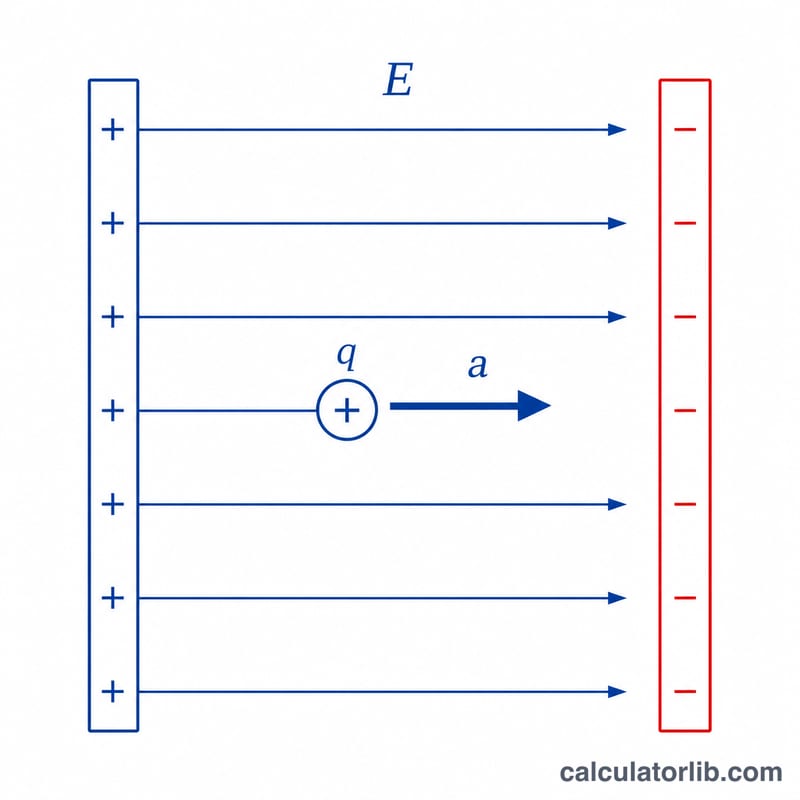
This calculator finds the acceleration experienced by a charged particle placed in a uniform electric field. When a charge sits in an electric field, the field exerts a force on it, and by Newton's second law that force produces an acceleration. The relationship combines electrostatics and mechanics into one compact formula: \(a = qE/m\).
How to Use It
Enter three values: the particle's electric charge \(q\) in coulombs (C), the electric field strength \(E\) in newtons per coulomb (N/C), and the particle's mass \(m\) in kilograms (kg). The calculator multiplies the charge by the field to get the electric force (\(F = qE\)), then divides by the mass to give the acceleration in meters per second squared (m/s²). For subatomic particles such as electrons or protons, use scientific values like \(1.602\times10^{-19}\) C for charge.
The Formula Explained
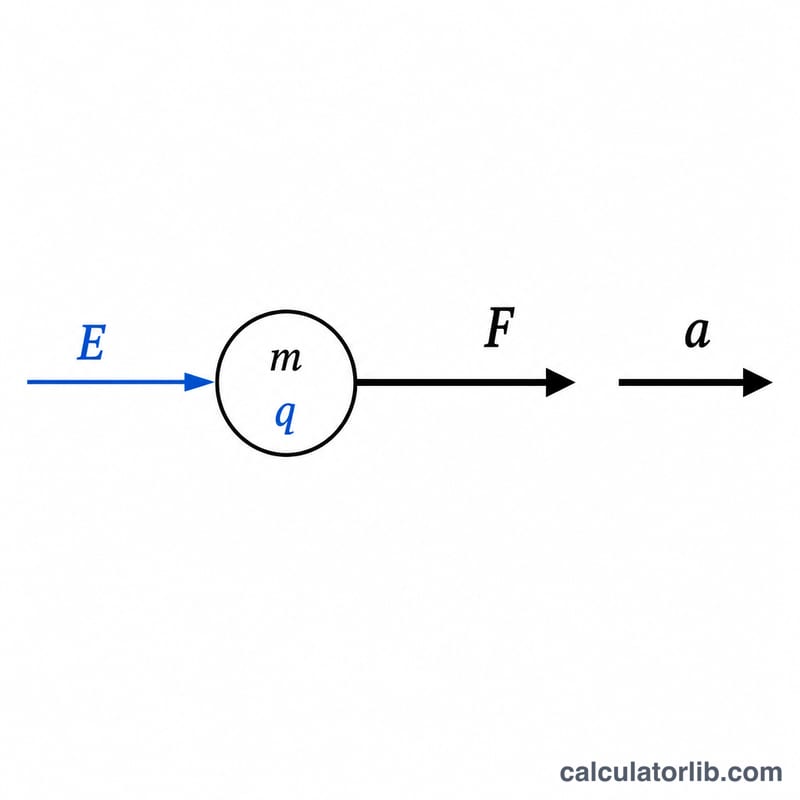
The electric force on a charge is \(F = qE\). Newton's second law states \(F = ma\), so \(a = F/m\). Substituting the electric force gives $$a = \dfrac{qE}{m}$$ A larger charge or stronger field increases acceleration, while a larger mass decreases it. The direction of acceleration follows the field for a positive charge and opposes it for a negative charge.
Worked Example
An electron (\(q = 1.602\times10^{-19}\) C, \(m = 9.11\times10^{-31}\) kg) is placed in a field of 1000 N/C. The force is $$F = (1.602\times10^{-19})(1000) = 1.602\times10^{-16}\ \text{N}$$ The acceleration is $$a = \dfrac{1.602\times10^{-16}}{9.11\times10^{-31}} \approx 1.759\times10^{14}\ \text{m/s}^2$$ — an enormous value because the electron's mass is tiny.
Constants & Reference Values
The acceleration of a charged particle in a uniform electric field follows from Newton's second law combined with the electric force, \(a = \frac{qE}{m}\). To use this relation you need the particle's charge \(q\) (in coulombs, C), the field strength \(E\) (in newtons per coulomb, N/C, equivalently volts per metre, V/m), and the mass \(m\) (in kilograms, kg). The table below lists commonly used reference values.
| Quantity | Symbol | Value | Unit |
|---|---|---|---|
| Elementary charge | \(e\) | \(1.602\times10^{-19}\) | C |
| Electron charge | \(q_e\) | \(-1.602\times10^{-19}\) | C |
| Electron mass | \(m_e\) | \(9.11\times10^{-31}\) | kg |
| Proton charge | \(q_p\) | \(+1.602\times10^{-19}\) | C |
| Proton mass | \(m_p\) | \(1.673\times10^{-27}\) | kg |
| Alpha particle charge | \(q_\alpha\) | \(+3.204\times10^{-19}\) (\(=2e\)) | C |
| Alpha particle mass | \(m_\alpha\) | \(6.645\times10^{-27}\) | kg |
| Charge-to-mass ratio (electron) | \(e/m_e\) | \(1.759\times10^{11}\) | C/kg |
| Charge-to-mass ratio (proton) | \(e/m_p\) | \(9.58\times10^{7}\) | C/kg |
Note that the electric field unit N/C is dimensionally identical to V/m, so a field expressed either way can be entered directly. The sign of the charge sets the direction of the acceleration relative to the field: positive charges accelerate along \(\vec{E}\), negative charges opposite to it.
Key Terms Defined
- Charge (\(q\), coulombs, C)
- The electric charge carried by the particle. It can be positive or negative, and its magnitude is often expressed as a multiple of the elementary charge \(e = 1.602\times10^{-19}\) C. The sign determines whether the particle accelerates with or against the field.
- Electric field strength (\(E\), N/C or V/m)
- The force per unit charge exerted by the field at a point, \(E = F/q\). Newtons per coulomb (N/C) and volts per metre (V/m) are equivalent units. A field points from regions of high to low potential.
- Mass (\(m\), kilograms, kg)
- The inertial mass of the particle, which resists acceleration. Larger mass yields smaller acceleration for the same force, since \(a \propto 1/m\).
- Acceleration (\(a\), metres per second squared, m/s²)
- The rate of change of the particle's velocity, given by \(a = qE/m\). It is directed along the electric force.
- Electric force (\(F\), newtons, N)
- The force the field exerts on the charge, \(F = qE\). Combined with Newton's second law \(F = ma\), this yields the acceleration relation \(a = qE/m\).
FAQ
Does the charge sign matter? The magnitude of acceleration is the same; the sign tells you the direction relative to the field. Enter the signed charge if you want a signed result.
What units should I use? SI units: coulombs, N/C, and kilograms give acceleration in m/s².
Is gravity included? No. This computes only the electric-field acceleration. For charged particles in everyday fields the electric acceleration usually dwarfs gravity.