
What It Calculates
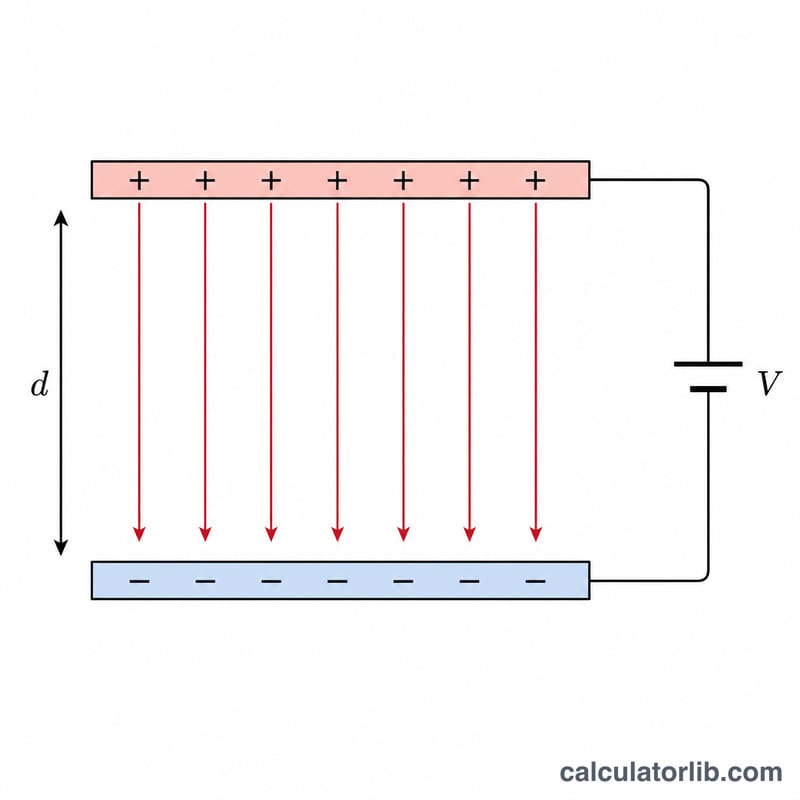
This calculator finds the strength of the uniform electric field between two parallel conducting plates — the classic parallel-plate capacitor setup. When a voltage is applied across two plates separated by a small distance, a nearly uniform electric field forms in the gap, pointing from the positive plate to the negative plate.
How to Use It
Enter the voltage (potential difference) applied across the plates in volts, and the separation between the plates in meters. The calculator returns the field strength in volts per meter (V/m), which is numerically equal to newtons per coulomb (N/C).
The Formula Explained
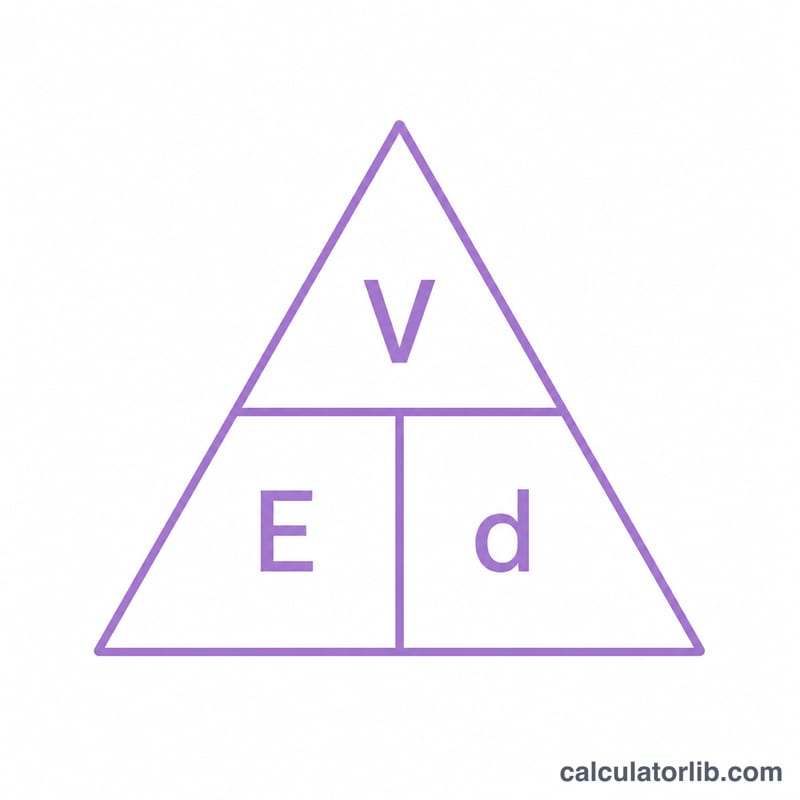
The field is given by $$E = \frac{\text{Voltage (V)}}{\text{Plate separation (m)}}$$ Because the field between large parallel plates is uniform, the potential difference equals field strength times distance (\(V = E \cdot d\)), so dividing the voltage by the gap distance recovers the field. Keep units consistent: volts and meters give a result in V/m. If your gap is in millimeters, convert to meters first (1 mm = 0.001 m).
Worked Example
Suppose two plates are connected to a 100 V supply and are 0.01 m (1 cm) apart. Then $$E = \frac{100}{0.01} = 10{,}000 \text{ V/m}$$ A test charge placed in this gap would feel a force of 10,000 N per coulomb of charge.
FAQ
Are V/m and N/C the same? Yes. One volt per meter is exactly equal to one newton per coulomb, so the units are interchangeable for electric field strength.
Does plate area matter? Not for the field strength itself — \(E = V/d\) depends only on voltage and gap, assuming the plates are large compared to the separation so edge effects are negligible.
What if I increase the gap? For a fixed voltage, a larger separation produces a weaker field, since the same voltage is spread over a greater distance.