
What Is Electric Potential?
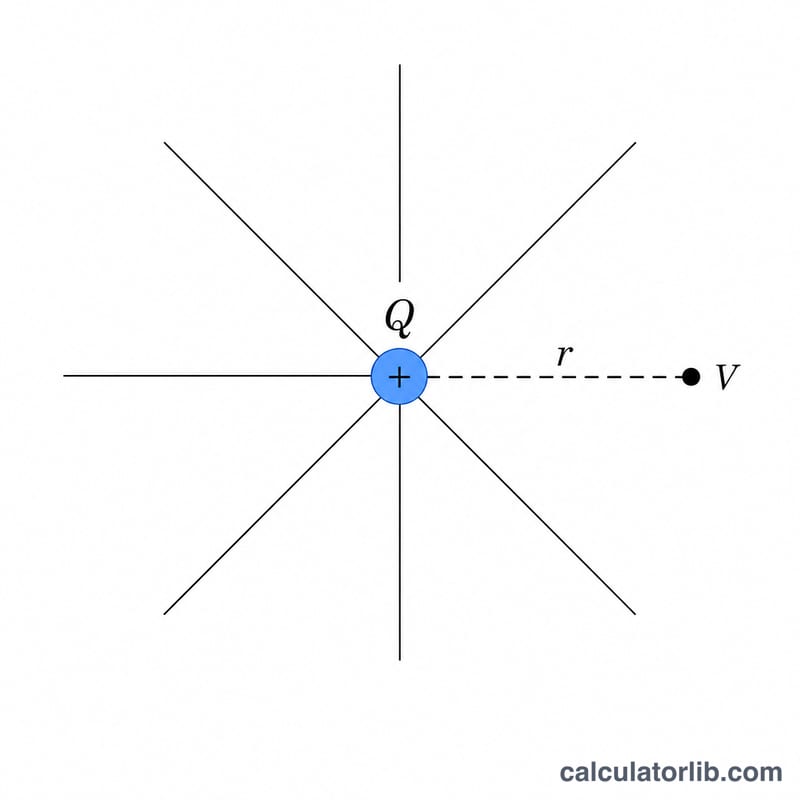
Electric potential, measured in volts (V), is the amount of electric potential energy per unit charge at a point in space created by a source charge. For a single point charge Q, the potential at a distance r is given by Coulomb's law for potential: \(V = kQ/r\). This calculator works for any consistent SI inputs and applies universally — it is pure physics, not jurisdiction-specific.
How to Use the Calculator
Enter the source charge Q in coulombs (C) — you can use scientific values like 0.000001 for 1 microcoulomb — and the distance r in meters (m) from the charge to the point of interest. The calculator returns the electric potential in volts. A positive charge produces a positive potential; a negative charge produces a negative potential.
The Formula Explained
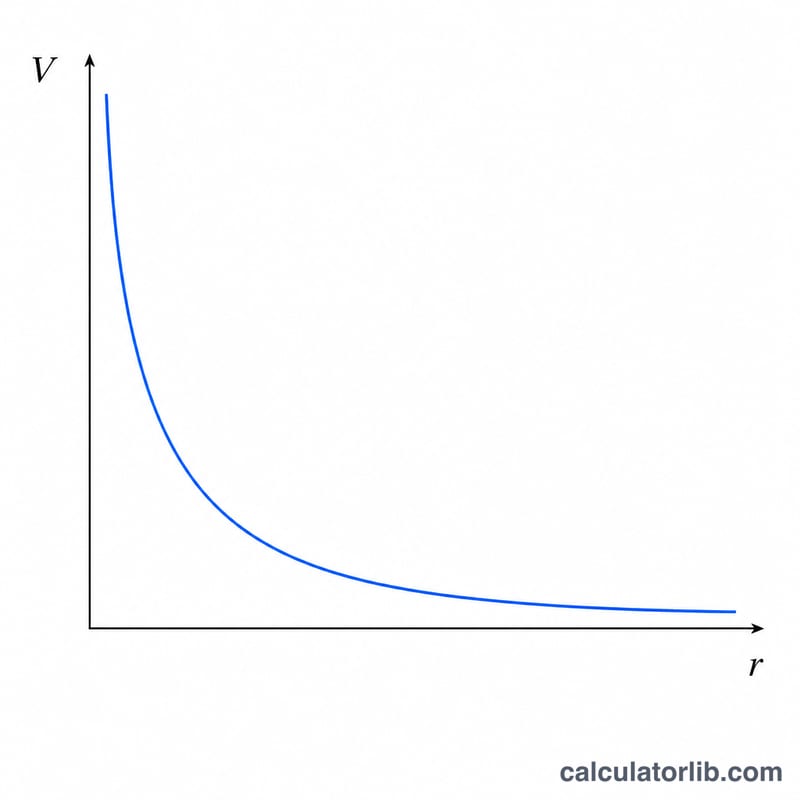
$$V = k\,\frac{\text{Charge }Q}{\text{Distance }r}$$ where \(k\) is Coulomb's constant, approximately \(8.9875 \times 10^{9}\ \text{N}\cdot\text{m}^2/\text{C}^2\) (often rounded to \(9 \times 10^{9}\)). \(Q\) is the source charge in coulombs and \(r\) is the radial distance in meters. The potential decreases inversely with distance — moving twice as far away halves the potential. Unlike the electric field (which falls off as \(1/r^2\)), potential falls off as \(1/r\).
Worked Example
Suppose a charge of \(Q = 2 \times 10^{-6}\ \text{C}\) (2 µC) sits in space and we want the potential 0.05 m away. Then $$V = \frac{8.9875 \times 10^{9} \times 2 \times 10^{-6}}{0.05} = \frac{17975}{0.05} \approx 359{,}502 \text{ volts}.$$ So the potential at that point is about 360 kV.
FAQ
Does sign matter? Yes. A negative charge gives a negative potential, since potential is a scalar that carries the sign of the source charge.
What if r = 0? The formula diverges at \(r = 0\) (the potential becomes infinite), so distance must be greater than zero. The calculator returns 0 to avoid dividing by zero.
What value of k is used? The exact CODATA-based value \(8.9875517873681764 \times 10^{9}\ \text{N}\cdot\text{m}^2/\text{C}^2\).