
What This Calculator Does
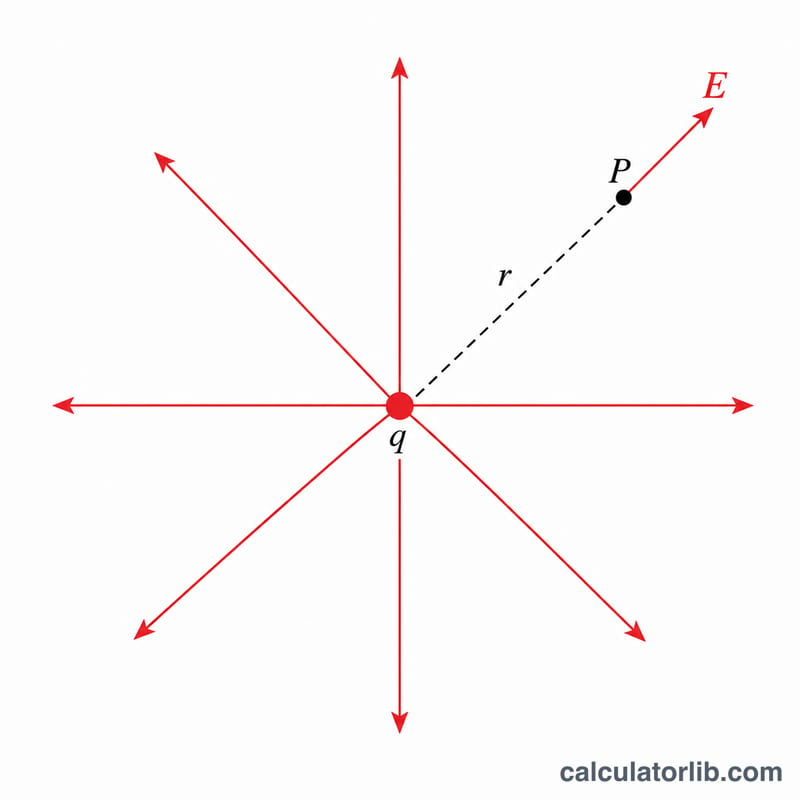
This tool computes the magnitude of the electric field produced by a single point charge at a given distance. The electric field describes the force a stationary positive test charge would experience per unit charge at that location. It is a universal physics relationship and applies anywhere — no country-specific assumptions are needed.
How to Use It
Enter the source charge q in coulombs (C) and the distance r from the charge in meters (m). Small charges are often given in microcoulombs (1 µC = 0.000001 C) or nanocoulombs (1 nC = 0.000000001 C), so convert before entering. The calculator returns the field magnitude in newtons per coulomb (N/C), which is identical to volts per meter (V/m).
The Formula Explained
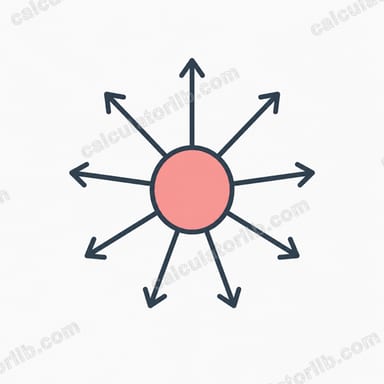
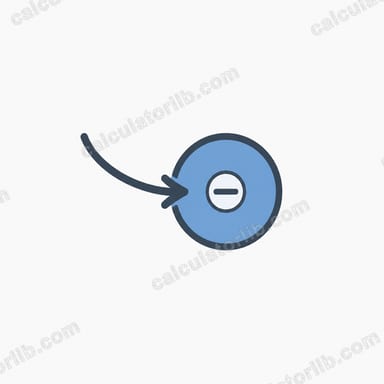
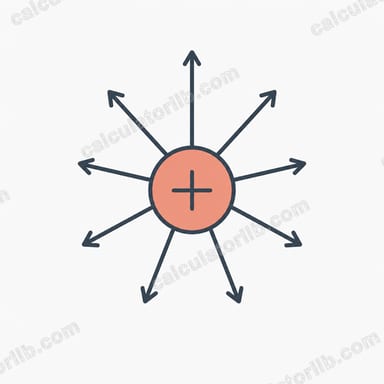
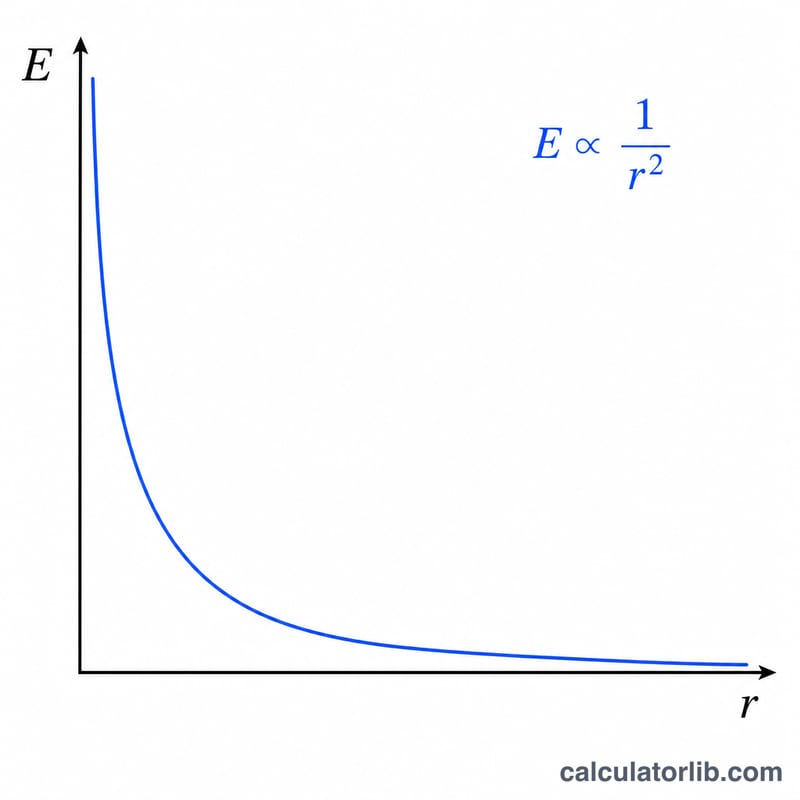
The governing equation is $$E = k \cdot \frac{\left|q\right|}{r^{2}}$$ where \(k\) is Coulomb's constant, approximately \(8.9875 \times 10^{9}\ \text{N}\cdot\text{m}^{2}/\text{C}^{2}\). The field falls off with the square of the distance — doubling \(r\) reduces the field to one quarter. We use the absolute value of \(q\) so the result is a magnitude; the field points away from a positive charge and toward a negative one.
Worked Example
Suppose \(q = 1\ \text{µC} = 1 \times 10^{-6}\ \text{C}\) at \(r = 0.5\ \text{m}\). Then $$E = \frac{8.9875 \times 10^{9} \times 1 \times 10^{-6}}{0.5^{2}} = \frac{8987.55}{0.25} \approx 35{,}950\ \text{N/C}$$ So a small +1 µC charge produces a field of about 36 kN/C half a meter away.
FAQ
What are the units of the electric field? Newtons per coulomb (N/C), equivalent to volts per meter (V/m).
Does the sign of the charge matter? The sign sets the direction (toward vs. away). This calculator reports magnitude using \(|q|\).
Why is the field undefined at r = 0? Dividing by \(r^{2}\) blows up as \(r\) approaches zero; a true point charge has an infinite field at its own location, so \(r\) must be greater than zero.