
What is a Thin-Film Optical Coating Calculator?
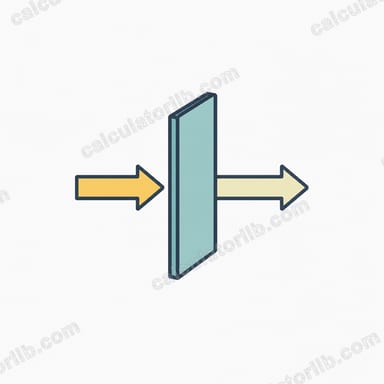
Anti-reflection (AR) coatings reduce unwanted reflections from lenses, displays, and optical windows. The most common design is the quarter-wave coating: a single thin layer whose optical thickness equals one quarter of the design wavelength. At that thickness, light reflected from the top of the film and light reflected from the substrate interface arrive a half-wavelength out of phase and destructively interfere, cancelling the reflection. This calculator returns the required physical layer thickness from your design wavelength and the coating material's refractive index.
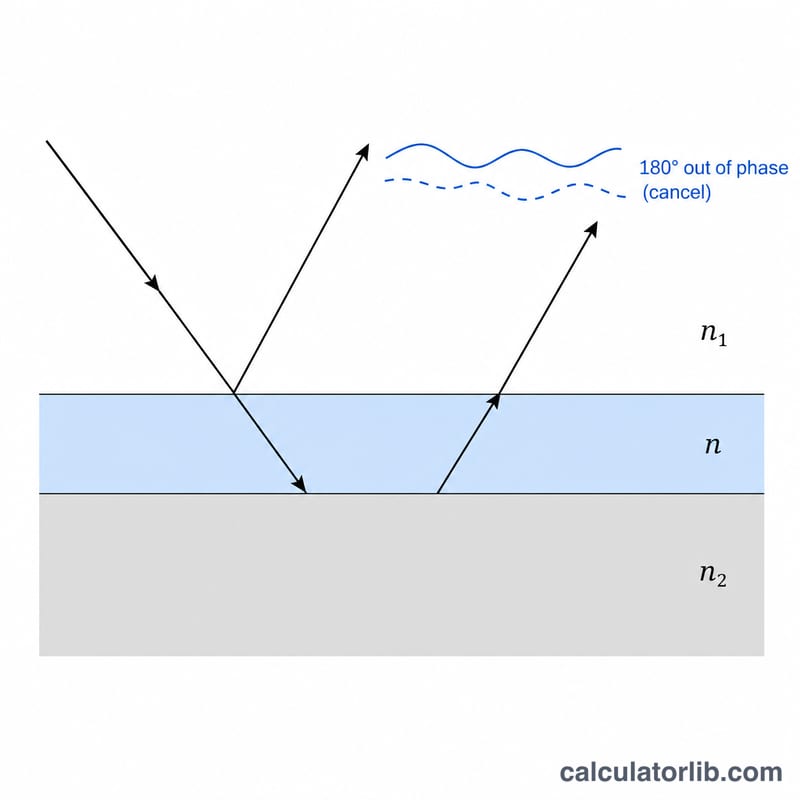
How to use it
Enter the design wavelength \(\lambda\) in nanometers (e.g. 550 nm for the green center of the visible spectrum), the refractive index \(n\) of the coating material (e.g. 1.38 for magnesium fluoride, MgF₂), and the order \(m\). Use \(m = 1\) for the thinnest single quarter-wave layer; higher odd orders (3, 5, …) give thicker layers that work at the same wavelength but over a narrower band. The result gives both physical thickness and optical thickness.
The formula explained
The physical thickness is $$t = \frac{m\lambda}{4n}.$$ The factor \(1/n\) converts the optical path \((m\lambda/4)\) into a real geometric thickness inside the higher-index film, since light travels slower and has a shorter effective wavelength \(\lambda/n\) inside the material. The optical thickness \(n\cdot t\) therefore equals \(m\lambda/4\), an odd multiple of a quarter wave — the condition for an AR minimum.
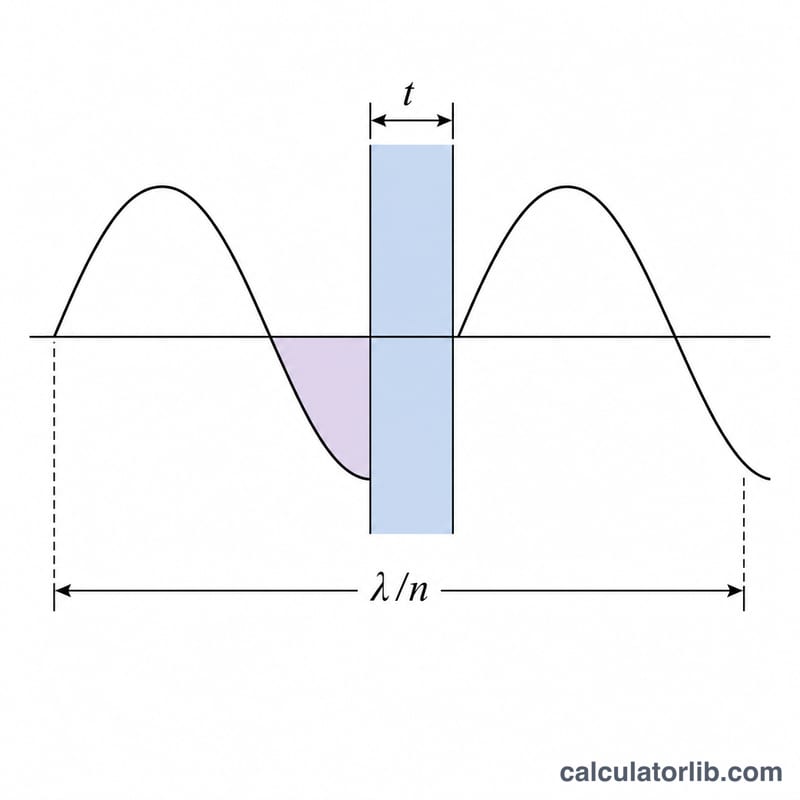
Worked example
For \(\lambda = 550\) nm, \(n = 1.38\) (MgF₂), and \(m = 1\): $$t = \frac{1 \times 550}{4 \times 1.38} = \frac{550}{5.52} \approx 99.64 \text{ nm}.$$ So a single MgF₂ layer about 100 nm thick minimizes reflection at green light. Its optical thickness is \(1.38 \times 99.64 \approx 137.5\) nm \(= 550/4\).
FAQ
Why must the order be odd? Only odd multiples of a quarter wave produce the half-wavelength round-trip phase needed for destructive interference; even multiples behave like an absentee layer.
What refractive index is ideal for a single-layer AR coating? The reflection vanishes completely when \(n_{\text{film}} = \sqrt{n_{\text{substrate}}}\). For glass (\(n \approx 1.5\)), that ideal is about 1.22; MgF₂ at 1.38 is the practical low-index choice.
Can I use this for high-reflector mirror stacks? The same quarter-wave thickness rule applies to each layer in a multilayer dielectric stack, though full stack performance requires transfer-matrix analysis.