
What is critical damping?
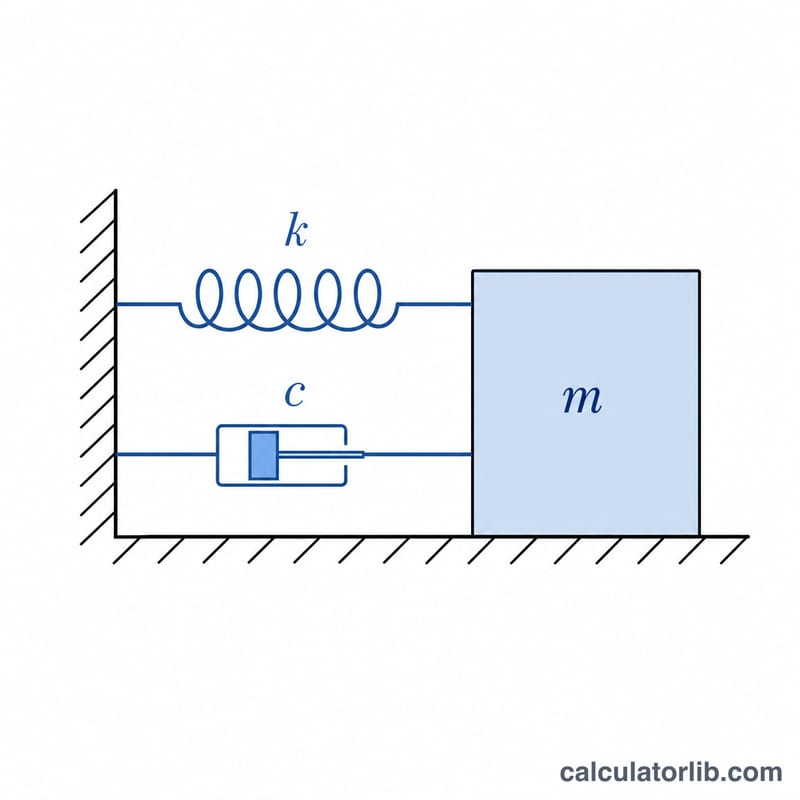
In a vibrating spring-mass-damper system, critical damping is the exact amount of damping that returns the system to equilibrium in the shortest possible time without oscillating. The critical damping coefficient depends on the mass m and the spring stiffness k. This calculator computes that coefficient along with the system's damping ratio and undamped natural frequency.
How to use it
Enter the mass m in kilograms, the stiffness k in newtons per metre, and (optionally) the actual damping coefficient c in N·s/m. The tool returns the critical damping coefficient c꜀, the damping ratio ζ, and the natural frequency ωₙ. Compare ζ to 1 to classify the response.
The formula explained
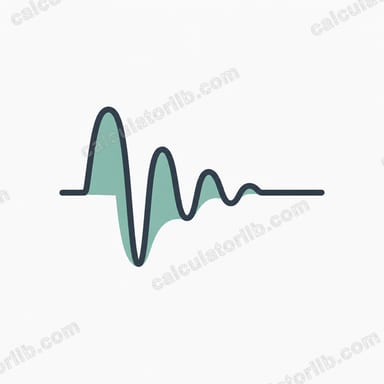
The critical damping coefficient is \(c_c = 2\sqrt{k \cdot m}\). The damping ratio is the actual damping divided by the critical value, \(\zeta = c / c_c\). The undamped natural frequency is \(\omega_n = \sqrt{k/m}\). When \(\zeta < 1\) the system is underdamped and oscillates; \(\zeta = 1\) is critically damped; \(\zeta > 1\) is overdamped and creeps back slowly.
$$c_c = 2\sqrt{\text{Stiffness } k \cdot \text{Mass } m}$$ $$\text{where}\quad \left\{ \begin{aligned} \zeta &= \dfrac{\text{Damping } c}{c_c} \\ \omega_n &= \sqrt{\dfrac{\text{Stiffness } k}{\text{Mass } m}} \end{aligned} \right.$$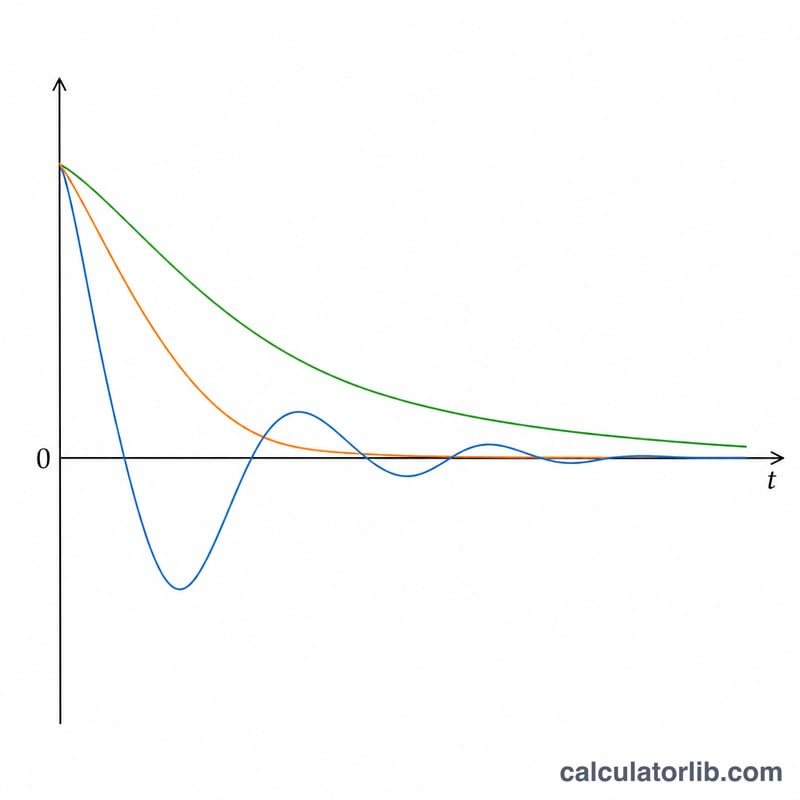
Worked example
For m = 1 kg and k = 100 N/m:
$$c_c = 2\sqrt{100 \times 1} = 2 \times 10 = 20 \ \text{N}\cdot\text{s/m}$$If the actual damping is c = 10 N·s/m, then
$$\zeta = \frac{10}{20} = 0.5$$meaning the system is underdamped. The natural frequency is
$$\omega_n = \sqrt{\frac{100}{1}} = 10 \ \text{rad/s}$$FAQ
What does a damping ratio of 1 mean? The system is critically damped — it settles fastest with no overshoot or oscillation.
Can the mass be zero? No. A zero mass makes the natural frequency and critical damping undefined, so use positive values.
What units should I use? Use consistent SI units (kg, N/m, N·s/m) so the coefficient comes out in N·s/m and frequency in rad/s.