
What this calculator does
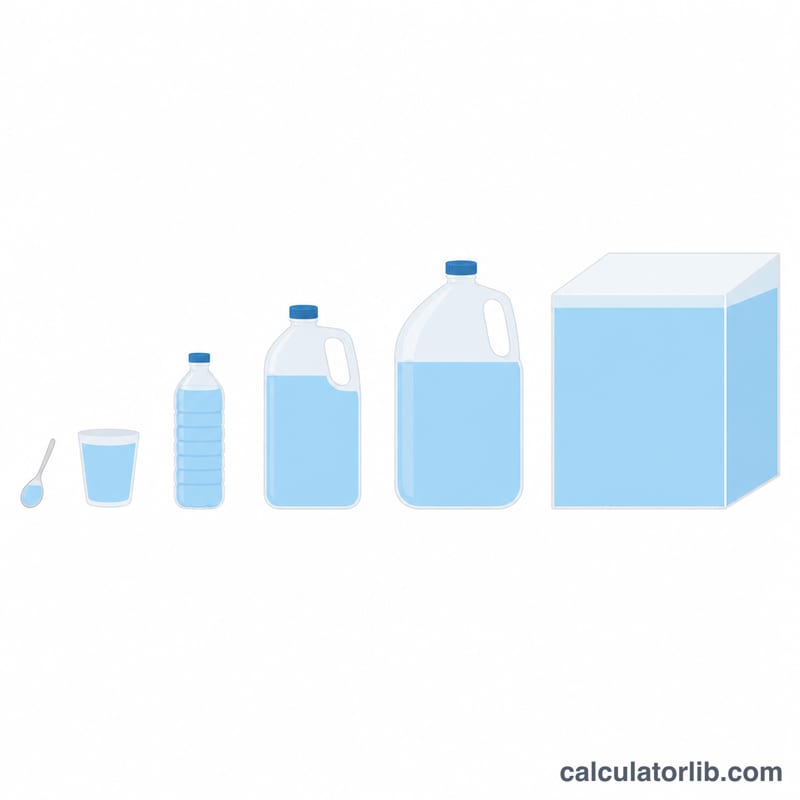
This Volume Conversion Calculator converts a quantity of volume from one unit to another across metric units (cubic meter, liter, milliliter, deciliter, microliter, cubic centimeter), US customary units (fluid and dry gallons, quarts, pints, cups, ounces, gills, tablespoons, teaspoons, barrels, bushels, pecks), Imperial (UK) units, Canadian kitchen units, and special units such as the acre-foot, cord, hogshead and petroleum barrel. It is a universal physics/units tool that works the same everywhere, although it intentionally includes both US and Imperial customary systems, which are different sizes.
How to use it
Enter your Value, pick the From unit and the To unit, and read the converted result. The calculator also shows the equivalent in cubic meters so you can see the intermediate normalization.
The formula explained
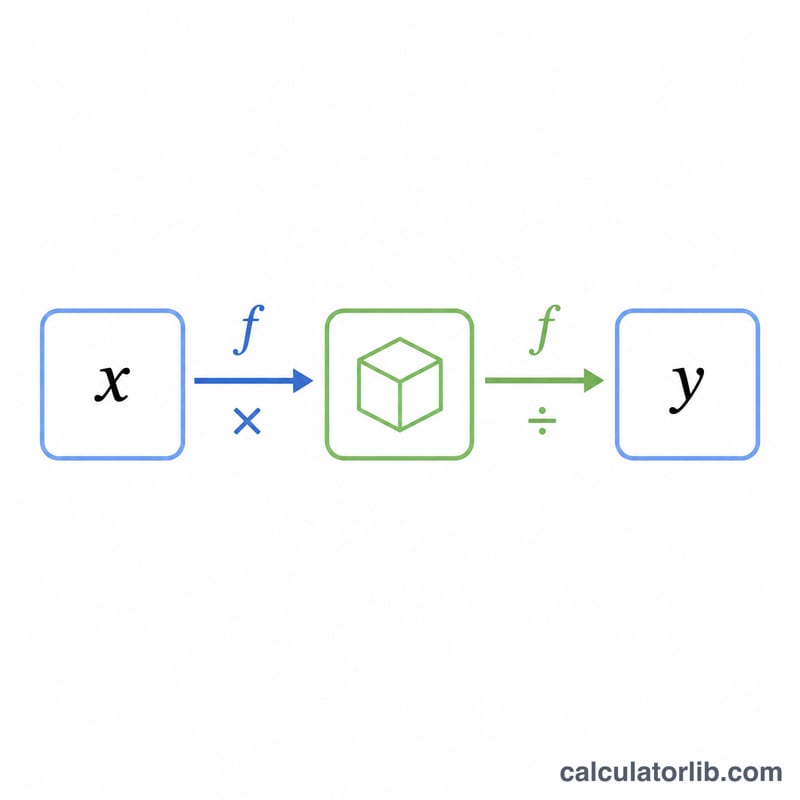
Every unit is stored as a factor equal to its size in cubic meters (the SI base unit for volume). The conversion is a single ratio: $$\text{result} = \text{value} \times \dfrac{f_{\text{from}}}{f_{\text{to}}}$$ First the input is converted to cubic meters (\(\text{value} \times f_{\text{from}}\)), then divided by the To-unit factor. There are no offsets, so converting a unit to itself returns the value unchanged.
Worked example
Convert 1 liter to US fluid gallons. \(f_{\text{liter}} = 0.001\ \text{m}^3\) and \(f_{\text{gallon US fluid}} = 0.003785411784\ \text{m}^3\). So $$\text{result} = 1 \times \frac{0.001}{0.003785411784} = 0.26417205236\ \text{US gallons}$$ matching the well-known fact that 1 US gallon = 3.785411784 liters.
FAQ
Is a US gallon the same as an Imperial (UK) gallon? No. A US fluid gallon is 3.785411784 L while an Imperial gallon is 4.54609 L, about 20% larger. Choose carefully.
What is "cc"? A cubic centimeter, which equals exactly one milliliter (\(1\mathrm{e}{-6}\) cubic meters).
Why are there US fluid and US dry versions? The US system uses separate measures for liquids and dry goods (grains, produce). A US dry quart is larger than a US fluid quart, so always match the variant to your material.