
What Is Stokes' Law?
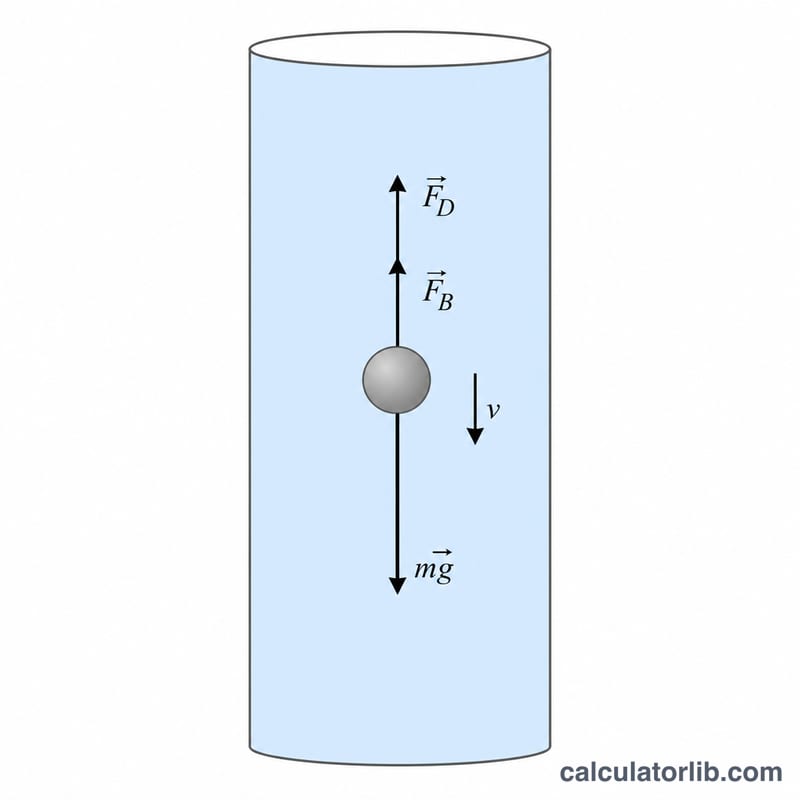
Stokes' Law describes the drag force on a small spherical particle moving slowly through a viscous fluid. When a particle settles under gravity, it quickly reaches a constant terminal (settling) velocity where gravity, buoyancy and drag balance. This calculator solves for that velocity given the particle and fluid properties. It applies to universal physics — no country or jurisdiction restrictions.
The Formula
The terminal velocity is:
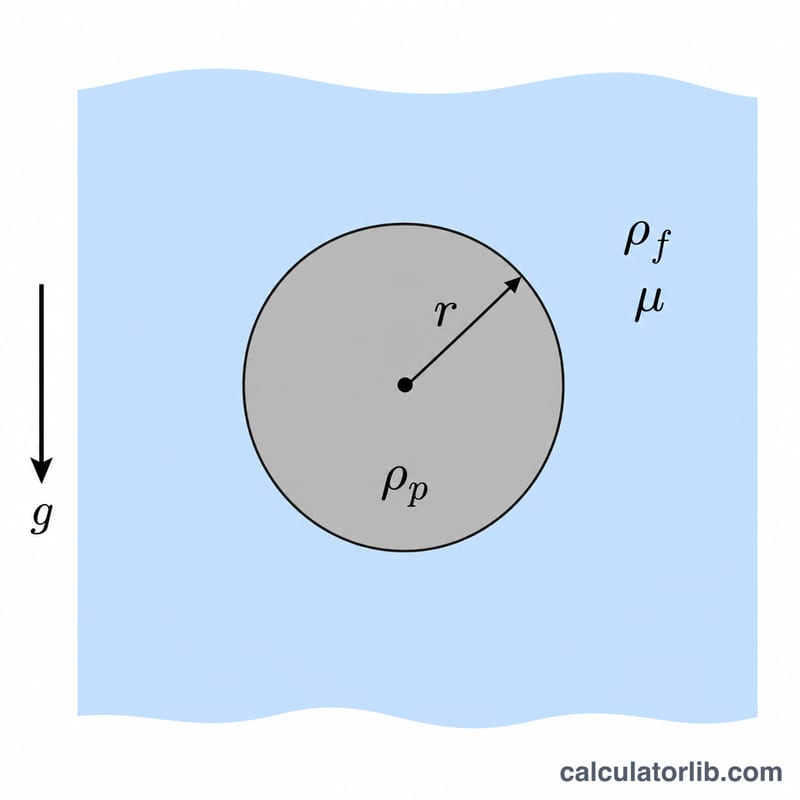
$$v = \frac{2}{9} \cdot \frac{(\rho_p - \rho_f) \cdot g \cdot r^{2}}{\mu}$$where \(\rho_p\) is particle density (kg/m³), \(\rho_f\) is fluid density (kg/m³), \(g\) is gravitational acceleration (m/s²), \(r\) is the particle radius (m), and \(\mu\) is the dynamic viscosity of the fluid (Pa·s). The associated drag force is \(F_d = 6\pi \mu r v\).
How to Use It
Enter the particle density, fluid density, particle radius (in metres), fluid viscosity and the local gravity (9.81 m/s² on Earth). The result gives the settling velocity in m/s. A positive value means the particle sinks; a negative value (when the particle is lighter than the fluid) means it rises.
Worked Example
A sand grain (\(\rho_p = 2500\) kg/m³, \(r = 0.001\) m) settles in water (\(\rho_f = 1000\) kg/m³, \(\mu = 0.001\) Pa·s, \(g = 9.81\)):
$$v = \frac{2}{9} \times \frac{(2500 - 1000) \times 9.81 \times (0.001)^{2}}{0.001} = \frac{0.2222 \times 1500 \times 9.81 \times 1\times10^{-6}}{0.001} \approx 3.27 \text{ m/s}$$(Note: real grains this size exceed the low-Reynolds range, so Stokes' Law overestimates here — it is exact only for very small particles.)
FAQ
When is Stokes' Law valid? Only at low Reynolds numbers (Re < ~1), i.e. small particles, slow speeds and viscous fluids.
Why must radius be in metres? The formula is in SI units; convert microns or millimetres to metres first (1 mm = 0.001 m).
What if the particle is less dense than the fluid? The velocity comes out negative, indicating the particle rises (buoyant) rather than sinks.