
What This Calculator Does
The Water Pressure at Depth Calculator estimates the pressure a fluid exerts at a given depth below its surface. It uses the hydrostatic pressure equation to combine the pressure pushing down from the atmosphere with the weight of the fluid column above the point of interest. This is universally applicable physics — useful for divers, engineers, aquarium designers, students and anyone working with submerged structures.
How to Use It
Enter the depth below the surface in metres, the density of the fluid (1000 kg/m³ for fresh water, about 1025 kg/m³ for seawater), the local gravitational acceleration (9.81 m/s² on Earth) and the atmospheric pressure at the surface (101,325 Pa at sea level). The calculator returns the absolute pressure in pascals, plus handy conversions to kilopascals and atmospheres, and the gauge pressure (the part contributed by the water alone).
The Formula Explained
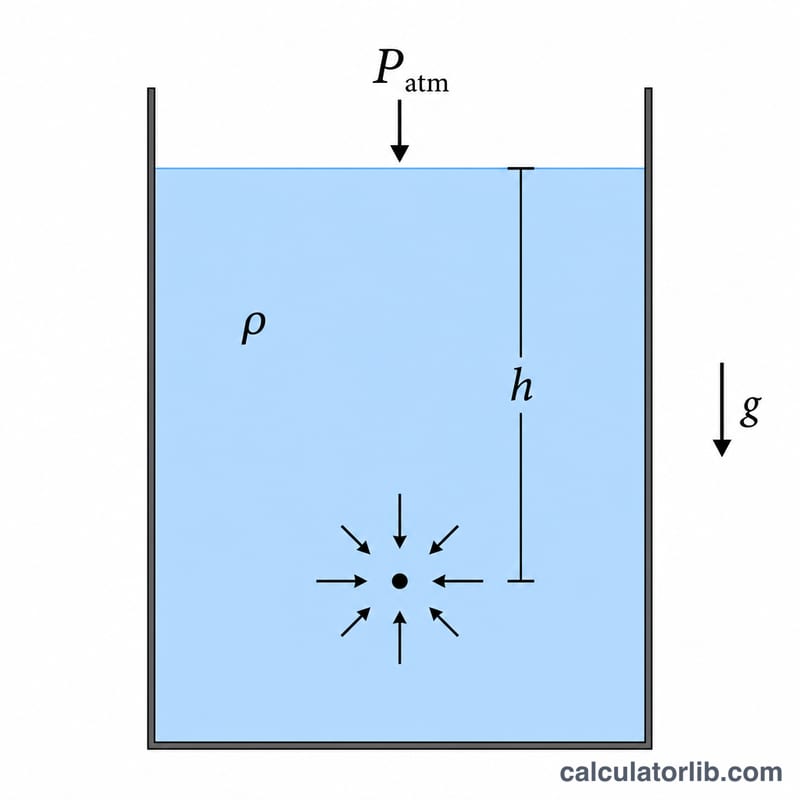
The governing relationship is $$P = P_{atm} + \rho g h$$ where \(P\) is absolute pressure, \(P_{atm}\) is surface atmospheric pressure, \(\rho\) is fluid density, \(g\) is gravitational acceleration and \(h\) is depth. The term \(\rho g h\) is the hydrostatic or gauge pressure — it grows linearly with depth. Pressure increases by roughly 9,810 Pa (about 0.097 atm) for every metre of fresh water, so depth dominates quickly.
Worked Example
A diver is 10 m deep in fresh water. With \(\rho = 1000\ \text{kg/m}^3\), \(g = 9.81\ \text{m/s}^2\) and \(h = 10\ \text{m}\), the gauge pressure is $$1000 \times 9.81 \times 10 = 98{,}100\ \text{Pa}.$$ Adding atmospheric pressure of 101,325 Pa gives an absolute pressure of 199,425 Pa, equal to about 199.4 kPa or roughly 1.97 atmospheres.
FAQ
What is the difference between gauge and absolute pressure? Gauge pressure ignores the atmosphere and measures only the water column (\(\rho g h\)). Absolute pressure adds atmospheric pressure on top.
Does shape or surface area matter? No. Hydrostatic pressure depends only on depth, fluid density and gravity — not on the shape or width of the container.
Can I use it for seawater? Yes — just set the density to about 1025 kg/m³ for typical seawater, which gives slightly higher pressures than fresh water.