
What It Is
When water is pumped or piped uphill, every foot of vertical rise costs pressure. This calculator converts a vertical elevation change into the static pressure loss measured in pounds per square inch (psi). The constant 0.433 psi per foot is the pressure exerted by a one-foot column of fresh water at standard conditions.
How to Use It
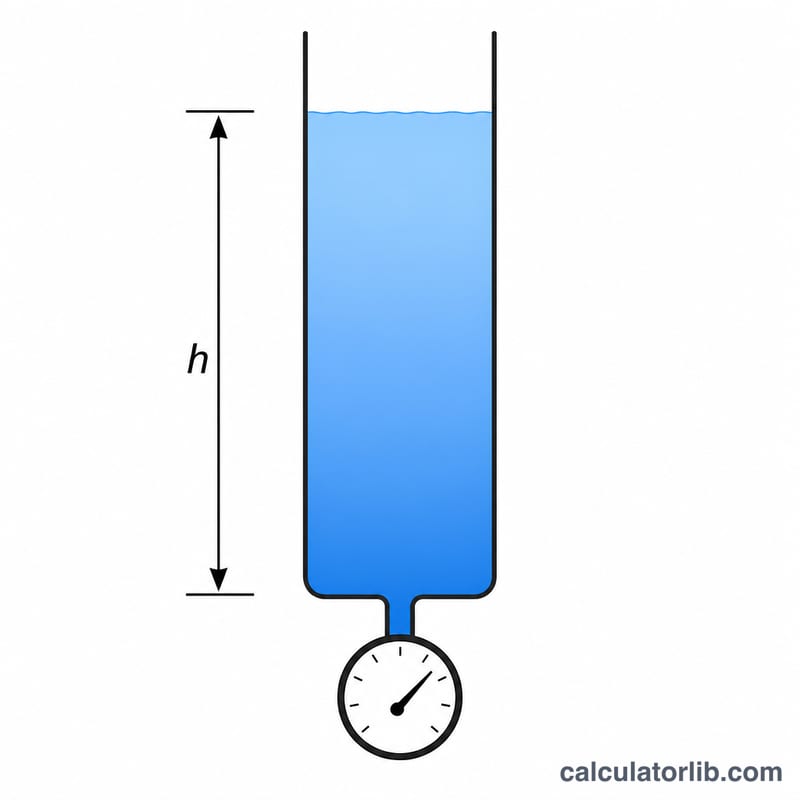
Enter the vertical elevation change in feet (the difference in height between the inlet and outlet, ignoring horizontal run). Enter the specific gravity of the fluid: use 1.0 for fresh water, slightly higher for salt water or denser liquids. The calculator returns the pressure loss in psi, the equivalent head in feet, and the value converted to bar.
The Formula Explained
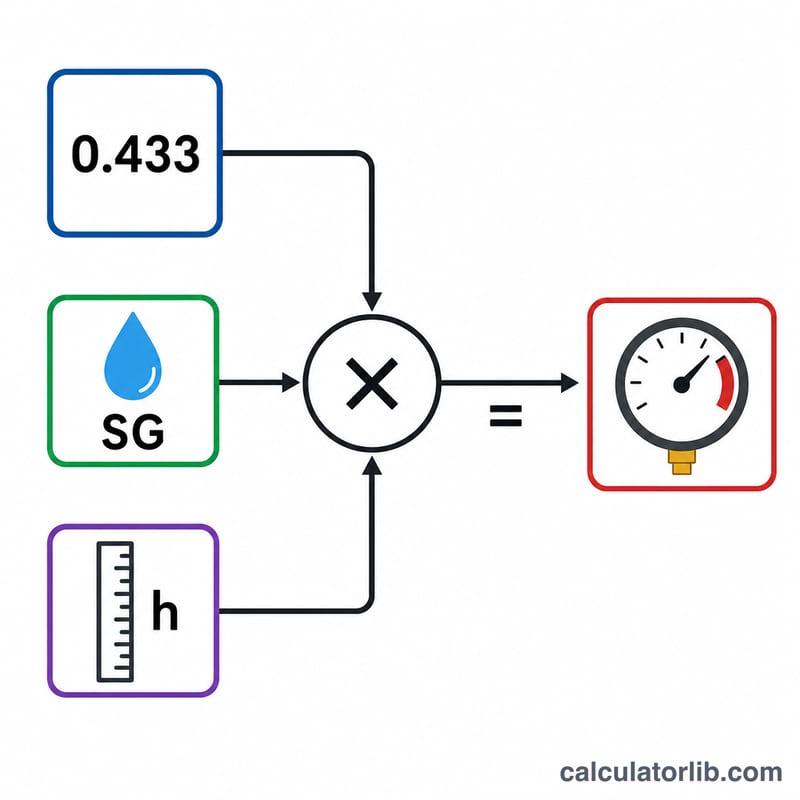
The governing equation is $$\Delta P = 0.433 \times \text{SG} \times h,$$ where 0.433 comes from dividing the density of water (62.4 lb/ft³) by 144 in² per ft². Each vertical foot of water adds 0.433 psi at the bottom. Multiplying by specific gravity scales the result for fluids heavier or lighter than water.
Worked Example
Suppose you need to lift water 150 feet up a hill with specific gravity 1.0. The pressure loss is $$0.433 \times 1.0 \times 150 = 64.95 \text{ psi}.$$ A pump at the bottom must overcome this static head before accounting for friction losses, so it needs at least ~65 psi just to reach the top with zero residual pressure.
FAQ
Why 0.433 and not 0.434? The exact figure depends on water temperature and density; 0.433 psi/ft (and its inverse 2.31 ft/psi) is the widely used engineering standard for fresh water at typical temperatures.
Does this include friction loss? No. This is static head only. Total pump pressure must also account for pipe friction, fittings, and any required residual pressure at the outlet.
What about pressure gain going downhill? The same magnitude applies as a gain. Dropping water 100 ft adds about 43.3 psi at the lower point.