
What Is Density Altitude?
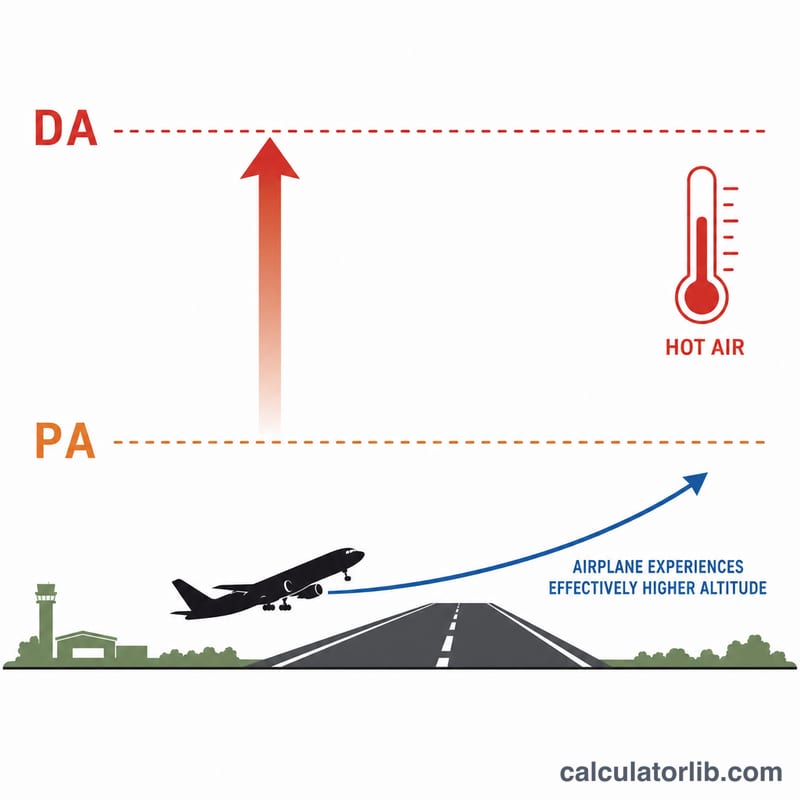
Density altitude is the pressure altitude corrected for non-standard temperature — in other words, the altitude at which the air density equals the actual local air density. Aircraft, engines, and propellers all perform according to the density of the air, not the height shown on the altimeter. On a hot day at a high-elevation airport the air can be so thin that the airplane behaves as though it were thousands of feet higher, lengthening takeoff rolls and reducing climb performance.
How to Use This Calculator
Enter your field elevation in feet, the current altimeter setting in inches of mercury (inHg), and the outside air temperature (OAT) in degrees Celsius. The calculator first converts elevation and altimeter setting into pressure altitude, then applies the temperature correction to produce density altitude. It also shows the standard ISA temperature for that pressure altitude so you can see how far above or below standard conditions you are.
The Formula Explained
Pressure altitude is found by adding 1,000 ft for each inHg the altimeter setting falls below the standard 29.92 inHg:
$$\text{PA} = \text{Elevation} + \left(29.92 - \text{Altimeter}\right)\times 1000$$The ISA temperature at that altitude is 15 °C minus a lapse rate of about 1.98 °C per 1,000 ft. Density altitude then applies the rule of thumb that every degree above ISA raises effective altitude by roughly 120 ft:
$$\text{DA} = \text{PA} + 120\times\left(\text{OAT} - \text{ISA}\right)$$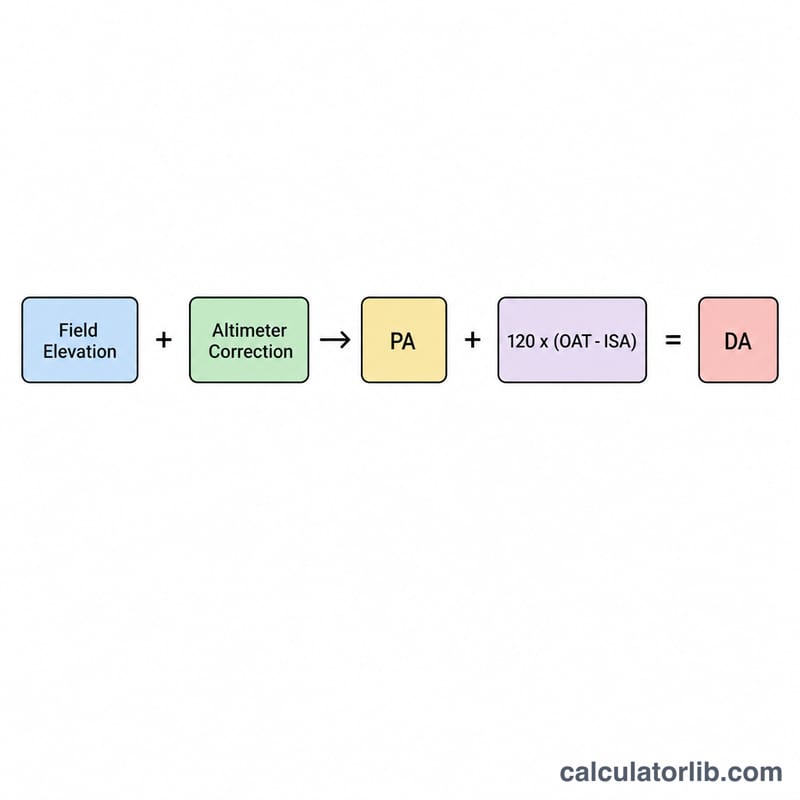
Worked Example
At a field elevation of 5,000 ft with a standard altimeter setting of 29.92 inHg, pressure altitude equals 5,000 ft. ISA at 5,000 ft is \(15 - 1.98 \times 5 = 5.1\) °C. With an OAT of 25 °C,
$$\text{DA} = 5{,}000 + 120 \times \left(25 - 5.1\right) = 5{,}000 + 2{,}388 = 7{,}388\ \text{ft}$$— nearly 2,400 ft higher than the airport elevation.
FAQ
Is this an exact value? No — it is the standard pilot rule-of-thumb approximation, accurate enough for performance planning but not a precise atmospheric model.
Does humidity matter? High humidity slightly increases density altitude, but this simplified formula ignores moisture.
Why does high density altitude matter? Thin air reduces lift, thrust, and engine power, so takeoff distance increases and climb rate decreases.