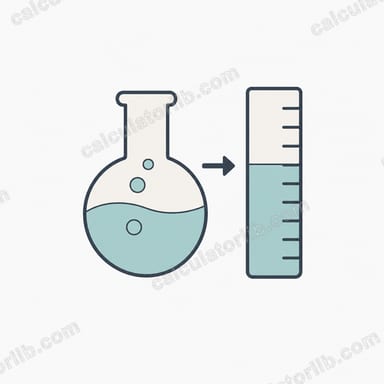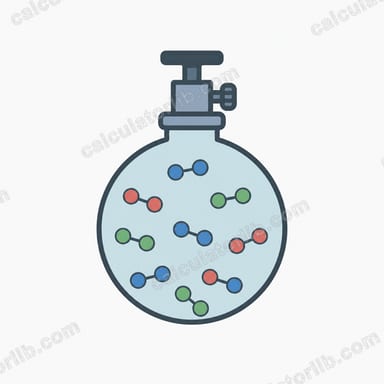

What This Calculator Does
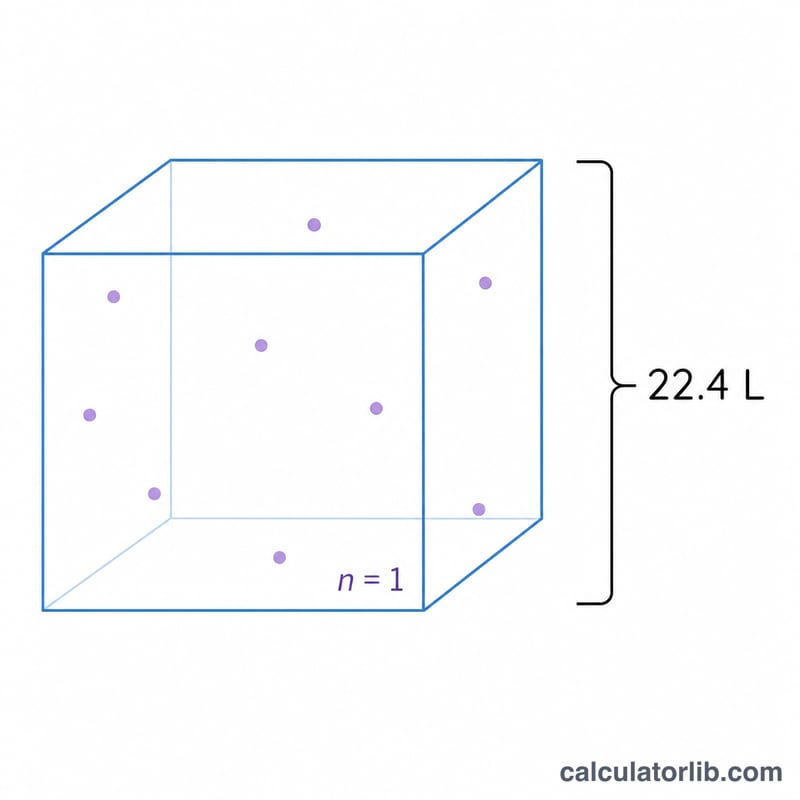
This tool converts an amount of gas measured in moles (n) into its volume in liters (V). It uses the molar volume of an ideal gas, which is 22.4 liters per mole at STP (Standard Temperature and Pressure: 0°C and 1 atm). You can also switch to 24.0 L/mol if you are working at room temperature (about 25°C).
How to Use It
Enter the number of moles of gas you have, then enter the molar volume. Leave the molar volume at 22.4 for standard STP problems. Press calculate and the tool returns the gas volume in liters. This shortcut works because, under Avogadro law, equal volumes of any ideal gas at the same temperature and pressure contain equal numbers of molecules.
The Formula Explained
The relationship is simply $$V = n \times V_m$$ where \(V\) is volume in liters, \(n\) is the amount in moles, and \(V_m\) is the molar volume (22.4 L/mol at STP). It is derived from the ideal gas law \(PV = nRT\) evaluated at 273.15 K and 1 atm, which yields a molar volume of 22.414 L/mol, commonly rounded to 22.4.
Worked Example
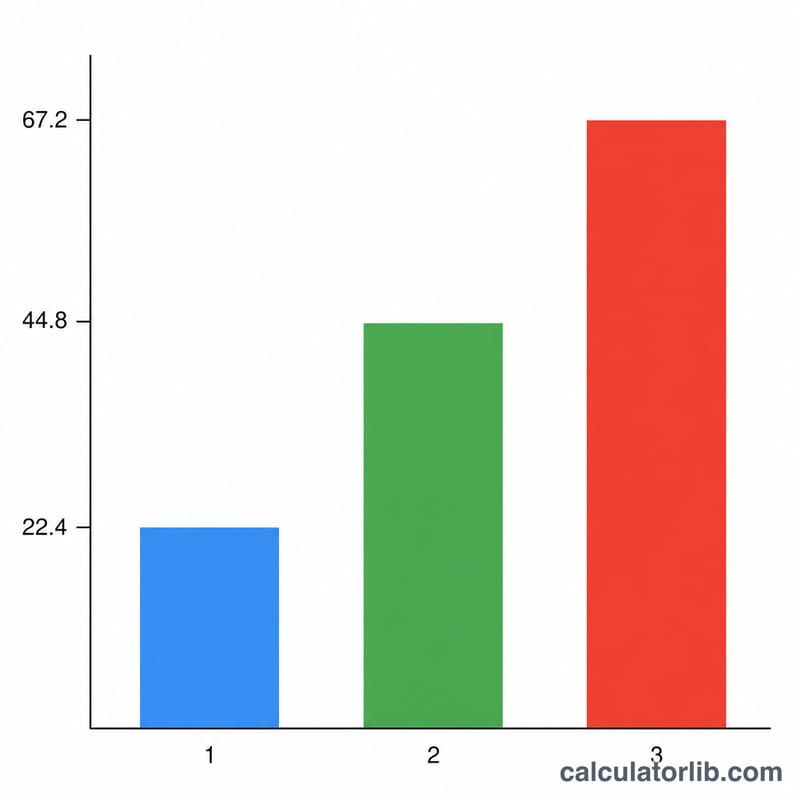
Suppose you have 2 moles of oxygen gas at STP. $$\text{Volume} = 2 \times 22.4 = 44.8 \text{ liters}$$ For 0.5 moles of carbon dioxide at STP: $$0.5 \times 22.4 = 11.2 \text{ liters}$$
FAQ
Why 22.4 L/mol? That is the volume one mole of any ideal gas occupies at 0°C and 1 atm pressure.
Does this work for real gases? It is an approximation. Real gases deviate slightly, but for most homework and lab estimates 22.4 L/mol is accurate enough.
What if my conditions are not STP? Use the ideal gas law \(V = nRT/P\) directly, or enter a molar volume that matches your temperature and pressure (e.g. 24.0 L/mol near 25°C).