
What Is Kinematic Viscosity?
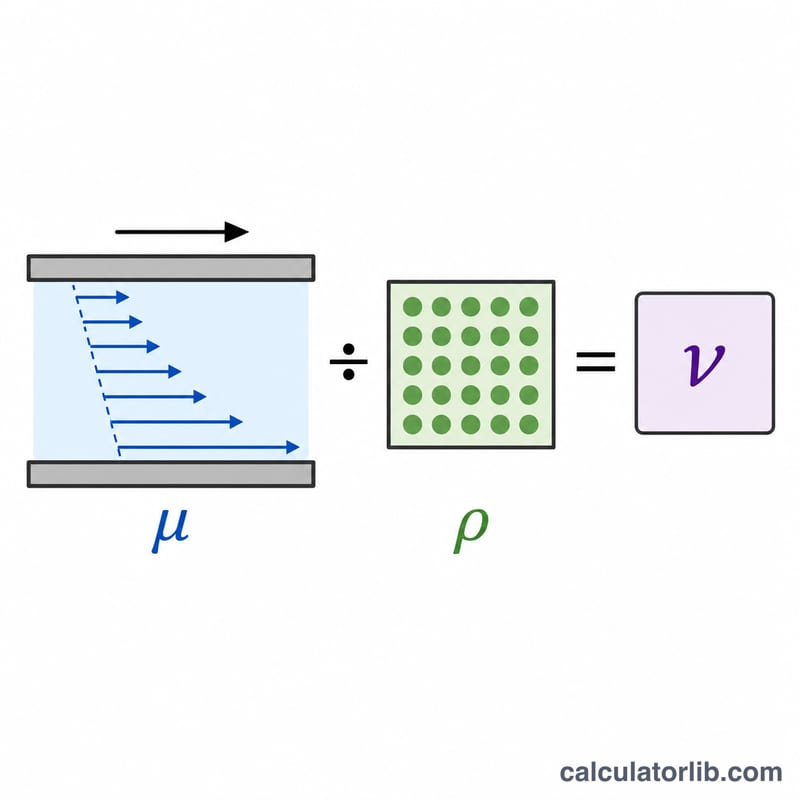
Kinematic viscosity (\(\nu\), the Greek letter nu) measures a fluid resistance to flow under the influence of gravity, accounting for its density. It is defined as the ratio of dynamic (absolute) viscosity \(\mu\) to density \(\rho\). Where dynamic viscosity describes a fluid internal friction directly, kinematic viscosity reflects how readily a fluid flows given its mass. The SI unit is the square metre per second (m²/s), though the Stokes (St) and centistokes (cSt) are widely used in engineering and lubricant specifications.
How to Use This Calculator
Enter the dynamic viscosity \(\mu\) in pascal-seconds (Pa·s) and the density \(\rho\) in kilograms per cubic metre (kg/m³). The calculator divides \(\mu\) by \(\rho\) and reports the kinematic viscosity in m²/s, along with automatic conversions to Stokes and centistokes. This tool is universal and applies to any Newtonian fluid regardless of region.
The Formula Explained
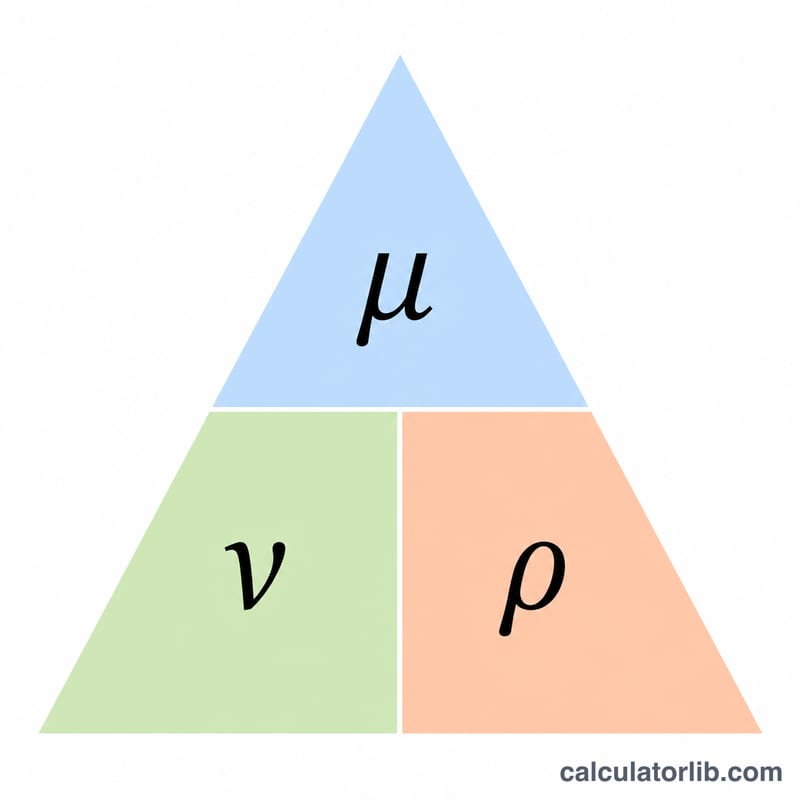
The governing equation is $$\nu = \dfrac{\mu}{\rho}$$ For example, water at 20 °C has a dynamic viscosity of about 0.001 Pa·s and a density of 1000 kg/m³, giving \(\nu = 0.001 / 1000 = 0.000001\ \text{m}^2/\text{s}\), or 1 cSt. Because $$1\ \text{m}^2/\text{s} = 10^{4}\ \text{St} = 10^{6}\ \text{cSt}$$ the conversions are simple multiplications.
Worked Example
A light oil has \(\mu = 0.085\ \text{Pa}\cdot\text{s}\) and \(\rho = 850\ \text{kg/m}^3\). Then $$\nu = \frac{0.085}{850} = 0.0001\ \text{m}^2/\text{s} = 1\ \text{St} = 100\ \text{cSt}$$
FAQ
What is the difference between dynamic and kinematic viscosity? Dynamic viscosity (\(\mu\)) measures internal friction; kinematic viscosity (\(\nu\)) is dynamic viscosity divided by density, capturing flow under gravity.
What units should I use? Use Pa·s for \(\mu\) and kg/m³ for \(\rho\) to get \(\nu\) in m²/s. The tool also shows St and cSt.
Why is density in the denominator? Denser fluids resist motion more for a given internal friction, so dividing by density isolates the gravity-driven flow behaviour.