
What is the Dynamic Viscosity Conversion Calculator?
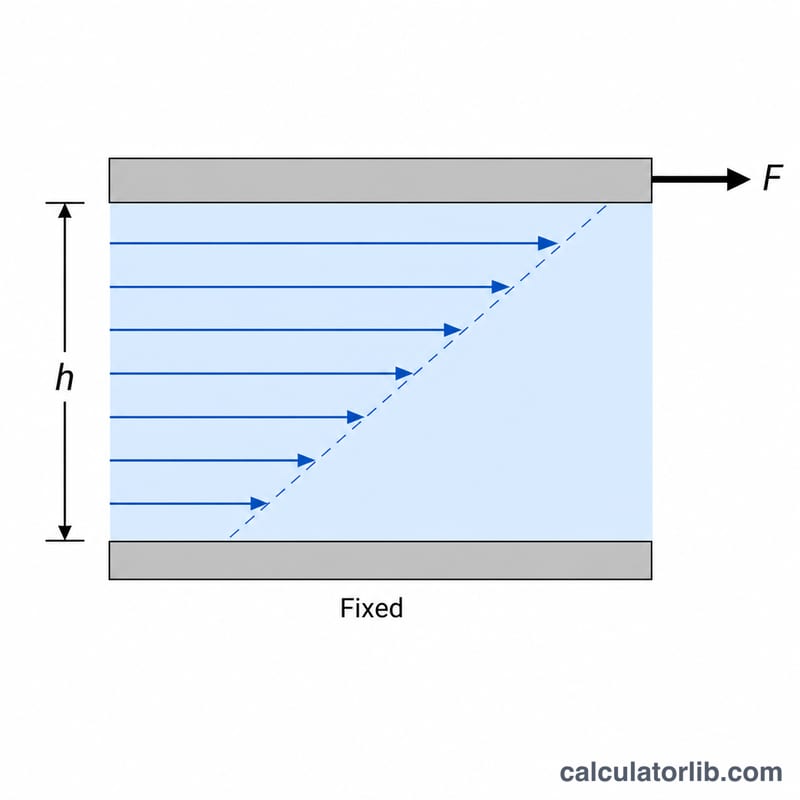
Dynamic (also called absolute) viscosity measures a fluid's internal resistance to flow under an applied shear stress. Its SI unit is the pascal-second (Pa.s). This tool converts a single viscosity value into every common SI, CGS and gravitational/imperial unit at once, so you can read mPa.s, centipoise, poise, kgf.s/cm2 and reyn (lbf.s/in2) side by side. Viscosity units are universal, so the calculator works the same everywhere in the world.
How to use it
Enter your viscosity value, choose the unit it is expressed in from the dropdown, and submit. The result table lists the equivalent value in all supported units. Note this is dynamic viscosity only - it is not kinematic viscosity (Stokes or m2/s), which divides by density and is a separate calculation.
The formula
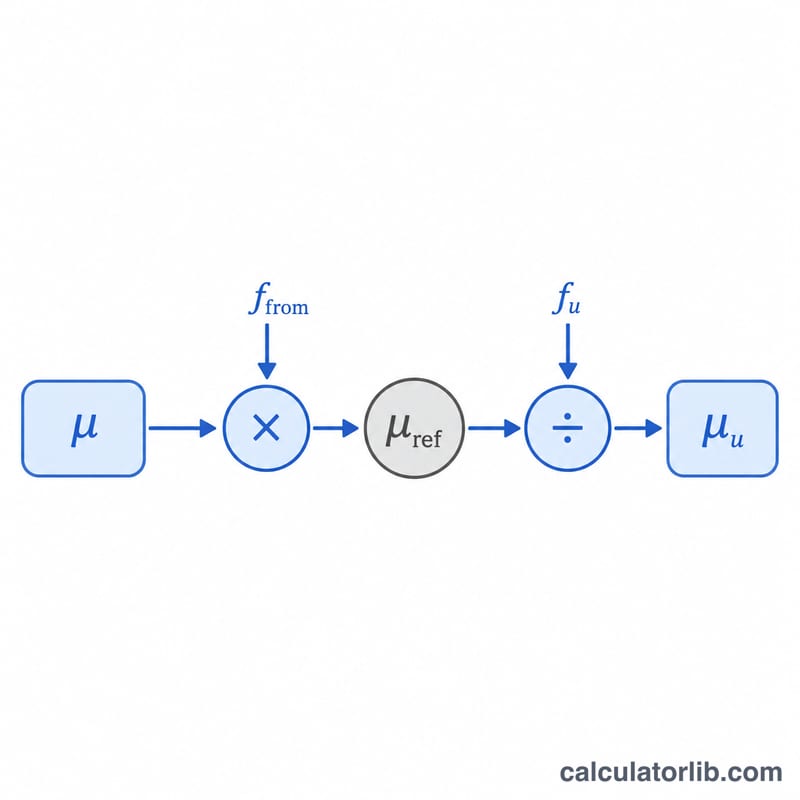
Each unit has a fixed factor that converts it to the SI base unit Pa.s. First the input is normalized: \(S = \text{viscosity} \times \text{factor}(\text{fromUnit})\). Then every output is \(S / \text{factor}(\text{targetUnit})\). The full conversion is:
$$\text{Value}_{\text{target}} = \text{Viscosity} \times \frac{f_{\text{From Unit}}}{f_{\text{target}}}$$Several units are numerically identical because they share a factor: Pa.s = kg/(m.s) = N.s/m2, and cP = mPa.s = g/(m.s), and P = dyn.s/cm2.
Worked example
Enter viscosity = 1 in millipascal-second (mPa.s). Normalizing gives:
$$S = 1 \times 10^{-3} = 0.001 \ \text{Pa}\cdot\text{s}$$The outputs are: 1000 uPa.s, 1 mPa.s, 0.001 Pa.s, 10 mP, 1 cP, 0.01 P, 1 g/(m.s), 0.001 kg/(m.s), 0.001 N.s/m2, 0.01 dyn.s/cm2, about \(1.0197 \times 10^{-8}\) kgf.s/cm2, about \(2.0885 \times 10^{-5}\) lbf.s/ft2 and about \(1.4504 \times 10^{-7}\) lbf.s/in2.
FAQ
Is centipoise the same as millipascal-second? Yes, exactly: 1 cP = 1 mPa.s = 1 g/(m.s). Water at about 20 C is roughly 1 cP.
What is a reyn? The reyn is the pound-force-second per square inch (lbf.s/in2), an imperial viscosity unit used in lubrication engineering; 1 reyn is about 6894.76 Pa.s.
Can I enter a negative value? The math is linear so it will compute, but a negative dynamic viscosity has no physical meaning.