
What is the HBP per 9 Innings rate?
Hit-by-pitch rate per nine innings (HBP/9) is a standard baseball pitching statistic that measures how often a pitcher hits opposing batters, scaled to a full regulation game of nine innings. It is analogous to ERA (earned run average) but counts batters hit by a pitch instead of earned runs. Lower numbers are better: a pitcher with a low HBP/9 keeps better control and puts fewer free runners on base. This is a universal baseball metric used wherever the game is played.
How to use this calculator
Enter the whole innings pitched, choose any partial inning from the dropdown (0, 1/3 for one out, or 2/3 for two outs), and enter the total number of batters hit by a pitch. The calculator combines the whole and partial innings into total innings pitched, then applies the per-nine formula. Innings in baseball are recorded as whole innings plus thirds, because each out advances the count by one-third of an inning.
The formula explained
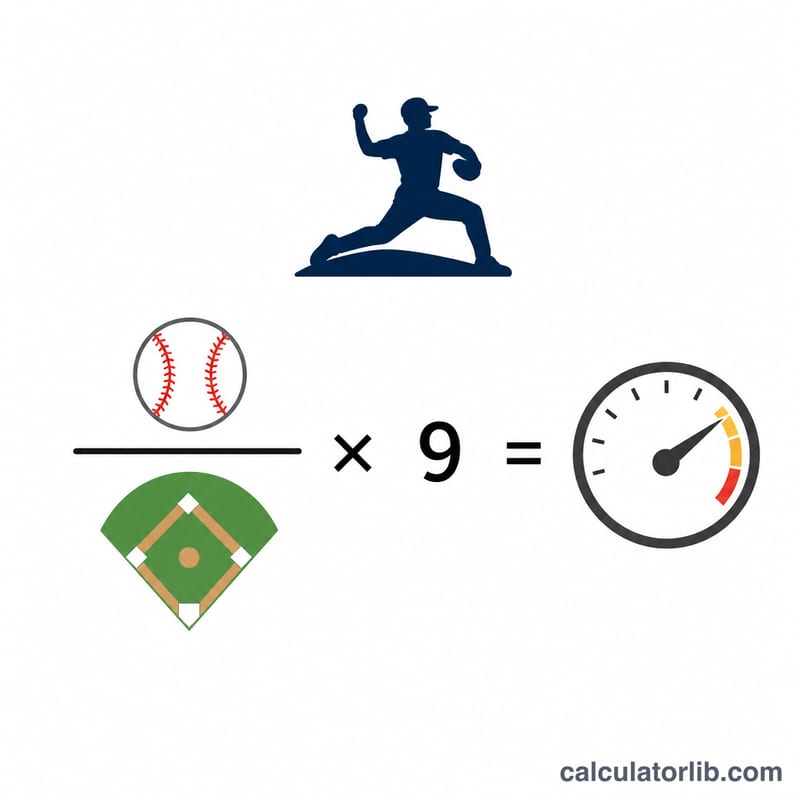
The rate is $$\text{HBP/9} = \frac{\text{Hit Batters}}{\text{Innings} + \text{Outs}} \times 9$$ Total innings pitched equals the whole innings plus the fractional value of any outs recorded in an incomplete inning. The multiplier 9 reflects a regulation game length of nine innings, so the result expresses how many batters the pitcher would be expected to hit over a complete game at the current pace.
Worked example
Suppose a pitcher has thrown 15 whole innings, no partial inning, and has hit 2 batters. Total innings pitched = 15. $$\text{HBP/9} = 2 \div 15 \times 9 = 18 \div 15 = 1.20$$ The pitcher hits roughly 1.20 batters per nine innings. With 20 2/3 innings (20.667) and 3 hit batters, \(\text{HBP/9} = 3 \div 20.667 \times 9 \approx 1.31\).
Interpreting Your HBP/9 Result
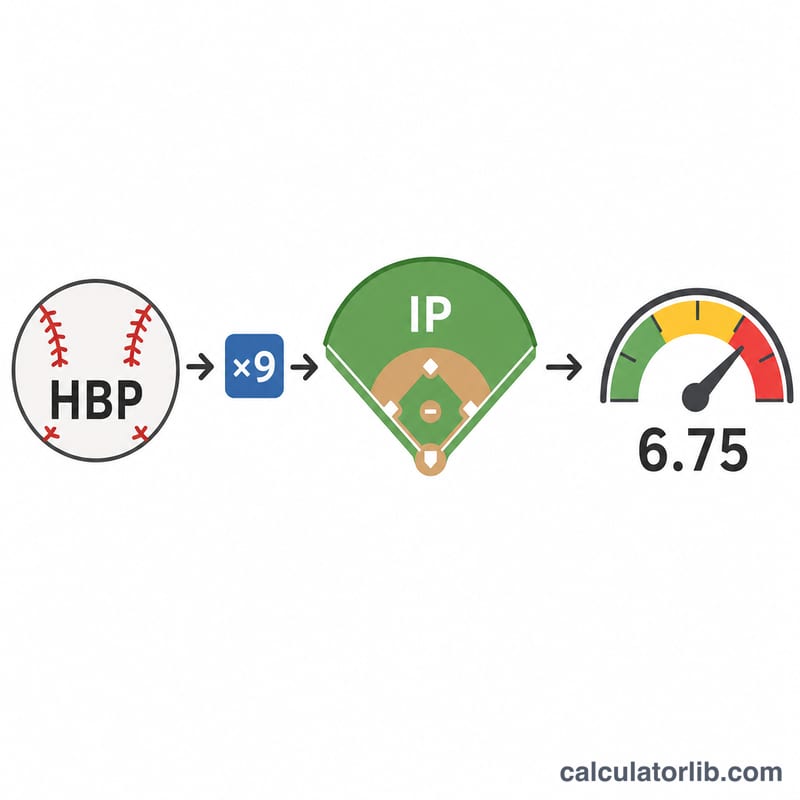
HBP/9 expresses how many batters a pitcher hits by pitch per nine innings of work, using the same per-nine framework as ERA, BB/9 and K/9. It is computed as:
$$\text{HBP/9} = \frac{\text{Hit Batters}}{\text{Innings Pitched}} \times 9$$
Lower is better. Unlike strikeout rate, where high values are good, hitting batters reflects control problems, so a small HBP/9 is the desirable outcome. Because hit-by-pitches are far less frequent than walks or strikeouts, the scale is compressed: a typical pitcher posts an HBP/9 well under 1.0, whereas BB/9 commonly sits between 2 and 4 and K/9 between 7 and 11. A reading of around 0.4 is roughly league-average, while values comfortably below 0.3 indicate strong command and figures above 0.8 suggest a pitcher who works inside aggressively or struggles to locate.
Keep sample size in mind. Because HBPs are rare events, small innings totals produce volatile, unreliable rates. A reliever who hits 1 batter in 6 innings shows an HBP/9 of 1.50, which looks alarming but reflects a single event over a tiny workload rather than a true skill level. Rates only stabilize over a full season's worth of innings, so interpret short-sample HBP/9 cautiously and lean on larger samples before drawing conclusions.
HBP/9 Reference Values
The ranges below reflect typical major-league norms. Because hit batters are uncommon, the entire scale is narrow — even "high" values stay under roughly one hit batter per nine innings.
| HBP/9 Range | Label | What It Suggests |
|---|---|---|
| Under 0.30 | Excellent | Pitch-to-contact or fine command; rarely plunks hitters. |
| 0.30 – 0.40 | Above average | Solid control, slightly better than the league norm. |
| 0.40 – 0.50 | Average | Around the typical MLB rate for starters and relievers. |
| 0.50 – 0.80 | Below average | Works inside aggressively or has occasional command lapses. |
| Over 0.80 | Control concern | Hits batters frequently; potential location or approach issue. |
These bands are guidelines, not hard cutoffs. Pitchers who deliberately pound the inside corner can carry an elevated HBP/9 while still being effective overall.
FAQ
What counts as a partial inning? Each out recorded in an unfinished inning equals one-third of an inning, so 1 out is 1/3 and 2 outs is 2/3.
Is a lower HBP/9 better? Yes. A lower value means the pitcher hits fewer batters per nine innings, indicating better control.
Is this the same as walks per nine? No. This statistic counts batters hit by a pitch (HBP), not walks (bases on balls). They are separate metrics.