
What is kinematic viscosity?
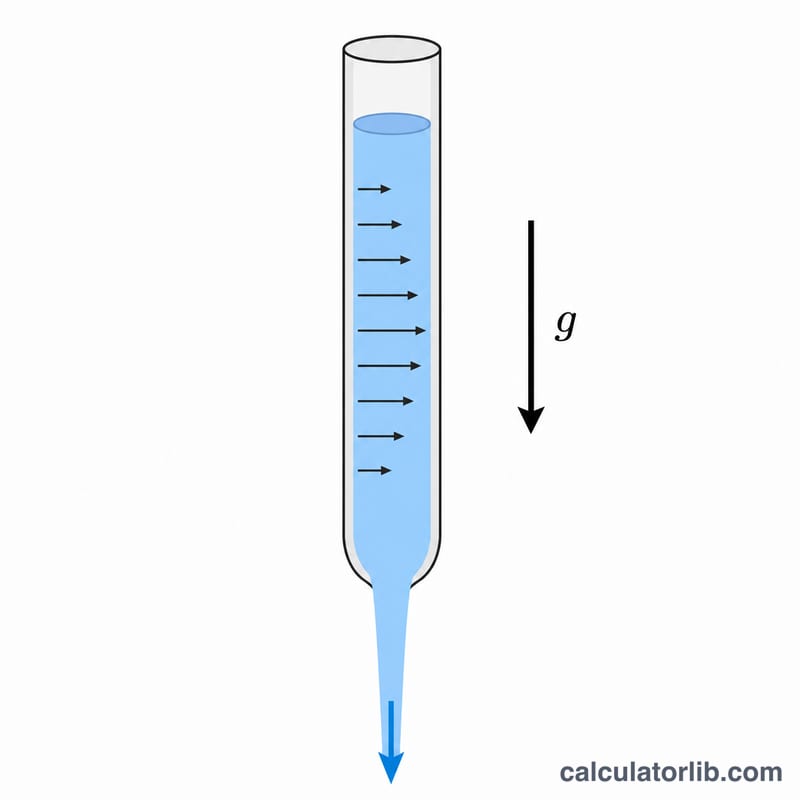
Kinematic viscosity measures a fluid's resistance to flow under gravity. It is defined as the dynamic (absolute) viscosity divided by the fluid's density, so its dimensions are area per time. The SI unit is the square metre per second (m2/s), but engineers commonly work in Stokes (St) and centistokes (cSt) from the CGS system, while imperial fields use square inch per second (in2/s) and square foot per second (ft2/s). This calculator is a universal physics and engineering unit conversion - no regional rules apply.
How to use it
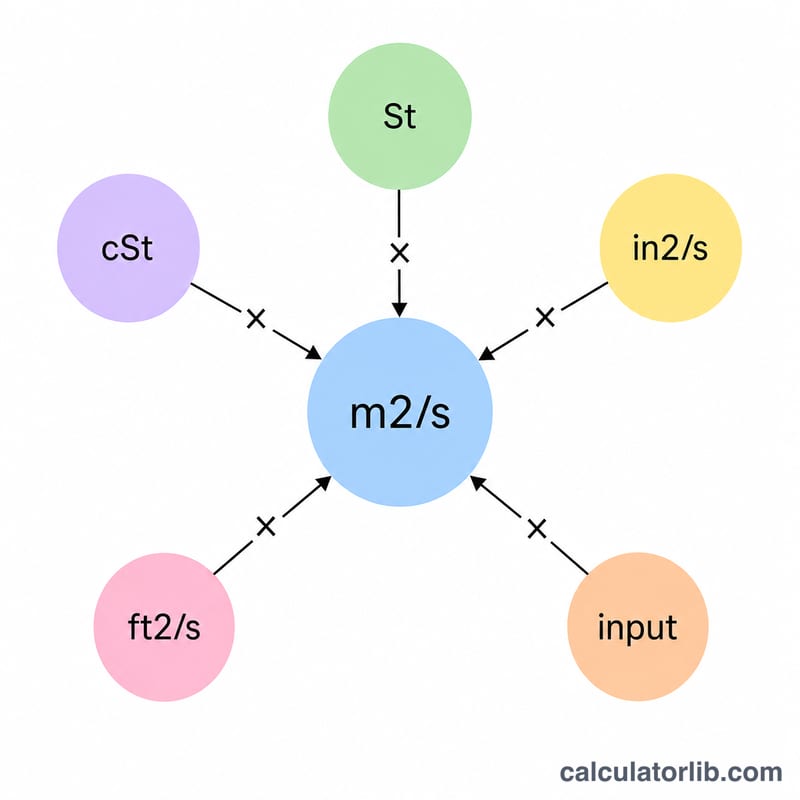
Enter the magnitude of your kinematic viscosity in the "Kinematic viscosity" box, then pick the unit it is currently expressed in from the "Input unit" dropdown. The calculator normalizes your value to the SI base unit and instantly displays the equivalent value in all five supported units side by side, grouped by metric and imperial systems.
The formula explained
Each unit has a factor that converts it to m2/s. The tool first computes the SI value as value × factor(input unit), then for every output it divides that SI value by the target unit's factor: output = (value × f_in) / f_U. The key factors are: $$\nu_{\text{SI}} = \text{Value} \times f \qquad f = \begin{cases} 1 & \text{m}^2/\text{s} \\ 10^{-4} & \text{St} \\ 10^{-6} & \text{cSt} \\ 6.4516\times10^{-4} & \text{in}^2/\text{s} \\ 0.09290304 & \text{ft}^2/\text{s} \end{cases}$$ m2/s = 1, St = 1e-4, cSt = 1e-6, in2/s = 6.4516e-4, ft2/s = 0.09290304. The reference identity is \(1\ \text{m}^2/\text{s} = 10{,}000\ \text{St} = 1{,}000{,}000\ \text{cSt} = 1550.0031\ \text{in}^2/\text{s} = 10.76391\ \text{ft}^2/\text{s}\).
Worked example
Convert 50 cSt to other units. The SI value is $$50 \times 10^{-6} = 5\times10^{-5}\ \text{m}^2/\text{s}.$$ That gives \(0.5\) St, \(50\) cSt, \(5\times10^{-5}\) m2/s, about \(0.0775\) in2/s and about \(0.000538\) ft2/s. With the default value of \(1\) m2/s you get exactly \(10{,}000\) St, \(1{,}000{,}000\) cSt, \(1550.0031\) in2/s and \(10.76391\) ft2/s.
FAQ
What is the difference between Stokes and centistokes? One Stokes equals 100 centistokes; cSt is convenient because the kinematic viscosity of water at 20 C is about 1 cSt.
Can I enter a negative value? The math preserves the sign, but real kinematic viscosity is never negative - physically meaningful inputs should be zero or greater.
How do I convert dynamic to kinematic viscosity? Divide the dynamic viscosity by the fluid density. This tool only converts between kinematic viscosity units; it does not perform the dynamic-to-kinematic step.