
What Is Kinematic Viscosity?
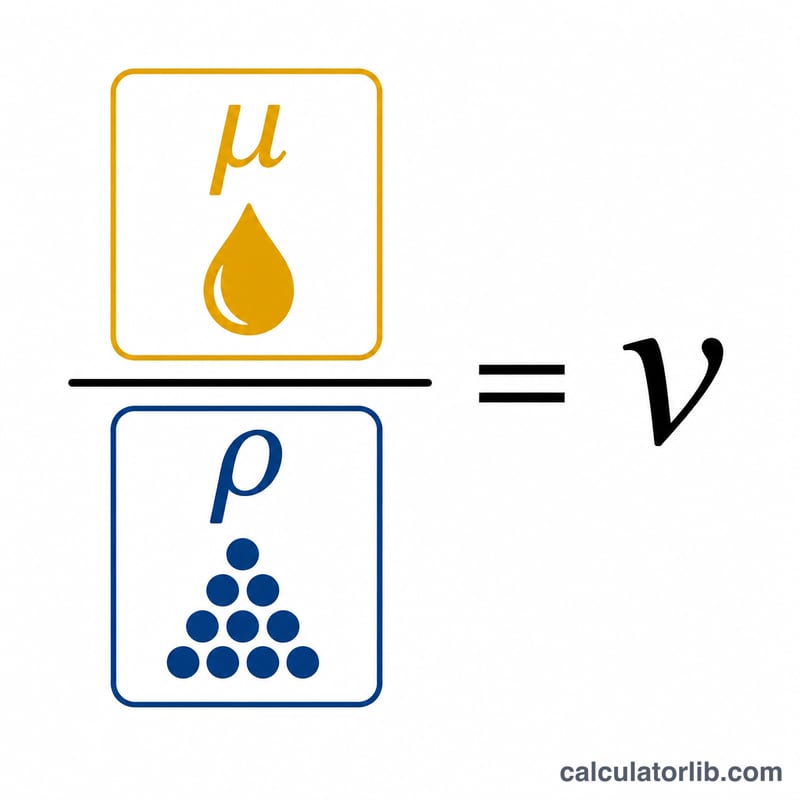
Kinematic viscosity (\(\nu\)) describes a fluid's resistance to flow under the influence of gravity, accounting for its density. It is defined as the ratio of dynamic (absolute) viscosity \(\mu\) to density \(\rho\). For air, this property is essential in aerodynamics, HVAC design, and any calculation involving the Reynolds number. This universal calculator works for any fluid, but the default values are tuned for air at standard conditions.
How to Use This Calculator
Enter the dynamic viscosity \(\mu\) in pascal-seconds (\(\text{Pa}\cdot\text{s}\)) and the air density \(\rho\) in kilograms per cubic meter (\(\text{kg/m}^3\)). The calculator returns kinematic viscosity in SI units (\(\text{m}^2/\text{s}\)) and also converts it to centistokes (\(\text{mm}^2/\text{s}\), equal to \(10^{-6}\ \text{m}^2/\text{s}\)), the unit most commonly quoted in engineering tables. At 20 °C and sea level, air has \(\mu \approx 1.825 \times 10^{-5}\ \text{Pa}\cdot\text{s}\) and \(\rho \approx 1.204\ \text{kg/m}^3\).
The Formula Explained
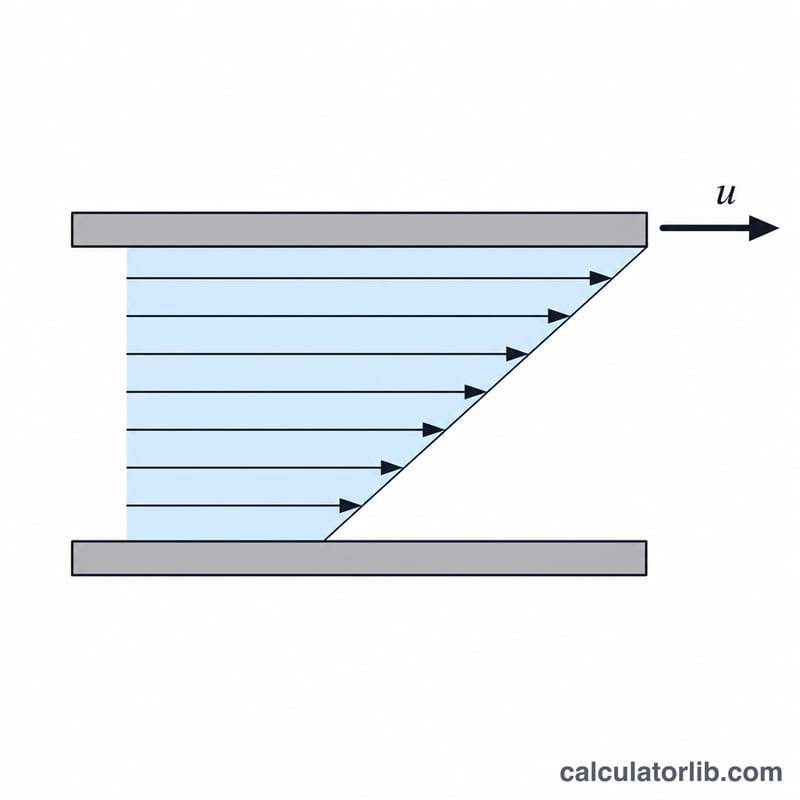
The governing equation is $$\nu = \dfrac{\mu}{\rho}$$ Dynamic viscosity \(\mu\) measures internal friction between fluid layers, while density \(\rho\) measures mass per unit volume. Dividing the two normalizes the friction by the fluid's inertia, yielding kinematic viscosity with units of area per time (\(\text{m}^2/\text{s}\)). Because air density falls as temperature rises or pressure drops, its kinematic viscosity increases sharply with altitude.
Worked Example
Take \(\mu = 1.825 \times 10^{-5}\ \text{Pa}\cdot\text{s}\) and \(\rho = 1.204\ \text{kg/m}^3\). Then $$\nu = \frac{1.825 \times 10^{-5}}{1.204} = 1.5158 \times 10^{-5}\ \text{m}^2/\text{s}$$ or about 15.16 centistokes — close to the standard textbook value for air at 20 °C.
FAQ
What units should I use? Use \(\text{Pa}\cdot\text{s}\) for \(\mu\) and \(\text{kg/m}^3\) for \(\rho\) to get \(\nu\) in \(\text{m}^2/\text{s}\). The tool also shows centistokes for convenience.
How does temperature affect air viscosity? Dynamic viscosity rises slightly with temperature, but density drops faster, so kinematic viscosity increases noticeably as air gets hotter or thinner.
Can I use this for other gases or liquids? Yes. The formula \(\nu = \dfrac{\mu}{\rho}\) applies to any Newtonian fluid; just enter that fluid's \(\mu\) and \(\rho\).