
What is the Volumetric Flow Rate Conversion Calculator?
This tool converts a single volumetric flow rate into 21 common flow-rate units at once, spanning metric (liters, milliliters, cubic meters, cubic millimeters), US customary (cubic feet, US gallons) and imperial UK (UK gallons) systems, each expressed per hour, per minute and per second. It is a pure unit conversion and applies identically everywhere in the world.
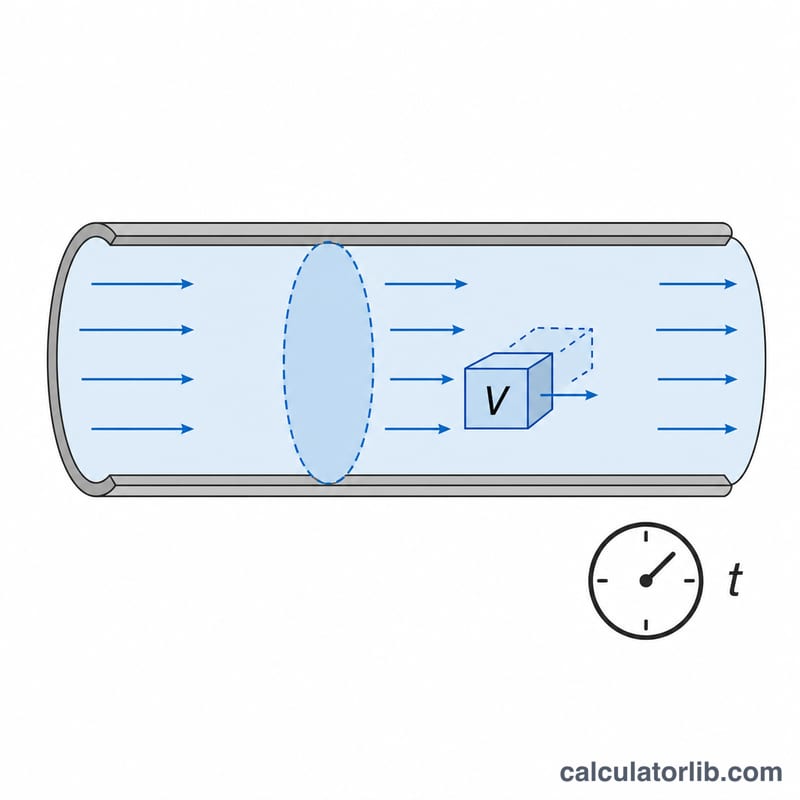
How to use it
Enter the numeric flow value, then pick the unit that value is expressed in. The calculator instantly shows the equivalent flow in every other supported unit. The value may be zero or negative; the conversion is linear so the sign is preserved.
The formula explained
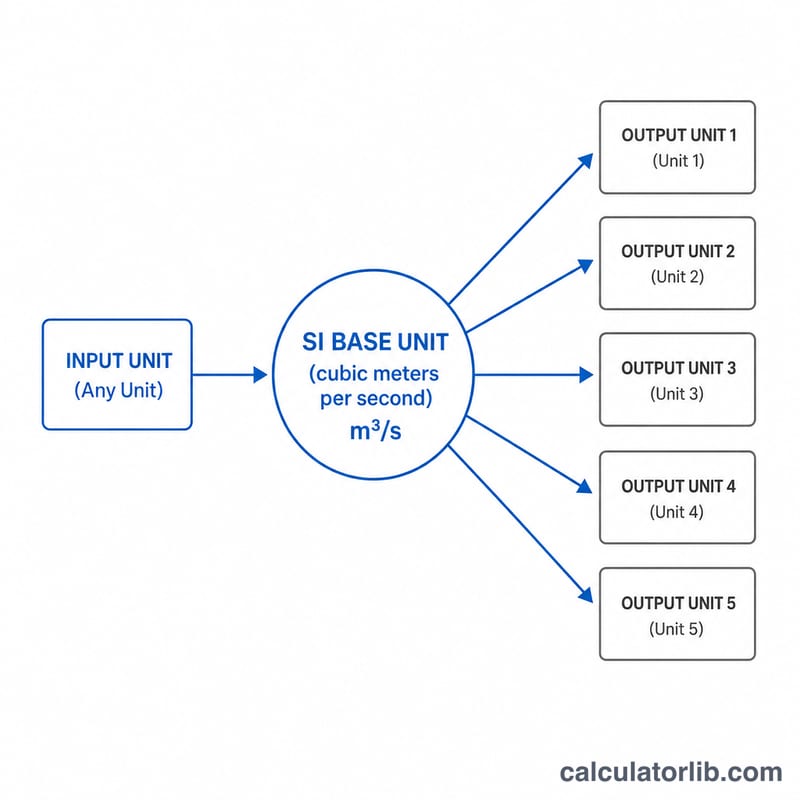
Every unit has a fixed factor equal to its value in the SI base unit, cubic meters per second (m3/s). A unit's factor is its volume in cubic meters divided by its time span in seconds. For example one liter per minute equals 0.001 m3 divided by 60 s = 1.6666...e-5 m3/s.
First the input is normalized to SI: $$Q_{\text{SI}} = \text{Flow value} \times \text{factor}\!\left(\text{Input unit}\right)\ \left[\text{m}^3/\text{s}\right]$$ Then each output is output[u] = q_SI / factor[u]. Equivalently output[u] = flowValue x factor[inputUnit] / factor[u].
Worked example
For flowValue = 1 and inputUnit = Liters per minute: $$q_{\text{SI}} = 1 \times 1.6666\mathrm{e}{-5} = 1.6666\mathrm{e}{-5}\ \text{m}^3/\text{s}$$ Dividing by each target factor gives 60 L/hour, 1 L/min, 0.016667 L/sec, 60,000 mL/hour, 1,000 mL/min, and 60,000,000 mm3/hour, matching standard references.
FAQ
Why is the "per hour" number larger than "per second"? The same physical flow expressed over a longer time window accumulates a bigger count, so 1 L/min equals 60 L/hour.
Which gallon is used? Both: US gallon = 3.785411784 L and UK imperial gallon = 4.54609 L are shown separately.
Does country matter? No. These are universal physical unit definitions with no regional assumptions.