
What Is the Density of a Cylinder Calculator?
This calculator determines the density of a solid cylinder from three measurements: its mass, its radius, and its height. Density tells you how much mass is packed into a given volume and is a key property for identifying materials, checking quality, and solving physics and engineering problems. The tool works with any consistent set of units; with mass in kilograms and dimensions in meters, the result is in kilograms per cubic meter (kg/m³).
How to Use It
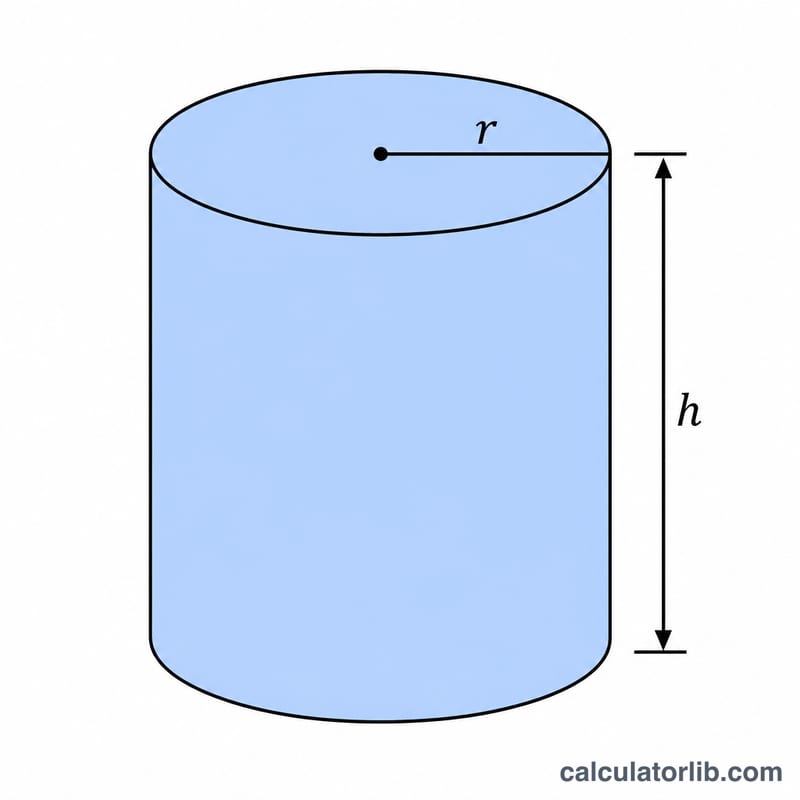
Enter the cylinder's mass, the radius of its circular base, and its height. The calculator first computes the volume using \(V = \pi r^2 h\), then divides the mass by that volume to give the density. Make sure your measurements share a consistent unit system so the answer is meaningful.
The Formula Explained
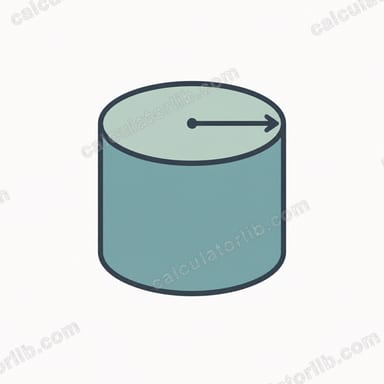
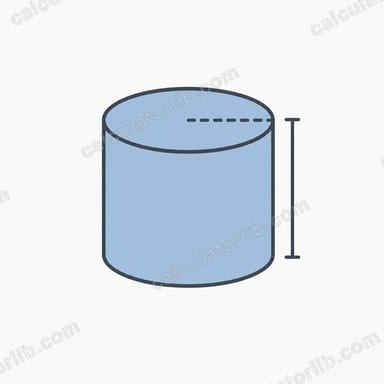
The density formula is $$\rho = \frac{m}{\pi r^2 h}$$ where \(\rho\) (rho) is density, \(m\) is mass, \(r\) is the base radius, and \(h\) is the height. The denominator \(\pi r^2 h\) is simply the volume of the cylinder — the area of the circular base (\(\pi r^2\)) multiplied by the height.
Worked Example
Suppose a metal cylinder has a mass of 10 kg, a radius of 0.5 m, and a height of 2 m. Its volume is $$\pi \times 0.5^2 \times 2 = \pi \times 0.5 \approx 1.5708 \text{ m}^3.$$ The density is therefore $$\frac{10}{1.5708} \approx 6.366 \text{ kg/m}^3.$$
FAQ
What units does the result use? If you enter mass in kilograms and lengths in meters, density is in kg/m³. Use grams and centimeters for g/cm³.
Do I need the diameter or the radius? The formula uses the radius. If you only know the diameter, divide it by two before entering.
Does this work for hollow cylinders? No — this assumes a solid cylinder. For hollow tubes you must subtract the inner volume separately.