
What Is the Density to Mass Calculator?
This calculator finds the mass of an object or substance when you know its density and volume. It is based on the fundamental relationship between these three quantities and works for any material — solids, liquids, or gases — as long as your density and volume use matching units.
How to Use It
Enter the density (\(\rho\)) and volume (\(V\)), then choose a consistent unit set. Use kg/m³ with m³ to get mass in kilograms, or g/cm³ with cm³ to get mass in grams. The calculator multiplies the two values together to return the mass instantly.
The Formula Explained
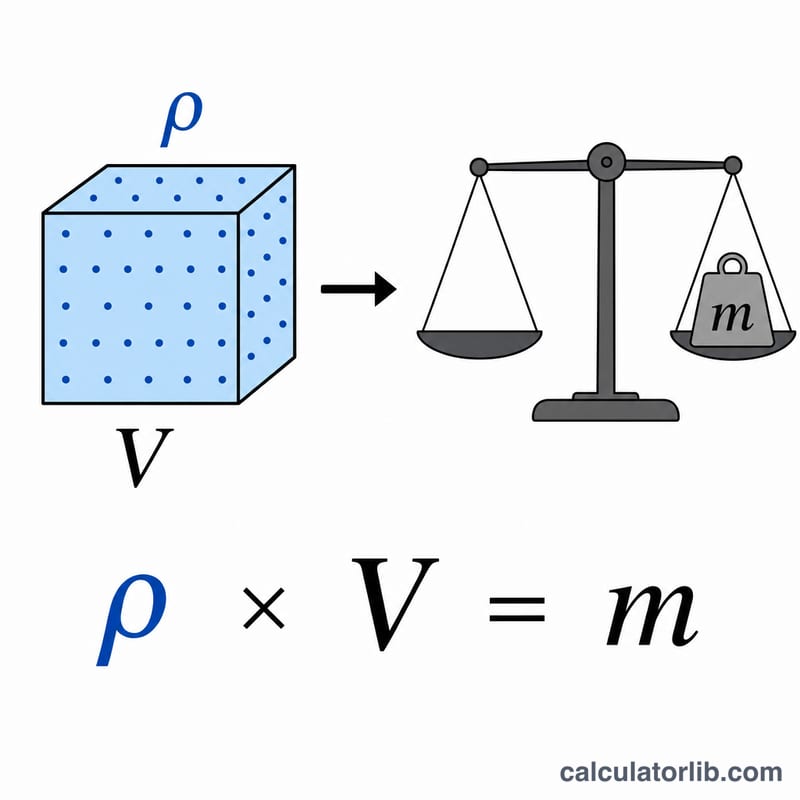
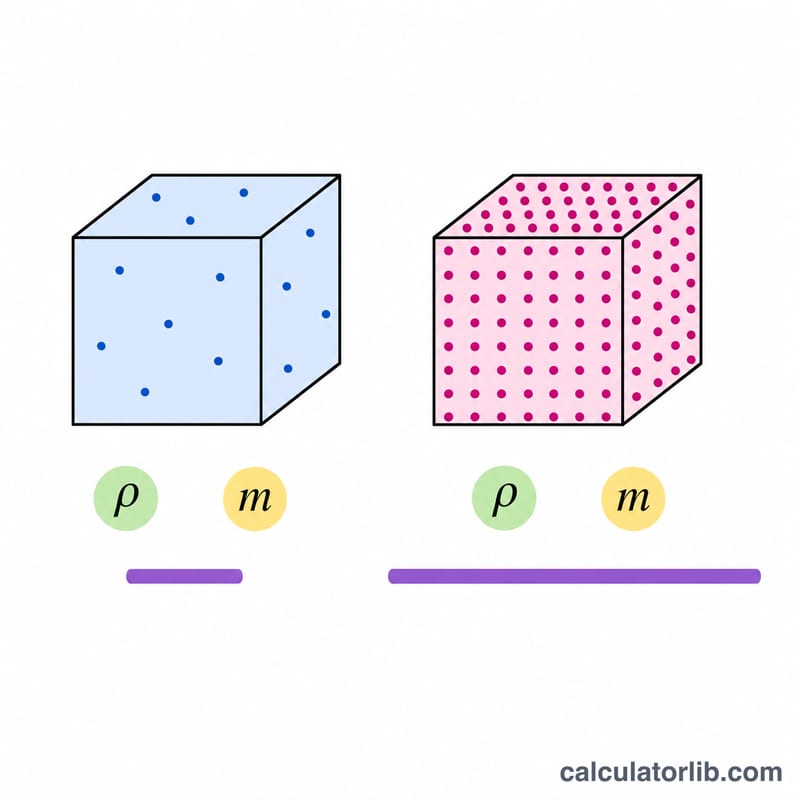
The equation is $$m = \rho \times V$$ where \(m\) is mass, \(\rho\) (rho) is density, and \(V\) is volume. Density tells you how much mass is packed into each unit of volume, so multiplying by the total volume gives the total mass. This rearranges the more familiar definition of density, \(\rho = m / V\).
Worked Example
Suppose water has a density of 1000 kg/m³ and you have 2 m³ of it. Then $$m = 1000 \times 2 = 2000 \text{ kg}$$ As another example, aluminum has a density of about 2.7 g/cm³; a block of 50 cm³ would have a mass of $$2.7 \times 50 = 135 \text{ g}$$
FAQ
Do the units have to match? Yes. Density and volume units must be consistent (e.g. kg/m³ with m³). Mixing units gives wrong answers.
Can I find volume instead? Rearrange to \(V = m / \rho\), or use a mass-to-volume calculator.
Does this work for gases? Yes, as long as you use the gas's actual density at the relevant temperature and pressure.