
What is the Density to Weight Calculator?
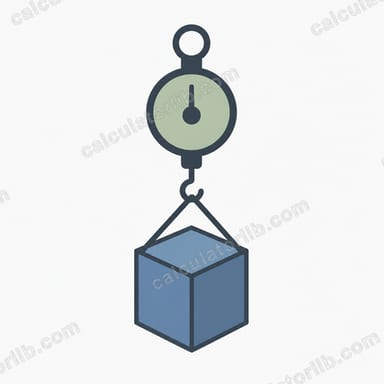
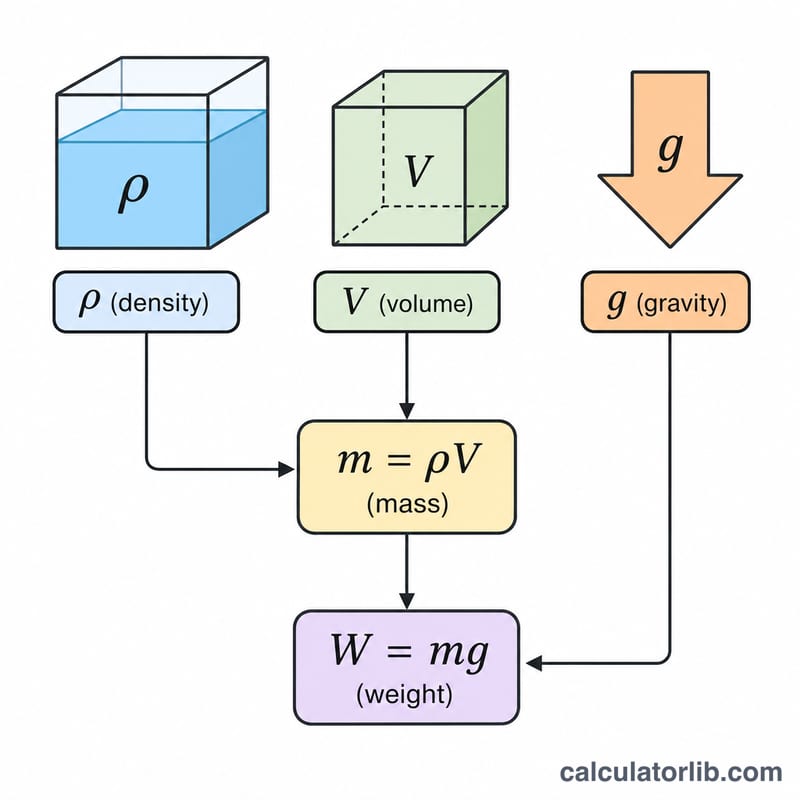
This calculator converts an object's density and volume into its weight (the gravitational force it exerts) and its mass. Density describes how much mass is packed into a given volume, so multiplying density by volume gives mass, and multiplying mass by gravitational acceleration gives weight in newtons. It is useful in engineering, physics, shipping, and material science whenever you know what a substance is and how much space it occupies but need to know how heavy it is.
How to use it
Enter the density of the material in kilograms per cubic metre (for example, water is about 1000 kg/m³ and steel about 7850 kg/m³), the volume in cubic metres, and the gravitational acceleration. The default gravity of 9.80665 m/s² is Earth's standard value — change it for the Moon (1.62) or other planets. The calculator returns the weight in newtons along with the underlying mass in kilograms.
The formula explained
The relationship is $$W = \rho \times V \times g$$ where \(\rho\) (rho) is density, \(V\) is volume, and \(g\) is gravitational acceleration. The intermediate quantity \(m = \rho \times V\) is the mass. Weight is therefore mass times gravity. Note that mass stays constant anywhere in the universe, but weight changes with local gravity.
Worked example
Suppose you have 2 m³ of water (density 1000 kg/m³) on Earth. Mass = \(1000 \times 2 = 2000\) kg. Weight = \(2000 \times 9.80665 = 19{,}613.3\) N. So two cubic metres of water weigh roughly 19.6 kilonewtons, equivalent to about 2000 kgf.
FAQ
What is the difference between weight and mass? Mass is the amount of matter (kg) and never changes; weight is the force gravity exerts on that mass (newtons) and depends on \(g\).
What units does this use? SI units: density in kg/m³, volume in m³, gravity in m/s², giving weight in newtons and mass in kilograms.
How do I get weight in kilograms-force? Divide the newton result by 9.80665, or simply use the mass value, which numerically equals kgf on Earth.