
What is the Friction Force Calculator?
This calculator finds the force of friction acting between two surfaces using the classic equation \(F = \mu N\), where μ (mu) is the dimensionless coefficient of friction and N is the normal force pressing the surfaces together, measured in newtons. The result, F, is the maximum static or kinetic friction force, also in newtons.
How to use it
Enter the coefficient of friction for your pair of materials and the normal force. The normal force often equals the object's weight (mass × g) when it rests on a flat horizontal surface, but it changes on inclines or when other vertical forces act. Press calculate to see the friction force instantly.
The formula explained
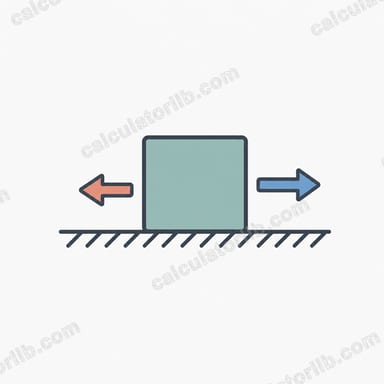
Friction opposes relative motion between surfaces. The friction force is proportional to how hard the surfaces are pressed together (the normal force) and to a coefficient that captures how rough or "grippy" the materials are. Typical values of μ range from about 0.04 (PTFE on steel) to over 1.0 (rubber on dry asphalt). Use the static coefficient for objects about to move and the kinetic coefficient for objects already sliding.
Worked example
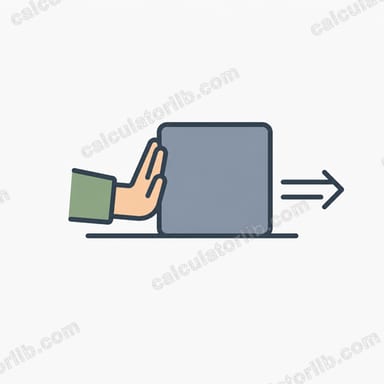
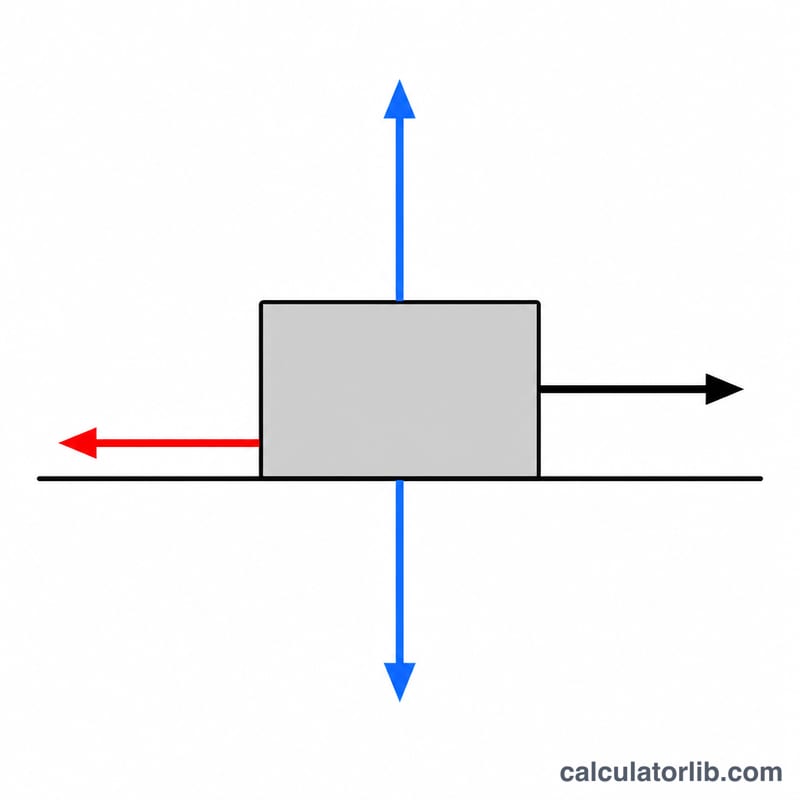
A crate experiences a normal force of 100 N against the floor, and the coefficient of friction is 0.3. Then $$F = 0.3 \times 100 = 30 \text{ N}$$ You would need to push with more than 30 N to overcome static friction and start the crate moving.
FAQ
Does the contact area matter? In the standard model, no — friction depends only on μ and the normal force, not on the apparent contact area.
Is the coefficient ever above 1? Yes. Sticky or high-grip surface pairs such as rubber on certain road surfaces can have μ greater than 1.
What's the difference between static and kinetic friction? Static friction (up to \(\mu_s N\)) keeps a still object from moving; kinetic friction (\(\mu_k N\)) acts on a sliding object and is usually slightly smaller.