
What Is Noise Figure?
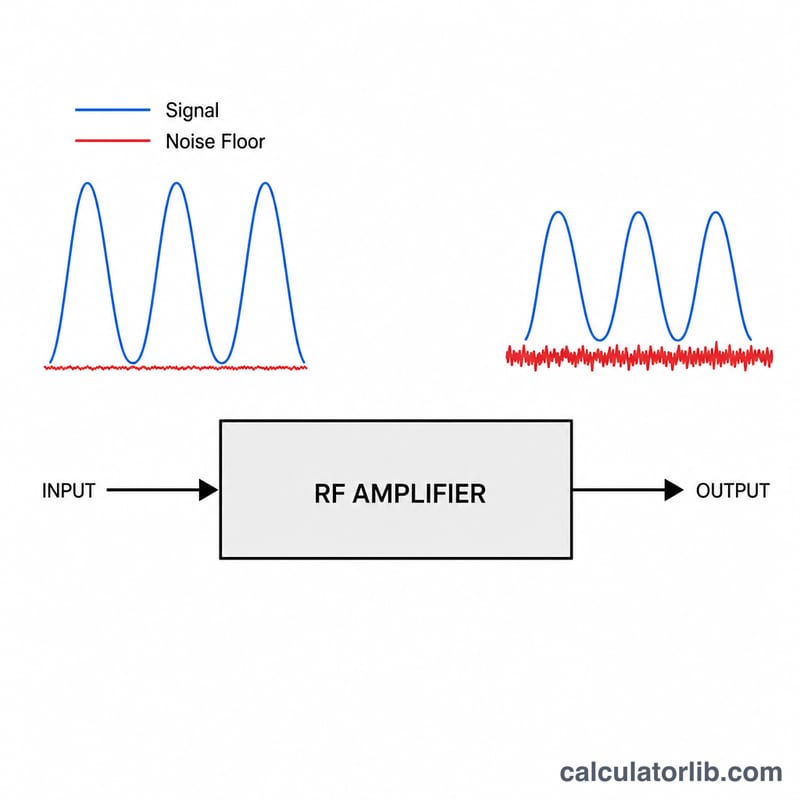
Noise figure (NF) is a measure of how much a component or system degrades the signal-to-noise ratio (SNR) of a signal passing through it. It is expressed in decibels (dB) and is widely used in RF and microwave engineering to characterize amplifiers, mixers, and entire receiver chains. A lower noise figure means a quieter, more sensitive system.
How to Use This Calculator
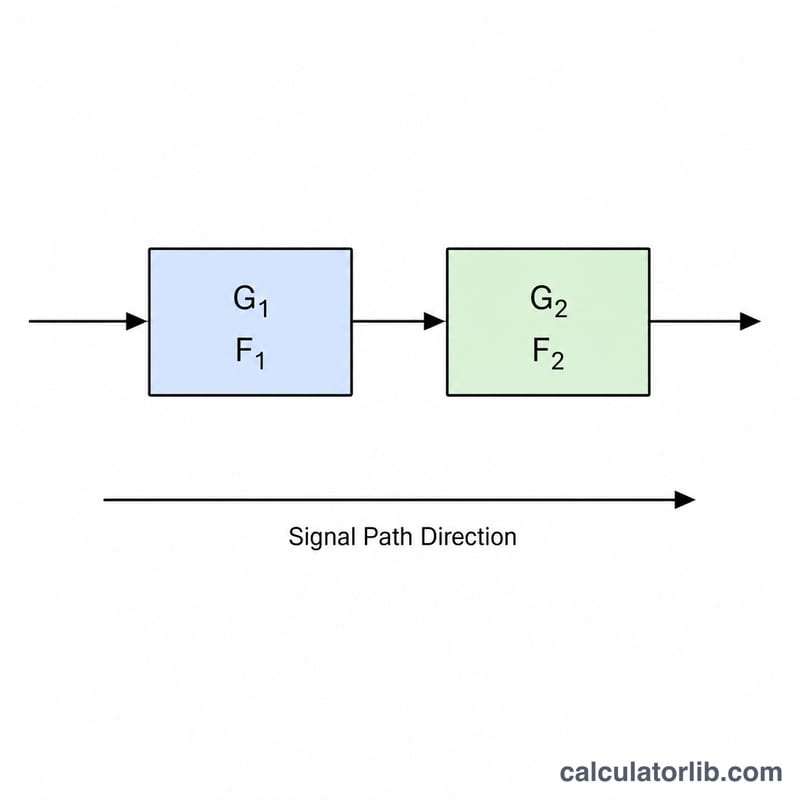
Choose a mode. In From SNR mode, enter the input and output SNR in dB — the noise figure is simply their difference. In Cascade mode, enter the noise figure and gain of stage 1 plus the noise figure of stage 2 (all in dB); the tool applies the Friis formula to find the combined noise figure of the two-stage chain.
The Formula Explained
The noise factor F is the linear ratio of input SNR to output SNR. Noise figure is its decibel form: \(\text{NF(dB)} = 10\cdot\log_{10}(F)\). When working in dB, SNR ratios subtract, so
$$\text{NF} = \text{SNR}_{in} - \text{SNR}_{out}$$For cascaded stages the Friis equation applies: \(F = F_1 + \frac{F_2-1}{G_1} + \frac{F_3-1}{G_1 G_2} + \dots\), where F and G values are linear (convert from dB with \(F = 10^{\text{NF}/10}\) and \(G = 10^{\text{Gain}/10}\)). Because the first stage's noise is divided by nothing while later stages are divided by the preceding gain, the first amplifier dominates the system noise figure.
Worked Example
Stage 1: \(\text{NF}_1 = 1\ \text{dB}\), \(G_1 = 15\ \text{dB}\). Stage 2: \(\text{NF}_2 = 4\ \text{dB}\). Converting: \(F_1 = 10^{0.1} \approx 1.2589\), \(F_2 = 10^{0.4} \approx 2.5119\), \(G_1 = 10^{1.5} \approx 31.623\). Then
$$F = 1.2589 + \frac{2.5119 - 1}{31.623} \approx 1.3067$$giving \(\text{NF} = 10\cdot\log_{10}(1.3067) \approx 1.163\ \text{dB}\). The 4 dB second stage barely matters thanks to the 15 dB first-stage gain.
FAQ
What is a good noise figure? For low-noise amplifiers, values under 1–2 dB are excellent; receivers may tolerate higher.
Why does the first stage matter most? The Friis formula divides every later stage's contribution by the accumulated gain ahead of it, so a high-gain, low-NF first stage suppresses downstream noise.
Can NF be negative? No. A passive system always adds noise, so \(\text{NF} \geq 0\ \text{dB}\) (\(F \geq 1\)).