
What Is Resistor Thermal Noise?
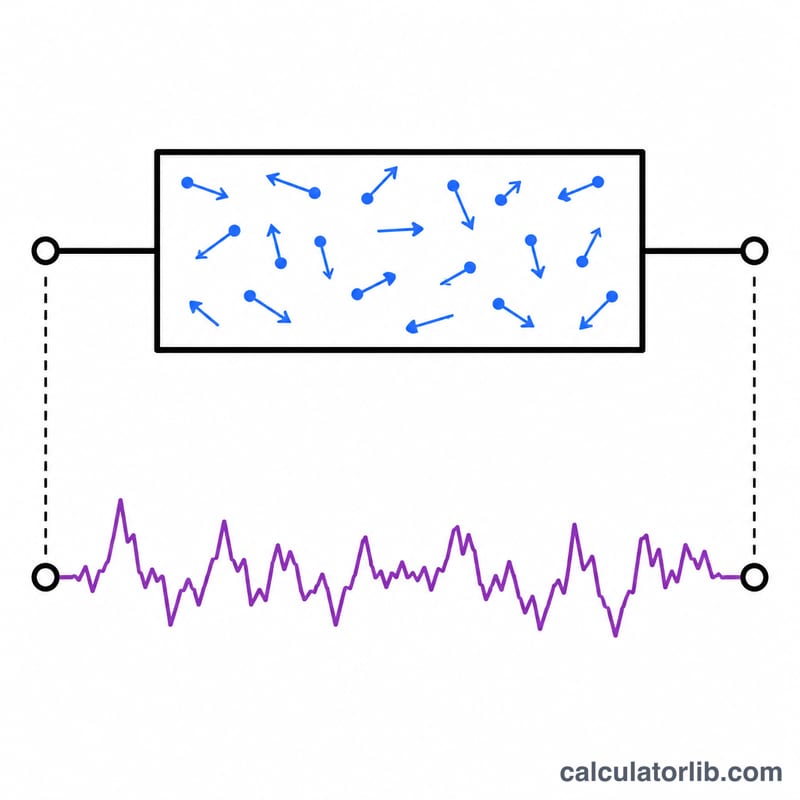
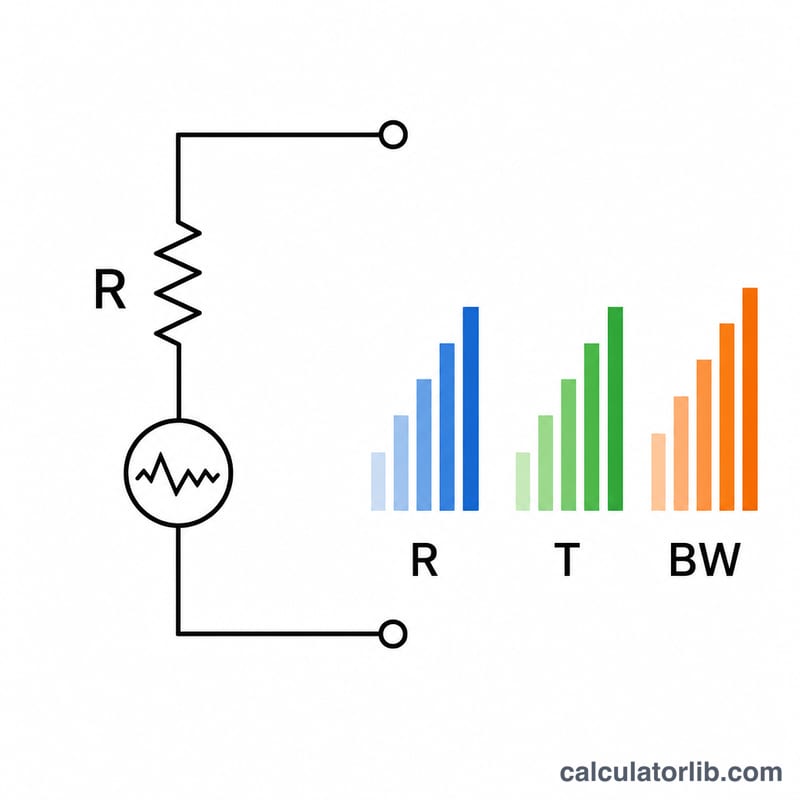
Every resistor generates a small random voltage caused by the thermal agitation of charge carriers, independent of any applied voltage. This is called Johnson–Nyquist noise or thermal noise. It sets a fundamental noise floor in amplifiers, sensors, and measurement systems. This calculator computes the RMS thermal noise voltage of a resistor over a given measurement bandwidth and temperature.
How to Use It
Enter the resistance in ohms, the absolute temperature in kelvin (room temperature ≈ 290–300 K), and the measurement bandwidth in hertz. The calculator returns the RMS noise voltage in nanovolts, the value in volts, and the noise voltage spectral density in nV/√Hz.
The Formula
The RMS thermal noise voltage is:
$$V_n = \sqrt{4\,k\,T\,R\,\text{BW}}$$
where \(k\) is the Boltzmann constant (\(1.38\times10^{-23}\ \text{J/K}\)), \(T\) is absolute temperature in kelvin, \(R\) is resistance in ohms, and BW is the noise bandwidth in hertz. The noise voltage spectral density is \(\sqrt{4\,k\,T\,R}\), expressed in V/√Hz.
Worked Example
For \(R = 1000\ \Omega\), \(T = 290\ \text{K}\), and \(\text{BW} = 10{,}000\ \text{Hz}\): $$V_n = \sqrt{4 \times 1.38\times10^{-23} \times 290 \times 1000 \times 10000} = \sqrt{1.60\times10^{-13}} \approx 4.00\times10^{-7}\ \text{V} = 400.06\ \text{nV RMS}.$$ The spectral density is \(\sqrt{4 \times 1.38\times10^{-23} \times 290 \times 1000} \approx 4.00\ \text{nV/}\sqrt{\text{Hz}}\).
FAQ
Does noise depend on the voltage across the resistor? No. Thermal noise is intrinsic and present even with no current flowing.
Why use kelvin? Thermal noise scales with absolute temperature, so T must be in kelvin (°C + 273.15).
What is nV/√Hz? It is the noise voltage density — multiply by √(bandwidth) to get total RMS noise over that bandwidth.