
What is the Resonant Frequency Calculator?
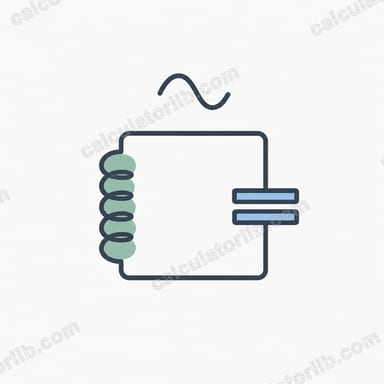
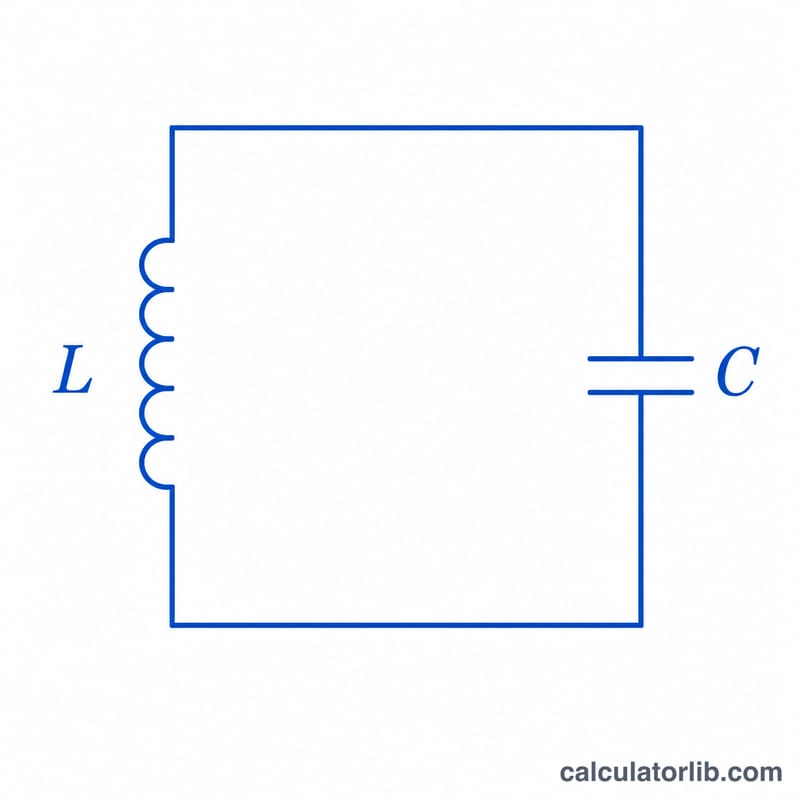
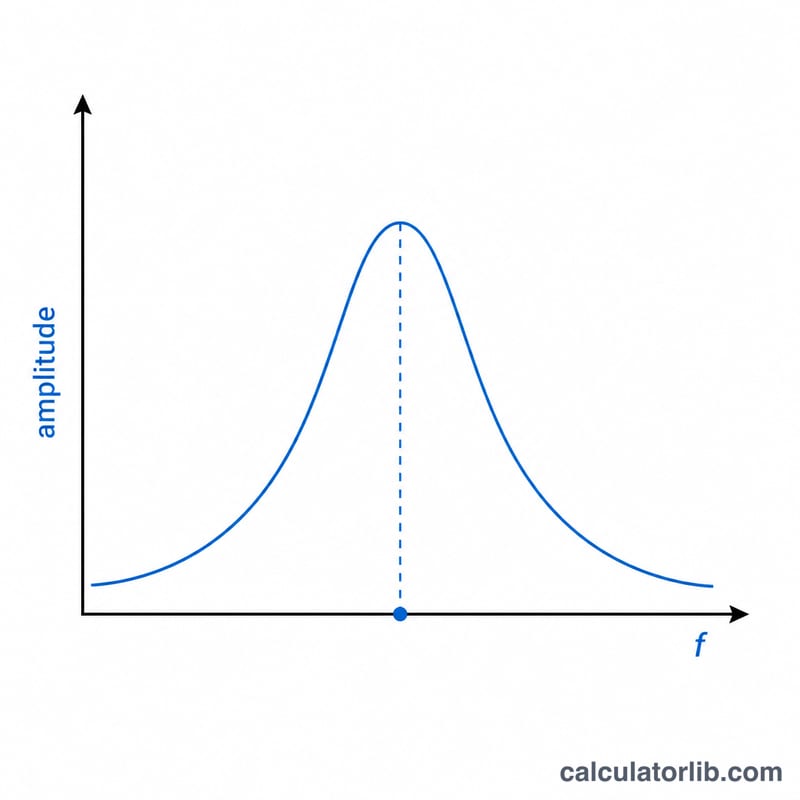
This calculator finds the resonant frequency of an LC circuit — a circuit containing an inductor (L) and a capacitor (C). At resonance, the inductive and capacitive reactances cancel, and energy oscillates back and forth between the magnetic field of the inductor and the electric field of the capacitor. This frequency is fundamental to radio tuners, oscillators, filters, and wireless power systems.
How to use it
Enter the inductance in henries (H) and the capacitance in farads (F). Remember to convert common sub-units first: 1 mH = 0.001 H, 1 µH = 0.000001 H, 1 µF = 0.000001 F, 1 nF = 0.000000001 F, 1 pF = 0.000000000001 F. The calculator returns the resonant frequency in hertz along with the angular frequency (rad/s) and the period of one oscillation (seconds).
The formula explained
The resonant frequency is given by $$f = \frac{1}{2\pi\sqrt{\text{L (H)} \cdot \text{C (F)}}}$$ The product \(L\cdot C\) sets the time constant of the oscillation: larger inductance or capacitance stores more energy and slows the oscillation, lowering the frequency. The square root means that to double the frequency you must reduce \(L\cdot C\) by a factor of four. The angular frequency is \(\omega = 2\pi f\) and the period is \(T = 1/f\).
Worked example
Suppose \(L = 1\,\text{mH}\ (0.001\,\text{H})\) and \(C = 1\,\mu\text{F}\ (0.000001\,\text{F})\). Then \(L\cdot C = 1\times10^{-9}\), and \(\sqrt{L\cdot C} = 3.1623\times10^{-5}\). So $$f = \frac{1}{2\pi \times 3.1623\times10^{-5}} \approx \frac{1}{1.9869\times10^{-4}} \approx 5{,}033\ \text{Hz}$$ or about 5.03 kHz.
FAQ
Does resistance affect the resonant frequency? In an ideal series or parallel LC circuit, no. In a real circuit with resistance the peak shifts slightly, but the formula above is the standard approximation used in design.
What units should I use? Always henries and farads for the inputs. Convert mH, µH, µF, nF and pF to base units before entering them.
What is angular frequency? It is the frequency expressed in radians per second, \(\omega = 2\pi f\), often used directly in reactance and impedance equations.