
What is the LC resonant frequency?
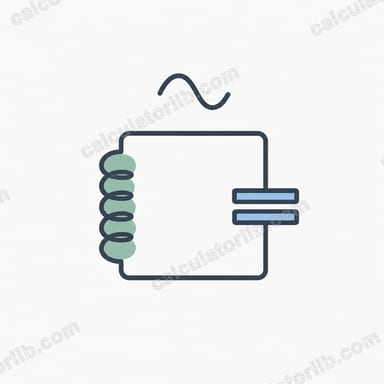
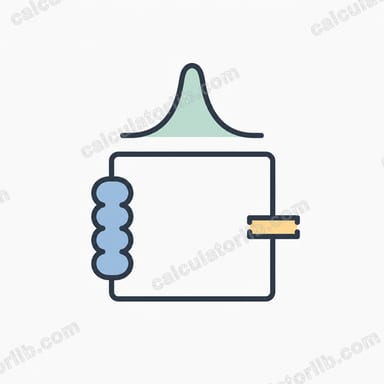
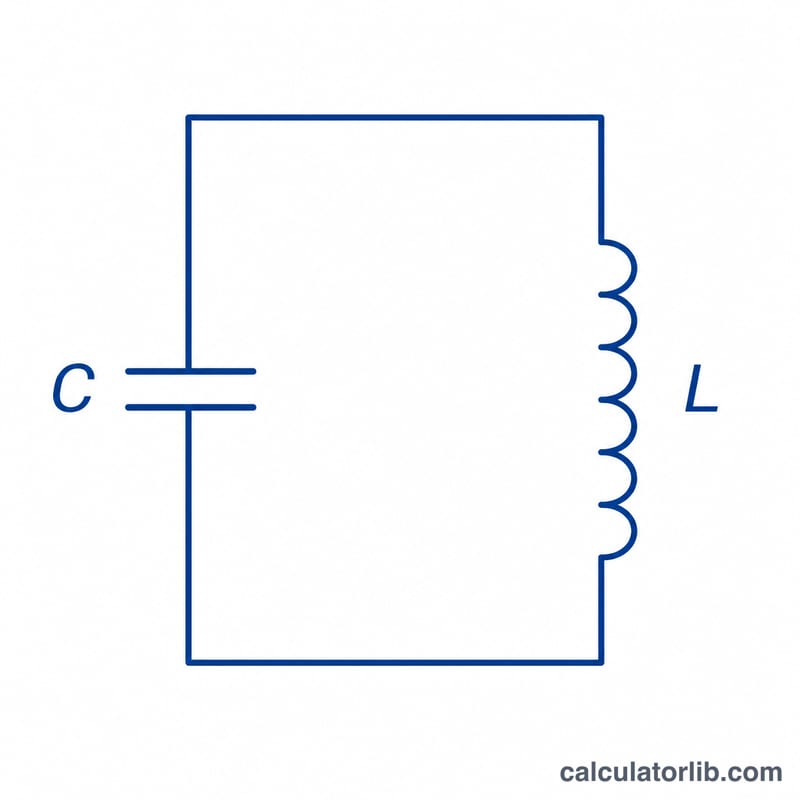
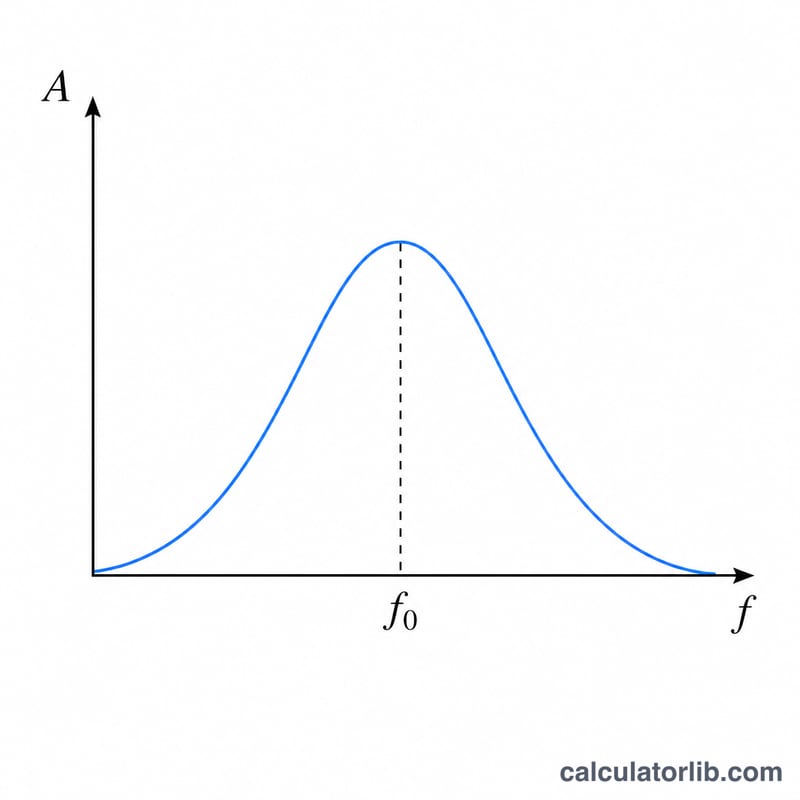
An LC circuit — also called a tank circuit — is a combination of an inductor (L) and a capacitor (C). When energy is allowed to flow between the two components it oscillates at a specific natural frequency called the resonant frequency. At resonance the inductive reactance equals the capacitive reactance and the circuit stores energy most efficiently. This frequency is the basis of radio tuners, oscillators, filters, and impedance-matching networks.
How to use this calculator
Enter the inductance value and pick its unit (H, mH, µH, or nH), then enter the capacitance value and pick its unit (F, µF, nF, or pF). The calculator converts both to base SI units, applies the resonance formula, and reports the frequency in Hz, kHz, and MHz, along with the angular frequency and the oscillation period.
The formula explained
The resonant frequency is given by $$f = \frac{1}{2\pi\sqrt{L\cdot C}}$$ where L is in henries and C is in farads. Larger inductance or capacitance lowers the frequency; smaller values raise it. The angular frequency \(\omega = 2\pi f = \frac{1}{\sqrt{LC}}\), and the period \(T = \frac{1}{f}\).
Worked example
Take \(L = 100\ \mu\text{H} = 0.0001\ \text{H}\) and \(C = 100\ \text{pF} = 1\times10^{-10}\ \text{F}\). Then \(L\cdot C = 1\times10^{-14}\), and \(\sqrt{L\cdot C} = 1\times10^{-7}\). So $$f = \frac{1}{2\pi \times 1\times10^{-7}} \approx \frac{1}{6.2832\times10^{-7}} \approx 1{,}591{,}549\ \text{Hz} \approx 1.59\ \text{MHz}$$ — squarely in the AM/medium-wave band.
FAQ
Does the calculator account for resistance? No. This is the ideal undamped resonant frequency. Real circuits with resistance resonate at a very slightly lower frequency, but the difference is negligible for high-Q circuits.
Can I solve for L or C instead? This tool solves for frequency. Rearranging, \(L = \frac{1}{4\pi^2 f^2 C}\) and \(C = \frac{1}{4\pi^2 f^2 L}\).
What units should I use? Any of the provided unit options — the tool converts everything to henries and farads internally, so mixing µH with pF works fine.