
What Is Wind Power Density?
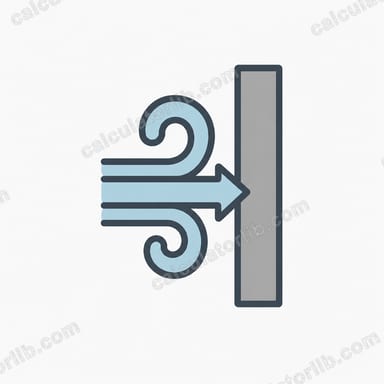
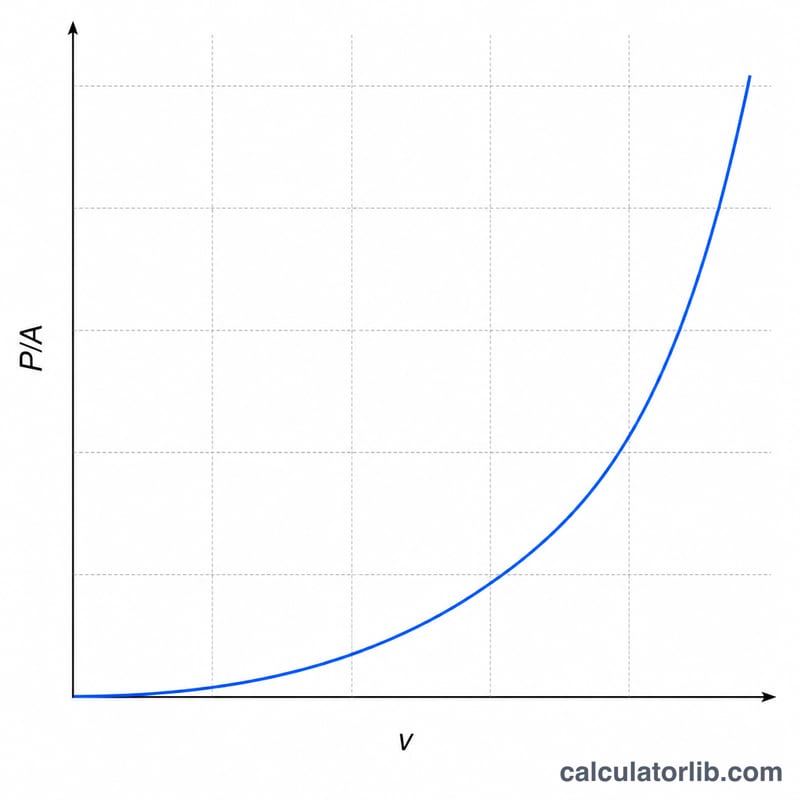
Wind power density (WPD) is the amount of kinetic energy flowing through one square meter of area perpendicular to the wind, expressed in watts per square meter (W/m²). It is the single most useful indicator of a site's wind resource because it captures the strong dependence of available power on wind speed. Since power scales with the cube of wind speed, doubling the wind speed makes roughly eight times more power available.
How to Use This Calculator
Enter the wind speed in meters per second and the air density in kilograms per cubic meter. At sea level and 15 °C, air density is about 1.225 kg/m³, which is the default. Colder, denser air yields more power; higher altitudes and warmer temperatures reduce it. The calculator returns the theoretical wind power density in W/m² (and kW/m²).
The Formula Explained
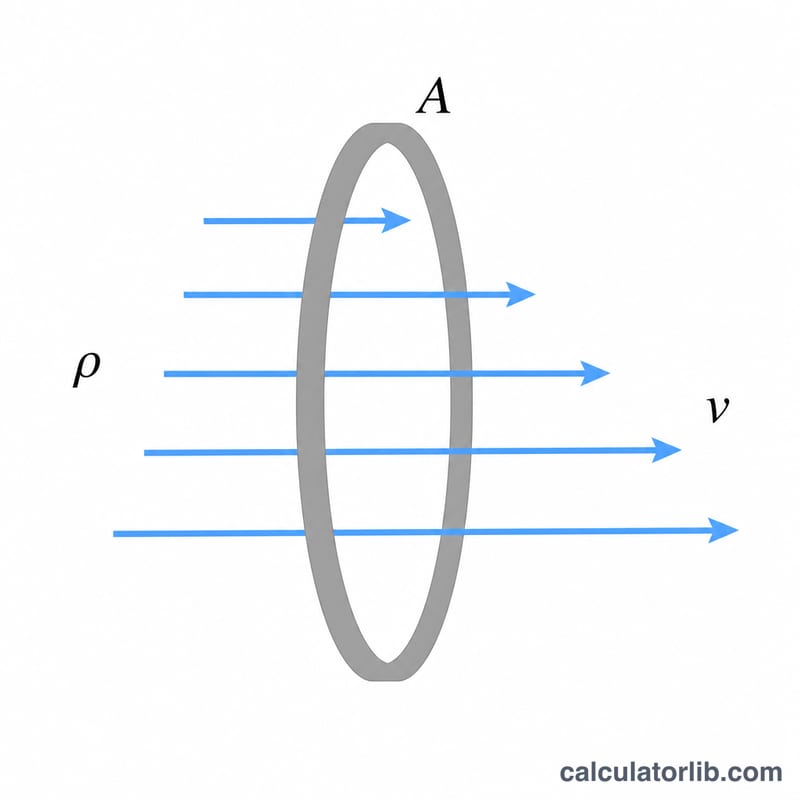
The equation is $$\frac{P}{A} = \frac{1}{2} \cdot \rho \cdot v^{3}$$ where \(\rho\) is air density and \(v\) is wind speed. The \(\frac{1}{2}\cdot\rho\cdot v^{2}\) term is dynamic pressure (energy per unit volume), and multiplying by \(v\) gives the volume flow rate per unit area, so the result is power per unit area. Note this is the power in the wind, not the power a turbine can extract — the Betz limit caps usable power at about 59.3%.
Worked Example
For a wind speed of 10 m/s at standard air density 1.225 kg/m³: $$\frac{P}{A} = 0.5 \times 1.225 \times 10^{3} = 0.5 \times 1.225 \times 1000 = 612.5 \ \text{W/m}^2$$ This corresponds to a "good" wind resource class.
FAQ
Why does air density matter? Denser air carries more mass and therefore more kinetic energy at the same speed, increasing available power proportionally.
Is this the power a turbine produces? No. It is the raw power in the wind. Real turbines extract only a fraction, limited by the Betz limit (~59.3%) and mechanical/electrical efficiencies.
What is a good wind power density? Sites above roughly 400 W/m² (at hub height) are generally considered good for wind energy development.