
What Is Wind Pressure?
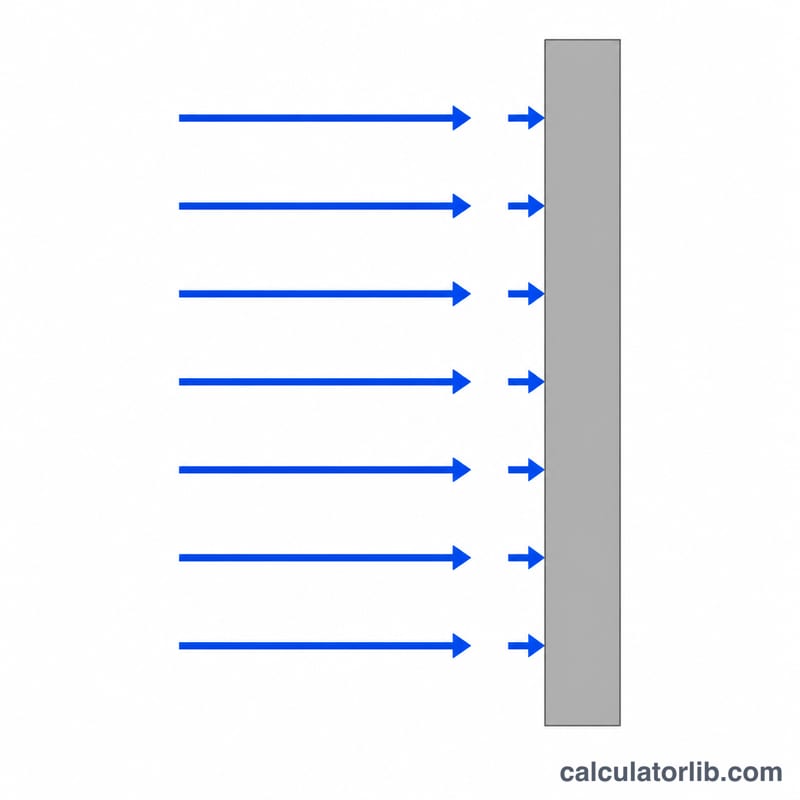
Wind pressure is the force per unit area that moving air exerts on a surface such as a wall, roof, sign, fence, or solar panel. It is the key input for structural wind-load checks and helps you understand how much force a gust pushes against an object. This calculator uses the widely used ASCE-style simplification \(P = 0.00256 \times v^2\), where pressure is in pounds per square foot (psf) and wind speed is in miles per hour (mph), and also reports the physical SI dynamic pressure in pascals.
How to Use the Calculator
Enter the wind speed in mph and the area of the surface facing the wind in square feet. The calculator returns the wind pressure in psf, the total force on the surface in pounds-force (lbf), and the equivalent pressure in pascals. Multiply pressure by area to find the total force the wind applies.
The Formula Explained
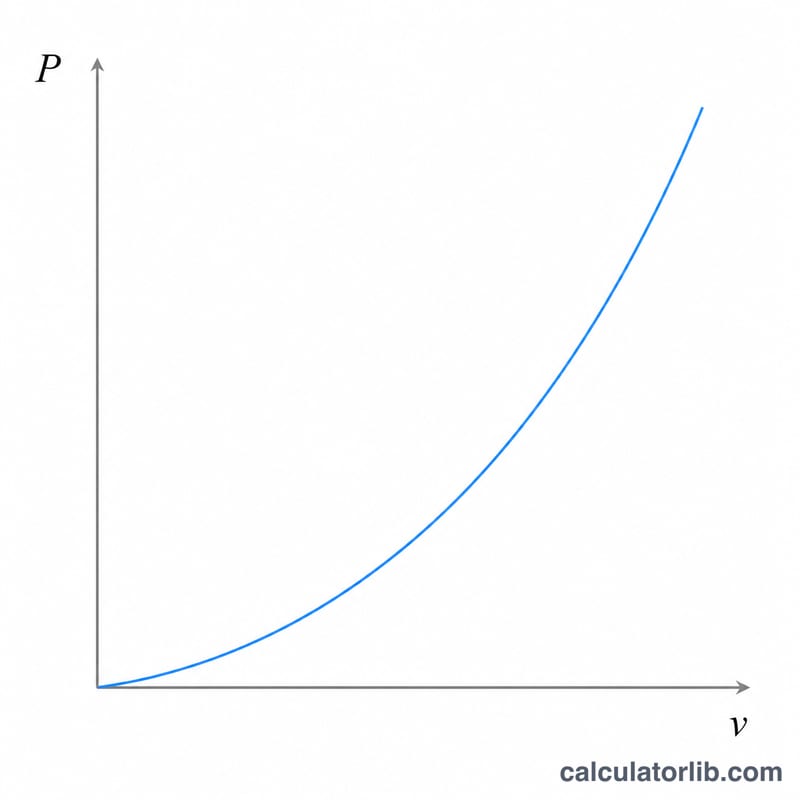
The simplified coefficient 0.00256 bundles air density and unit conversions for standard sea-level air, so pressure scales with the square of wind speed — double the speed and the pressure quadruples. The SI form, \(P = \tfrac{1}{2}\rho v^2\), uses air density \(\rho = 1.225 \text{ kg/m}^3\) with speed in meters per second (\(1 \text{ mph} = 0.44704 \text{ m/s}\)). Real-world design loads add gust, exposure, height, and shape factors, so treat these results as a baseline estimate.
Worked Example
For a 60 mph wind on a 100 ft² wall:
$$P = 0.00256 \times 60^2 = 0.00256 \times 3600 = 9.216 \text{ psf}$$Total force:
$$F = 9.216 \times 100 = 921.6 \text{ lbf}$$In SI: \(v = 60 \times 0.44704 = 26.82 \text{ m/s}\), so
$$P = 0.5 \times 1.225 \times 26.82^2 \approx 440.7 \text{ Pa}$$FAQ
Why does pressure grow so fast? Because it depends on velocity squared — a 25% faster wind raises pressure by about 56%.
Is this a code-compliant design value? No. It is a first estimate; official wind loads require gust, exposure, topographic, and shape factors per a building code such as ASCE 7.
Can I use it for metric inputs? Enter speed in mph; the calculator also outputs the SI dynamic pressure in pascals for reference.