
What Is Wind Load Pressure?
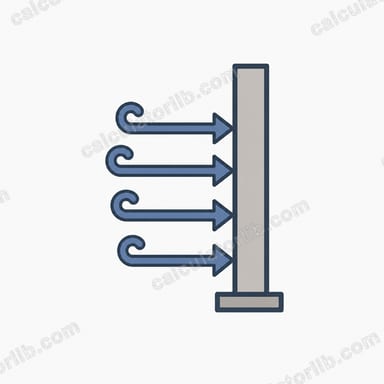
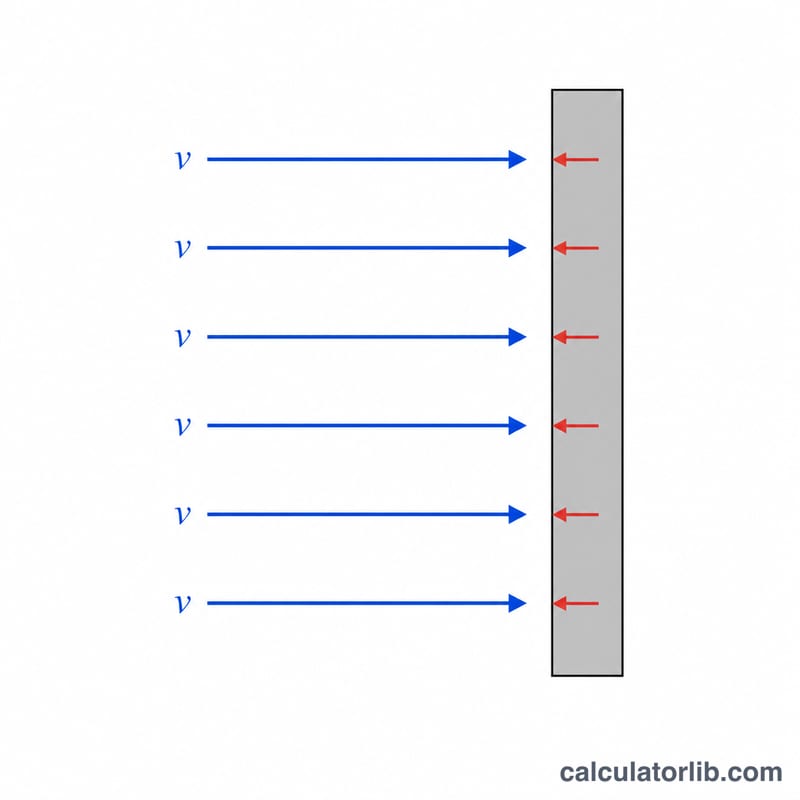
Wind load pressure is the dynamic pressure exerted by moving air on a surface. It is a fundamental quantity in structural engineering, used to size buildings, signs, solar panels, and other exposed structures. The basic stagnation (dynamic) pressure is given by the well-known relation \(q = \frac{1}{2}\rho v^{2}\), where \(\rho\) is the air density and \(v\) is the wind speed. This calculator is a universal physics tool and is not tied to any specific national building code.
How to Use the Calculator
Enter the wind speed in metres per second and the air density in kilograms per cubic metre. At sea level and 15°C, air density is about 1.225 kg/m³. Optionally, enter an exposed area to estimate the total wind force (\(F = q \times A\)). The result shows the dynamic pressure in pascals and, if you provided an area, the corresponding force in newtons.
The Formula Explained
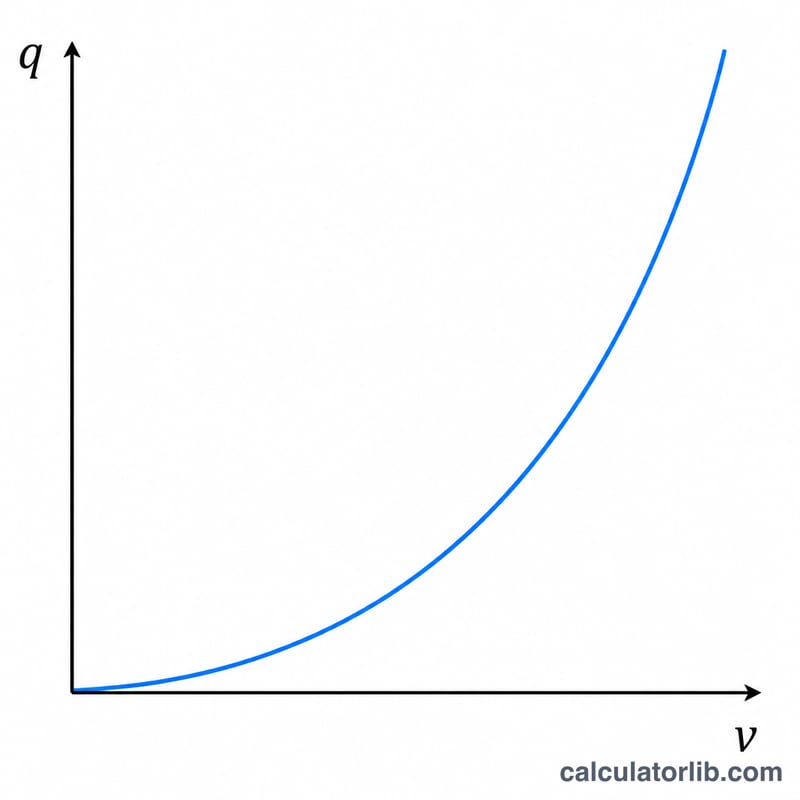
The dynamic pressure formula $$q = \frac{1}{2}\rho v^{2}$$ comes from Bernoulli principle: the kinetic energy of moving air is converted into pressure when the flow is brought to rest against a surface. Because the velocity is squared, doubling the wind speed quadruples the pressure. Real structural design adds shape, exposure, gust, and importance factors on top of this base pressure, but the dynamic pressure is always the starting point.
Worked Example
For a wind speed of 30 m/s and air density 1.225 kg/m³: $$q = 0.5 \times 1.225 \times 30^{2} = 0.5 \times 1.225 \times 900 = 551.25 \text{ Pa}.$$ If this acts on a 10 m² wall, the total force is \(551.25 \times 10 = 5{,}512.5 \text{ N}\).
FAQ
What air density should I use? Use 1.225 kg/m³ for standard sea-level conditions. Density drops at higher altitudes and temperatures.
How do I convert km/h to m/s? Divide km/h by 3.6 before entering the speed (e.g. 108 km/h = 30 m/s).
Does this include code safety factors? No. This is the base dynamic pressure only; multiply by the relevant code factors for design use.