
What this calculator does
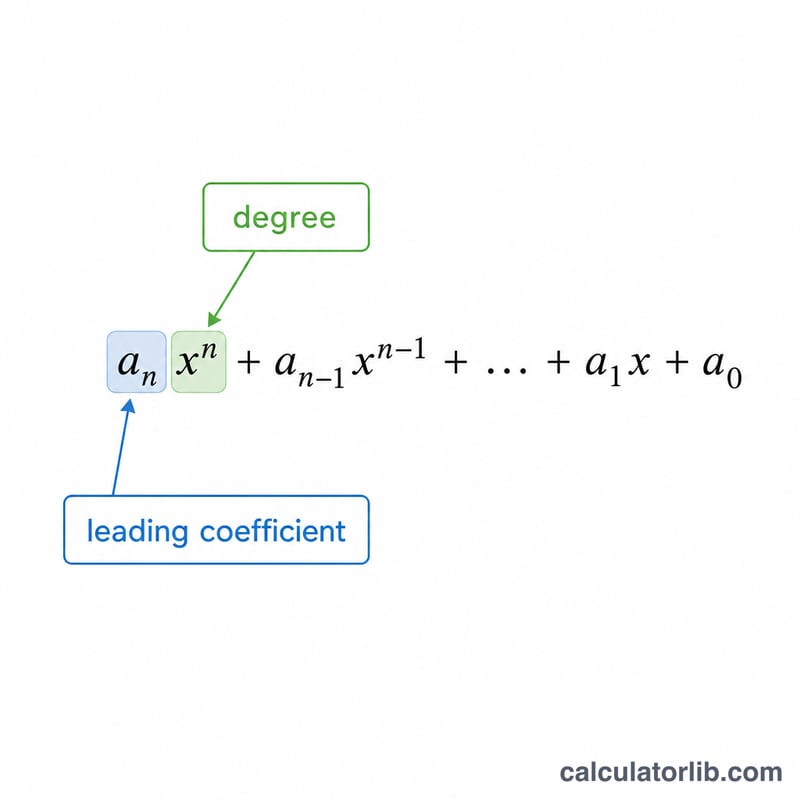
This tool finds the degree and the leading coefficient of a polynomial in one variable. The degree is the highest power of the variable that appears with a nonzero coefficient, and the leading coefficient is the number multiplying that highest-power term. Together they describe a polynomial end behavior and its classification (linear, quadratic, cubic, and so on).
How to use it
Write your polynomial in standard form (powers descending) and enter only the coefficients, separated by commas, from the highest power down to the constant term. Include a 0 for any missing power so the positions stay correct. For example, the polynomial 3x³ − 5x + 2 has no x² term, so you enter 3, 0, -5, 2.
The formula explained
If a polynomial is written as a list of coefficients a₀, a₁, …, aₙ, then the degree equals the largest index k for which aₖ ≠ 0, and the leading coefficient is that aₖ. The general form is
$$P(x) = \sum_{i=0}^{n-1} a_i\, x^{\,n-1-i}, \quad \text{Coefficients} = [a_0, a_1, \dots, a_{n-1}]$$so that
$$\begin{gathered} \deg(P) = \max\{\,n-1-i : a_i \neq 0\,\}, \qquad a_{\text{lead}} = a_{i^\ast} \\[1.5em] \text{where}\quad \left\{ \begin{aligned} [a_0, a_1, \dots, a_{n-1}] &= \text{Coefficients (highest degree first)} \\ n &= \text{number of coefficients} \\ i^\ast &= \text{smallest } i \text{ with } a_i \neq 0 \end{aligned} \right. \end{gathered}$$The calculator scans your list from the highest power, ignores any leading zeros, and reports the first nonzero term it meets.
Worked example
Take 0x⁴ + 3x³ + 0x² − 5x + 2, entered as 0, 3, 0, -5, 2. The leading 0 (for x⁴) is skipped, so the highest nonzero power is x³. The degree is 3 and the leading coefficient is 3. The polynomial has three nonzero terms.
FAQ
What is the degree of a constant like 7? A nonzero constant has degree 0. Enter just 7.
What about the zero polynomial? The polynomial that is identically 0 has no nonzero coefficient; its degree is often left undefined, but this tool reports degree 0 with a leading coefficient of 0.
Do I need to enter terms in order? Yes — list coefficients from the highest power to the constant, using 0 for any missing power.