
What is the Polynomial Multiplication Calculator?
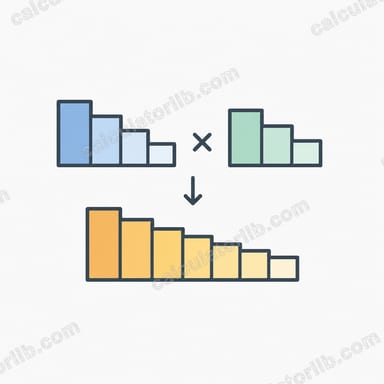
This calculator multiplies two polynomials and returns the fully expanded product. You enter the coefficients of each polynomial, and it computes the resulting polynomial, its coefficient list, and the degree of the product. It works for any polynomials with real coefficients, including negative numbers and decimals.
How to use it
Enter the coefficients of each polynomial from the highest degree term down to the constant, separated by commas. For example, 1, 2, 3 represents x² + 2x + 3, and 1, -1 represents x − 1. Missing terms must be entered as 0 (e.g. x² + 1 is 1, 0, 1). Press calculate to see the expanded product.
The formula explained
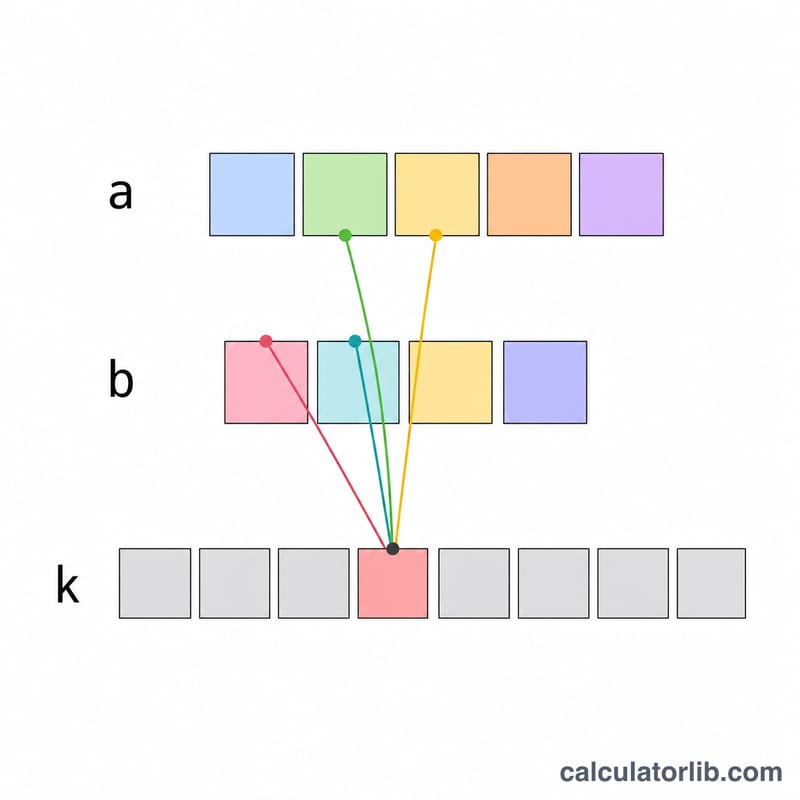
Multiplying polynomials is a convolution of their coefficient sequences. If the first polynomial has coefficients \(a_i\) and the second has \(b_j\), then the product coefficient for the term \(x^k\) is the sum of every \(a_i\cdot b_j\) whose exponents satisfy \(i + j = k\). The degree of the product equals the sum of the two input degrees.
$$\left(\text{A}(x)\right)\cdot\left(\text{B}(x)\right)=\sum_{k=0}^{m+n} c_k\,x^{\,m+n-k}, \qquad c_k=\sum_{i+j=k} a_i\,b_j$$
Worked example
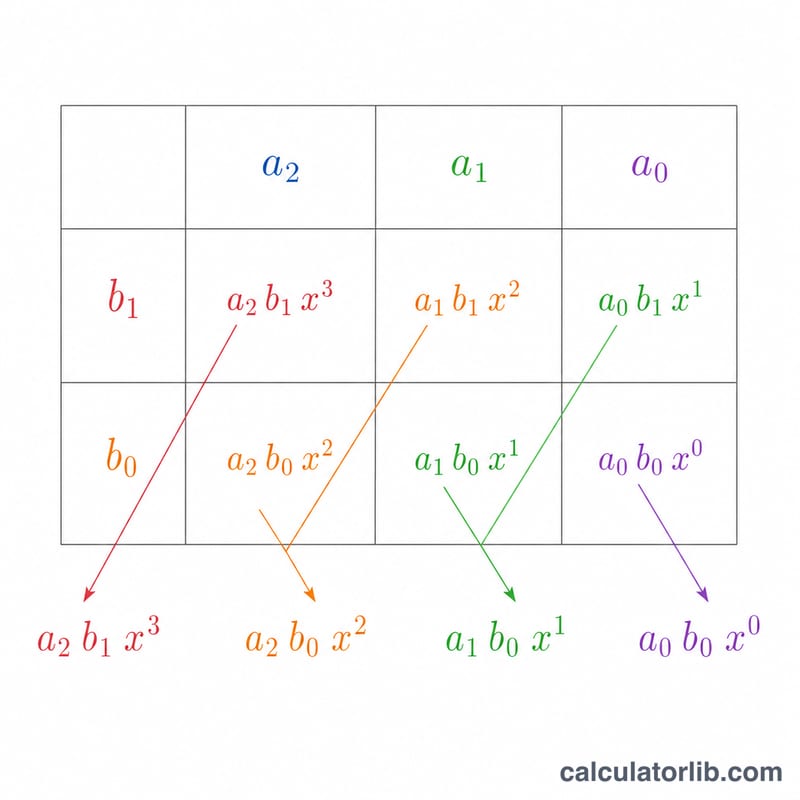
Multiply (x² + 2x + 3) by (x − 1). Distribute: \(x^2\cdot x = x^3\), \(x^2\cdot(-1) = -x^2\); \(2x\cdot x = 2x^2\), \(2x\cdot(-1) = -2x\); \(3\cdot x = 3x\), \(3\cdot(-1) = -3\). Combine like terms:
$$x^3 + (-1 + 2)x^2 + (-2 + 3)x - 3 = x^3 + x^2 + x - 3$$
The calculator returns coefficients 1, 1, 1, −3.
FAQ
Do I need to include zero coefficients? Yes. Every power between the highest and the constant must have a coefficient, so use 0 for missing terms.
Can I multiply by a constant? Yes — enter a single number as one polynomial, e.g. 5 to multiply everything by 5.
Does it handle decimals and negatives? Yes, any real coefficients such as 1.5 or -2 are supported.