
What This Calculator Does
This tool solves a system of three linear equations in three unknowns (x, y, z). You provide the coefficients of the equations in standard form:
\(a_1x + b_1y + c_1z = d_1\)
\(a_2x + b_2y + c_2z = d_2\)
\(a_3x + b_3y + c_3z = d_3\)
The calculator returns the unique values of x, y and z, along with the coefficient determinant \(\det(A)\). It works for any real coefficients, including negatives, fractions and decimals.
How to Use It
Each row corresponds to one equation. Type the coefficient in front of x (a), y (b) and z (c), then the constant on the right-hand side (d). Move every variable to the left and the constant to the right before entering values. If your equation is written as 5 = 2x − y, rewrite it as 2x − y + 0z = 5.
The Formula Explained
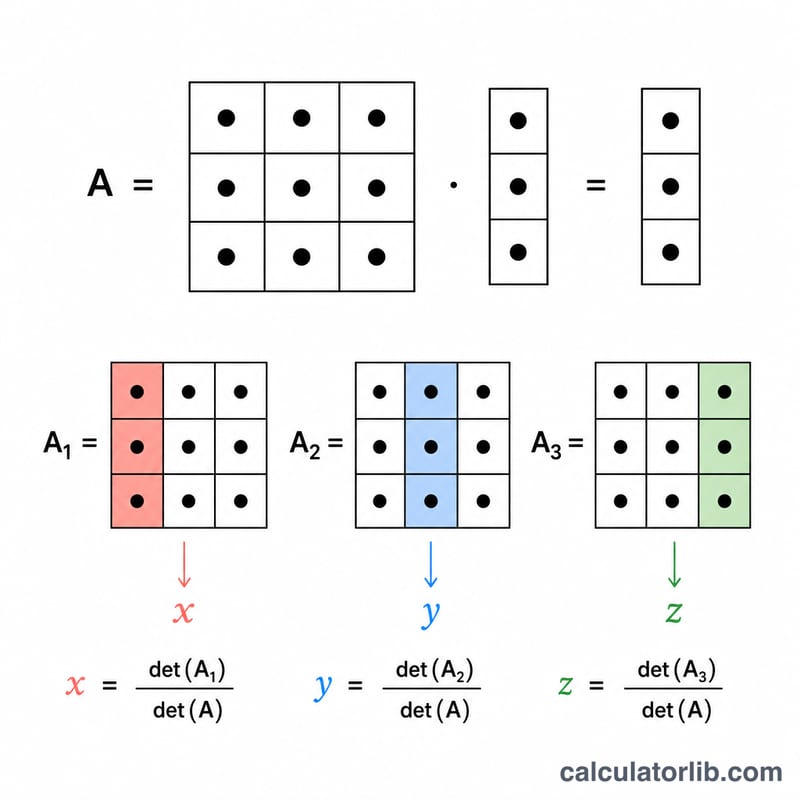
The solution uses Cramer's rule. First we compute the determinant of the coefficient matrix A. Then for each variable we replace the matching column of A with the constants column d and take that determinant. Dividing gives the variable:
$$x = \dfrac{\det(A_x)}{\det(A)},\quad y = \dfrac{\det(A_y)}{\det(A)},\quad z = \dfrac{\det(A_z)}{\det(A)}$$If \(\det(A) = 0\), Cramer's rule fails — the system has no unique solution (either no solution or infinitely many), and the calculator flags this.
Worked Example
Solve \(2x + y - z = 8\), \(-3x - y + 2z = -11\), \(-2x + y + 2z = -3\).
\(\det(A) = -1\). Applying Cramer's rule gives \(\det(A_x) = -2\), \(\det(A_y) = -3\), \(\det(A_z) = 1\), so \(x = 2\), \(y = 3\), \(z = -1\). You can verify:
$$2(2)+3-(-1)=8 \;\checkmark$$Interpreting Your Result
Each equation in a 3×3 system describes a plane in three-dimensional space. The solution is wherever all three planes meet, and the value of the determinant \(D=\det(A)\) tells you which of three cases you are in.
\(D\neq0\): unique solution
When the coefficient determinant is nonzero, the three planes intersect at exactly one point. Cramer's rule returns a single \((x,y,z)\), and that ordered triple is the only set of values satisfying all three equations at once. This is a consistent, independent system. The output \(x=D_x/D\), \(y=D_y/D\), \(z=D_z/D\) is exact (within rounding) and can be checked by substituting back into the original equations.
\(D=0\): no unique solution
When \(D=0\) the matrix is singular and Cramer's rule cannot divide. Two sub-cases exist:
- Inconsistent — no solution. The planes have no common point (for example, two or more are parallel, or they form a triangular prism arrangement where no single point lies on all three). The system has zero solutions.
- Dependent — infinitely many solutions. The planes share a whole line (or coincide). Here the equations are not independent, and there is an infinite family of \((x,y,z)\) triples, usually described with a free parameter.
The determinant alone cannot distinguish these two; you must inspect the equations (e.g., via row reduction) to see whether they are contradictory or redundant.
Reading the x, y, z output
The three returned numbers are the coordinates that make every equation true. A value can be negative, zero, or fractional. If the calculator reports \(D=0\), treat the answer with caution and re-examine the system rather than trusting a divided result.
Definitions & Glossary
- Coefficient matrix \(A\)
- The 3×3 array of the numbers multiplying \(x, y, z\) on the left side of each equation: rows are the equations, columns correspond to \(x\), \(y\), and \(z\).
- Constants vector \(d\)
- The column \((d_1, d_2, d_3)\) of right-hand-side values that the equations equal.
- Determinant \(\det(A)\) (also \(D\))
- A single scalar computed from a square matrix that measures whether the matrix is invertible. \(\det(A)\neq0\) means a unique solution exists.
- Cramer's rule
- A method that solves a square linear system by writing each variable as a ratio of determinants: \(x=D_x/D\), \(y=D_y/D\), \(z=D_z/D\), where \(D_x, D_y, D_z\) come from replacing the matching column with \(d\).
- Sarrus' rule
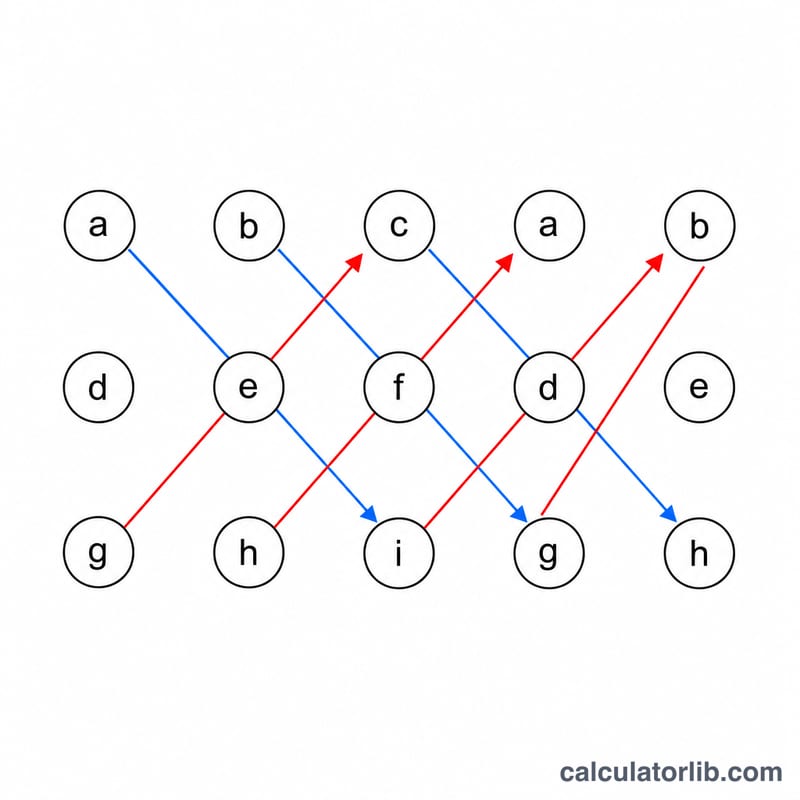
- A shortcut for the determinant of a 3×3 matrix: sum the three diagonals running top-left to bottom-right and subtract the three diagonals running top-right to bottom-left.
- Singular matrix
- A square matrix whose determinant is \(0\); it has no inverse, so Cramer's rule yields no unique solution.
- Unique solution
- Exactly one \((x,y,z)\) satisfies the system; occurs when \(D\neq0\).
- Consistent system
- A system that has at least one solution (one or infinitely many).
- Dependent system
- A consistent system with infinitely many solutions because the equations are not all independent.
- Inconsistent system
- A system with no solution at all; its equations contradict one another.
- \(a, b, c, d\) per row
- Within row \(i\), \(a_i\) is the \(x\)-coefficient, \(b_i\) the \(y\)-coefficient, \(c_i\) the \(z\)-coefficient, and \(d_i\) the constant on the right-hand side.
FAQ
What if det(A) is zero? The three planes do not meet at a single point, so there is no unique (x, y, z). The system is either inconsistent or dependent.
Can I use decimals or fractions? Yes — enter decimals directly (use 0.5 instead of 1/2).
Is Cramer's rule accurate? For a 3×3 system it is exact and stable for typical inputs. Very large or near-singular systems may show small rounding in the last decimals.